A pair of hikers in Yellowstone National Park were seriously injured in a bear attack earlier this week.
The number of bears involved, and their species, has not been released by park officials.
But Yellowstone is home to both black bears and grizzlies, and the attack occurred on a trail — Mystic Falls, near Old Faithful — that until 2024 had been closed to reduce the chance of conflicts with grizzlies, according to the WyoFile, a local nonprofit news outlet.
The two injured hikers, possibly brothers, were discovered by another hiker and airlifted to a nearby hospital, where one was listed in serious condition and the other in critical condition, according to another local news outlet, the Jackson Hole News & Guide.
The hikers were the first people injured by bears in Yellowstone in 2026, the National Park Service service said in a news release.
In September 2025, a 29-year old man was hiking alone on the remote Turbid Lake Trail when he apparently surprised a bear. While trying to use his bear spray canister, he sustained “significant but not life-threatening injuries to his chest and left arm,” according to officials.
The last fatal bear attack in Yellowstone was in 2015, park officials said, when an adult female grizzly with two cubs killed a solo hiker.
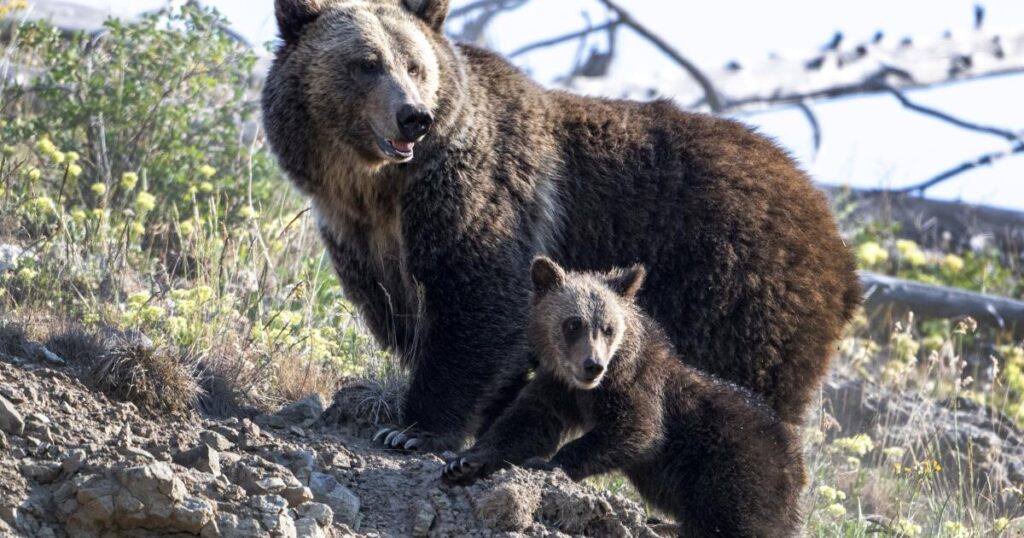
Grizzly bears, which can kill and eat large prey like elk and moose, often weigh twice as much as black bears, have larger claws and are considerably more aggressive.
Black bears are extremely common in California. But despite being featured on the state flag, wild grizzlies haven’t been spotted in the state for about a century. The last known wild grizzly bear in California was shot and killed in the 1920s.
Despite recent incidents, bear attacks in Yellowstone remain extraordinarily uncommon. Since the park was created in 1872, bears have killed eight people, according to park statistics. By comparison, 125 visitors have drowned and 23 have died from burns after falling into the park’s scalding hot springs.
Even spotting a grizzly in the wild is still relatively unusual in the lower 48 states. Historians estimate that before the arrival of large numbers of European settlers, roughly 50,000 grizzlies ranged across the American West. Settlers regarded the massive predators as a serious threat to people and livestock and hunted them aggressively, driving the population in the contiguous U.S. to fewer than 1,000 animals.
Conservation and recovery programs over the last several decades have helped the species rebound. Today, federal wildlife officials estimate there are close to 2,000 grizzlies in the lower 48, concentrated primarily in Wyoming, Idaho and Montana.
Still, few things unsettle hikers more than the possibility of a grizzly encounter. For years, wildlife experts advised people attacked by black bears to fight back, while recommending that anyone confronted by a much larger grizzly lie still and play dead.
The guidance has evolved slightly in recent years, though not dramatically. A National Park Service website advises: “If you surprise a grizzly/brown bear and it charges or attacks, do not fight back! Only fight back if the attack persists.”
In that case, officials advise, “Fight back with everything you have!”
In their press release after this week’s attack, parks officials offered more advice, including: carry bear spray and know how to use it, hike in groups of three or more and never run from a bear.
Curiously, staying home and watching Animal Planet didn’t make the list.
The post Two hikers in Yellowstone seriously injured in bear attack appeared first on Los Angeles Times.