There’s a comedian (and former Coast Guardsman) named Jim Tews who does an amusing bit about trying to get his father to drink more water. The trick, he decides, is to buy him a “tactical water bottle,” which he displays for the audience: It’s swaddled in a desert-drab carrier with copious attachment points and, Tews jokes, room for a few magazines of ammunition. Amazon, he points out, is full of products like this. There are tactical pens, a tactical kilt, even tactical dog food. For $56.99, you can purchase a tactical diaper bag, “in case you get deployed on the weekend you have the kids.” The guy in the product photo does indeed look like his nanny bailed on him right when he was supposed to show up for the 1991 Persian Gulf war.
Search almost any large marketplace for “tactical,” and you’ll find this stuff. Many products, like night-vision monoculars and gun accessories, will be geared toward professional or survivalist use; others will be similar but in more of a hobbyist, paintballing sense. There will be tactical belts and boots and flashlights that bring the features of military gear into more ordinary contexts, in the same way outdoor brands like Patagonia offer the perks of serious climbing gear to cold-weather commuters. Eventually, though, you will find a tactical version of something random, like gummy candy, or ordinary wallets and polo shirts, or bacon.
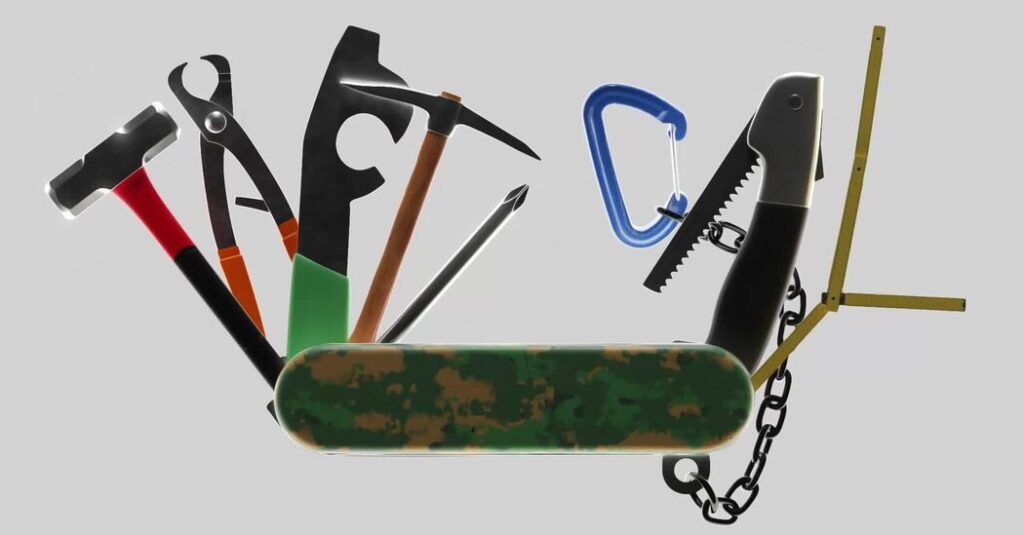
This is where “tactical” becomes clearest as a consumer segment and a marketing term, and possibly a bit of a gender-affirming one: As Tews jokes, “It just means ‘for boys.’” The product will almost certainly be black or coyote or drab, featuring a multitude of pockets, or complexly machined closures, or some spin on PALS (Pouch Attachment Ladder System) webbing or other MOLLE (Modular Lightweight Load-Carrying Equipment) standards. There will be hook-and-loop strips for the attachment of tactical morale patches like black-and-white American flags. Worn well, this stuff may help you feel as ready-for-anything as an emergency worker. Worn poorly, you may look like a LARPer, a threat to public safety or part of a beer-league paramilitary.
The marketing for this stuff rarely uses the word “military.” Only a few decades ago, “military” would have been followed by “surplus,” suggesting musty warehouses of government-issued goods. The market likes “tactical,” which carries positive connotations (“adroit in planning or maneuvering to accomplish a purpose,” per Merriam-Webster) and can apply to anyone in the field: armed forces, law enforcement, operators, militias, insurgents. The standard distinction is that “strategy” is about your grand objectives and plan for achieving them, while “tactics” relates to the on-the-ground execution of that plan — and we clearly enjoy the action-ready equipment of the people who do the thing. It can make even a simple act, like retrieving a store loyalty card from your wallet, feel like a strap-in, lock-and-load, mission-critical experience. Which, in the context of your personal day, it may well be.
This product category has been growing for decades now — at least since the early-1990s moment when 5.11, a company originally rooted in rock-climbing gear, learned that its trousers had become favorites at the F.B.I. Academy in Quantico, Va., and spun off the hugely successful 5.11 Tactical brand. It’s hardly the first time military gear has moved into everyday fashion — that’s how we got bomber jackets and trench coats, raglan sleeves and cardigans, T-shirts and desert boots.
But this isn’t people casually importing military items into civilian life; it’s ordinary civilian goods actively imitating the look of the combat theater or the SWAT deployment. Its embrace is so widespread that actual service members and firearm enthusiasts are constantly rolling their eyes at the things being marketed to everyone else. This is one part of how we got the word “tacticool,” a reference to both (1) gear that doesn’t make a lot of functional sense but looks very impressive, and (2) the sorts of people who wear it despite having no real situational need to. (See also the “mall ninja” — a boastful but inept fetishizer of military and law-enforcement gear and jargon — or, more disparagingly, the “Gravy SEAL.”) When somebody asked the r/tacticalgear subreddit, “Why is military tactical gear so popular?” one answer pointed to the practical selling points — claiming that it’s “generally built for harder use than its ultralight civilian equivalent” — while another equally popular post simply said: “Because deep down we all know what’s coming.”
What’s most striking about “tactical,” though, is the way it has spilled past its original meaning. First it described function. Then it came to describe aesthetics — the look of all those technical webbings and pockets, adopted everywhere from streetwear to runway fashion. But eventually it came to refer to something completely outside the products themselves — an ethos, an identity, an aspiration toward the “mission-driven” masculinity of a certain kind of guy.
This is how you get the tactical diaper bag. It’s also how the former F.B.I. negotiator Chris Voss, known for his use of “tactical empathy,” came to tell this magazine that the word “tactical” was really only there to make the technique sound more manly: “The same way you can’t teach a Navy SEAL ‘yoga breathing’; you’ve got to tell them it’s ‘tactical breathing.’” And it’s how Black Rifle Coffee Company, a military- and conservative-aligned roaster, can end up described on Military.com as a “tactical caffeine-delivery system.” Each time you see an ordinary item being sold this way, consider that “tactical” may not be describing the product — it may be describing the intended consumer.
Nitsuh Abebe is a story editor for the magazine.
The post For a Certain Kind of Guy, Even a Diaper Bag Needs to Be ‘Tactical’ appeared first on New York Times.