My family is white. My younger brother, now in his mid-30s, has struggled with substance abuse since his teens, leading to stints in prison, homelessness and periods of estrangement from our family. He is now about two years sober after extended treatment and has rebuilt his relationship with my parents and me — something I’m very proud of.
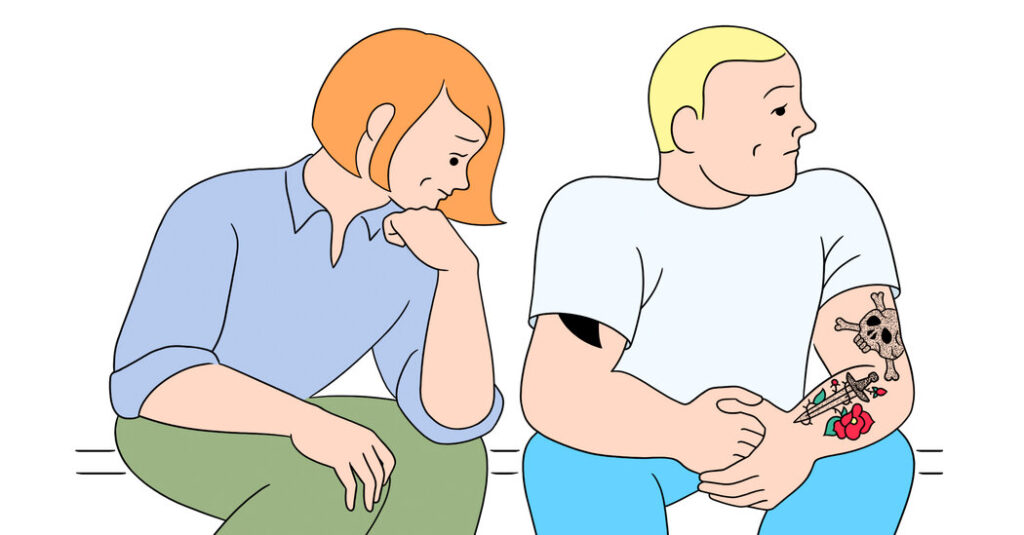
During one prison sentence, years before recovery, my brother joined a neo-Nazi gang and got a white-supremacist tattoo. I don’t know why he got it or how involved he was; we’ve never discussed it. My parents reacted harshly when they first learned of it, while he was still struggling. He has never expressed racism or antisemitic views around me and doesn’t expose the tattoo in public.
I know that some tattoo artists will cover white-supremacist tattoos at no cost for those who have disavowed those views. Part of me wants to bring this up with him — to understand the circumstances and encourage a cover-up if the tattoo no longer reflects his views — but my family’s rigid expectations and harsh judgment most likely contributed to his struggles, and I don’t want him to feel criticized. Still, I feel ashamed when I see the tattoo, and I realize that if he visited me, I’d have to tell him not to appear in public with it visible.
I’m seeking insight into whether I have standing — or an obligation — to raise this with him, and if so, how to convey that, while I don’t want to judge, I strongly feel he should cover the tattoo permanently if it no longer reflects his beliefs. — Name Withheld
From the Ethicist:
You ask whether you have the standing, or even an obligation, to raise this with your brother. On standing, the answer is plainly yes: A caring sibling with genuine concerns is entitled to voice them. Whether you have an obligation depends in no small part on what effect it would have on his recovery. The relationship you have is evidently supportive for him, and you rightly don’t want to jeopardize it. So I wouldn’t say you have a duty to speak up if speaking up would cause harm.
Before you decide, though, it’s worth being cleareyed about what that tattoo most likely represents. Prisons are places where gang affiliations are often a survival strategy, and the person who received that tattoo was a younger, actively addicted man in a coercive environment. It may say less about who your brother is, or was, than about the situation he was in.
Your brother, meanwhile, already covers his tattoo in public, so he’s hardly oblivious to the fact that people find it objectionable. Given that presumably he is aware that you’re not a white supremacist, he must have wondered how you feel about it. Better to open the conversation now than to wait until circumstances force a confrontation.
You don’t need to start by telling him you’d like the tattoo gone. What you want to know first is whether he still holds the views it represents. If you can find a way to lead with care rather than judgment, the inquiry need not echo the harsh responses he has faced before. Then if you learn that he has left those views behind (or, indeed, that he never truly held them), you will be in a position to talk about tattoo artists who will cover white-supremacist imagery without charge for people in his situation. You or your family might offer to defray any remaining costs. That makes the offer a natural extension of the conversation you’ve already been having, rather than a condition attached to your acceptance of him.
Readers Respond
The previous question was from a reader who had encountered a homeless man who wasn’t able to care for his cat, and wondered whether it would have been appropriate to offer to buy the animal. She wrote:
This past winter, I was walking through downtown Chicago on a frigid night when I encountered a homeless man and his pet cat. … The man was bundled up and in good spirits, but the cat looked miserable: She was leashed to a milk crate and had only a thin blanket and wore a light-up sombrero. I stopped to talk with the man, who was friendly, and to pet the cat, who was shut down and shivering and didn’t respond to being touched. From our brief conversation, I could tell that the man loved his cat, but also that he was mentally ill and unable to provide proper care for the animal. I gave him some money, said good night and walked on. Now, months later, I can’t stop thinking about them — especially the cat. … Would it have been inappropriate to offer the man money for his beloved pet, promising to find her a warm, loving home? — Name Withheld
In his response, the Ethicist noted:
To decide whether a transaction is exploitative, we ask a bundle of questions — about how constrained someone’s options are, whether what’s being given up is inherently invasive or violative of the person, whether someone has the capacity to understand what’s being given up, whether the loss is irreversible and how difficult refusal would be. All of which is to say that you were right to be uncomfortable about the exchange you were contemplating. … Your impulse to help this creature was a decent one. It’s just that you had ways to do so without leveraging the man’s hardship. One would be to do exactly what you did: Give him money outright, as a gift. There are also organizations like the A.S.P.C.A. and nonprofits specifically devoted to the animals of unsheltered people that exist for these situations. … Neither of these options requires anyone to surrender anything. On that frigid night, you came across two vulnerable beings, not one. The challenge was to find a way to do right by both.
(Reread the full question and answer here.)
⬥
The Ethicist’s response is in line with a trend in the animal-sheltering field in the past two decades: Animal advocates have recognized that pets with unmet needs are nearly always the pets of people with unmet needs. Rather than removing pets from these situations and rehoming them, many animal organizations today provide support to help pet owners care for their pets, such as veterinary and food assistance. Animal organizations may partner with social-service agencies to help ensure everyone in the family receives services. — Karen
⬥
Maybe the way to go might have been to ask the man if he needed help finding shelter for the night. Yes, that would have required a whole other level of involvement on the part of the letter writer. But on a “frigid night” in Chicago, they both needed a warm place to be. — Dorine
⬥
The bottom line is that this cat was suffering and the priority was to save her, no matter what. The best thing you could have done is take the cat, pronto; one option would have been to offer to house the cat until the warmer weather. I can tell the letter writer is a loving, thoughtful person. If you feel guilty about what you did not do, I suggest going to the nearest shelter and getting the oldest, ugliest kitty who might never get adopted and give her a home. — Alexandra
⬥
In Port Orchard, Wash., there is a new co-shelter for people experiencing homelessness with their pets. Today most short-term shelters do not allow pets to join their owners, yet so many unhoused people will not seek out shelters if they can’t bring their pets. While volunteering at a cold-weather shelter, I saw people turn away into the cold night because their pets could not come into the shelter with them. These pets are family and are often described by their owners as the reason they keep going — having a pet to care for brings purpose to their lives. These pets are not for sale because, for so many, they represent “home.” My hope is that the innovative efforts in Port Orchard will be a model adopted across the nation. — Amy
⬥
I would add the obvious point that relationships between cats and their humans are very strong. That cat may be attached to the man, and may be the only being on earth who the man feels genuinely connected to. Offering to buy the cat would have been giving the man a clear message that he couldn’t even look after a beloved animal. It could make him feel even more powerless and incapable than an unhoused person feels in a normal day. You did the right thing to give money. If you think you might bump into him again, maybe try to have a gift card on hand for the nearest place selling pet food. — Lisa
The post Can I Ask My Brother to Have His Racist Prison Tattoo Removed? appeared first on New York Times.