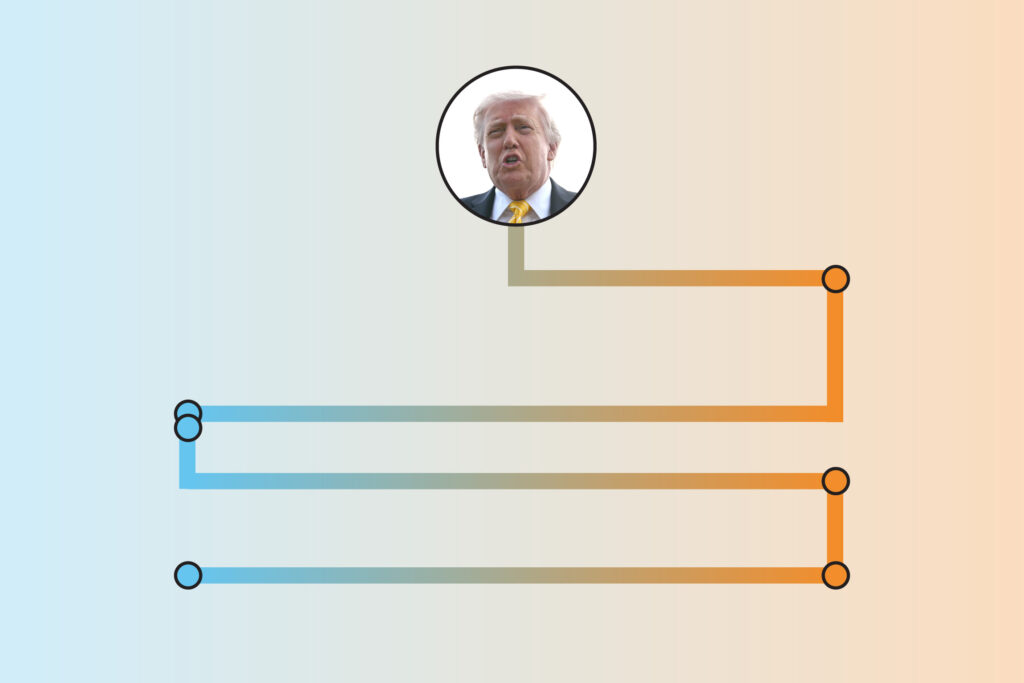
Since the start of the war in Iran in late February, President Donald Trump has made increasingly contradictory statements about the United States’ strategy. The administration’s shifting timeline for the war’s end has been one of the clearest examples of its flip-flopping messaging, which has led to confusion and required cleanup by the White House staff.
Before extending the fragile ceasefire agreement indefinitely on April 21, Trump had repeatedly suggested that the conflict was nearing a conclusion, often offering inconsistent roadmaps.
The president’s comments on the war’s conclusion often clashed with threats to continue attacks on Iran. On the morning of April 1, he told reporters the war would be over within three days. Hours later, in a prime-time address to the nation, he vowed to attack Iran “extremely hard” over the next two to three weeks. The attacks never materialized.
Leon Panetta, who served as defense secretary, CIA director and White House chief of staff under Democratic presidents, described the president’s messaging as “one of a kind.” “Historically and politically, I don’t think I’ve ever seen someone in a leadership role in politics engage in this constant and changing rationale for the actions that he’s engaged in,” he said.
Trump has also delivered inconsistent messages about the conflict’s goals and the United States’ role in the Strait of Hormuz.
In mid-March, Trump threatened Iran as he demanded it reopen the strait. Ten days later, he minimized its importance to the U.S., saying that countries reliant on its oil would have to “fend for themselves.” Two weeks after that, his threats resumed, and the U.S. imposed a blockade on Iranian vessels crossing the strait.
On Monday, the Trump administration launched operations to help guide stranded vessels out of the strait. In response, Ali Abdollahi, a top Iranian military commander, warned that any foreign armed force approaching the chokepoint would be “targeted and attacked.”
The vital waterway has been at the center of the high-stakes standoff between the two countries, with Iran’s de facto blockade putting more pressure on the global economy than the U.S. anticipated. It’s unlikely any resolution could be reached without the restoration of transit through the strait, Panetta said.
The administration has also shifted its stance on the war’s objectives. In his first address to the nation following U.S. and Israeli strikes on Iran, Trump indicated that eliminating threats from the Iranian regime was a central goal. A month later, he reversed course, saying regime change was never an objective.
Panetta says contradictions might be affecting the administration’s credibility, particularly during negotiations. “Iran has probably decided a long time ago that the president’s word isn’t worth very much,” he said. “There’s not a lot of trust at the table.”
A possible explanation for the administration’s conflicting messaging is that the U.S. initially underestimated Iran’s capacity to disrupt the global economy, said Suzanne Maloney, a vice president and director of the foreign policy program at the Brookings Institution. According to Maloney, whose research focuses on Iran and Persian Gulf energy, U.S. officials believed that the Iranian regime would collapse quickly and that the conflict would be short and have minimal economic fallout. “That presumption has not proven accurate. So I think there has been an attempt to try to spin the potentially lesser benefits that the U.S. has achieved in terms of degrading Iran’s military capabilities,” she said.
Another factor that may cause more confusion around the president’s remarks is the way those messages are delivered. Instead of formal, traditional mechanisms for communications, Trump often uses social media to articulate his policy on various issues. “We’re getting his real-time thinking and real-time spinning of the situation rather than a sort of formal articulation of U.S. policy,” Maloney said.
As negotiations reach a stalemate, Panetta said it’s unlikely that Tehran would agree to a multi-conditional peace agreement with the United States. “That’s not the way Iran operates,” he said, adding that both sides would have to make concessions to bring the conflict to an end.
Trump told reporters at the White House in late March that Tehran does not have to make a deal with Washington to end the war. Instead, the president said that, in order to bring hostilities to a halt, Iran would need to be “put into the stone ages” and be prevented from gaining access to a nuclear weapon. “Then we’ll leave,” he said.
But experts say that, while U.S. attacks might weaken Iran’s military power, they wouldn’t alter the conditions holding a deal back, including the standoff in the Strait of Hormuz. “It’s not clear to me that there’s a military solution that can be undertaken within a time frame that would prevent that really catastrophic fallout for the global economy,” Maloney said. “I think the ultimate outcome has to be one that’s achieved diplomatically.”
Maloney also notes that walking away without a deal could be seen as at odds with Washington’s long-standing role as a promoter of global peace, particularly through securing public goods such as freedom of navigation. “Realistically, we could walk away,” she said. “But I think it would be profoundly humiliating and a contradiction of at least 75 years of American policy in the region.”
The photo of President Donald Trump included in the graphic at the top of this article is from AFP/Getty Images.
The post How Trump’s timeline for ending the Iran war keeps shifting appeared first on Washington Post.