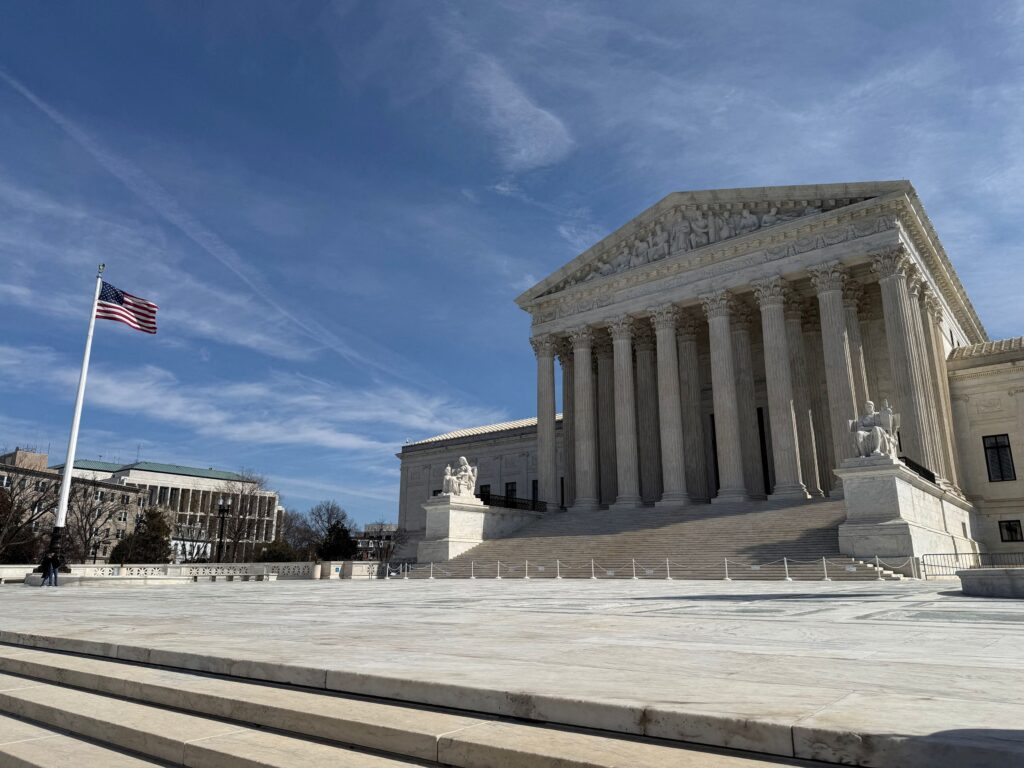
The Supreme Court on Monday evening issued an emergency order paving the way for the effort by Republicans in Louisiana to redraw their state’s congressional map in accordance with the court’s ideologically split decision last week to significantly weaken the Voting Rights Act.
In an unsigned opinion, the court granted a request by the plaintiffs to expedite the transmission of the Voting Rights Act opinion, which limits consideration of race in the drawing of electoral maps, to a lower court. Normally, it takes 32 days for a Supreme Court ruling to be formally conveyed to lower courts, but Monday’s order cuts that timeline short, allowing Louisiana to more rapidly redraw its maps in the hopes of yielding more wins for Republicans.
Soon after the Supreme Court decision last week, which set new standards for considering race under Section 2 of the Voting Rights Act, Louisiana Gov. Jeff Landry, a Republican, suspended this month’s House primary elections so state lawmakers could pass a new congressional map. Louisiana’s U.S. House delegation is currently made up of four Republicans, who are White, and two Democrats, who are Black; a new map is expected to yield five Republicans and one Democrat.
Other red states in the South are also scrambling to redraw majority-minority districts in light of the high court’s ruling, further intensifying a gerrymandering war unprecedented in modern times. The efforts could shift the dynamics of the upcoming midterm elections, when most political analysts expect Democrats to pick up enough seize to capture control of the U.S. House.
President Donald Trump last summer urged Republican-led states to redraw their maps in an effort to blunt Democrats’ momentum in the midterms, rather than waiting until after the next decennial census in 2030, as has been the practice. States like Texas heeded Trump’s call, prompting Democratic-led states, including California and Virginia, to redraw their own maps as they sought to offset the GOP efforts.
Alabama Gov. Kay Ivey and Tennessee Gov. Bill Lee, both Republicans, have called special sessions aimed at redrawing their states’ maps and picking up more Republican seats. That followed Landry’s announcement Thursday that he would suspend Louisiana’s May 16 U.S. House primaries.
Alabama has asked the Supreme Court to lift an injunction that prevents the state from redrawing its congressional map before 2030, but the high court did not address that request Monday.
The justices’ opinions announcing their decision featured sharp language, showcasing how the Supreme Court has increasingly found itself in the middle of bitter partisan battles amid an increasingly polarized political climate.
Justice Samuel A. Alito Jr. explained that the decision was based on the rapidly approaching election, since the midterm elections are to be held on Nov. 3. “The congressional districting map enacted by the legislature has been held to be unconstitutional, and the general election will be held in just six months,” Alito wrote in a concurring opinion, joined by fellow conservative justices Clarence Thomas and Neil M. Gorsuch.
In dissent, Justice Ketanji Brown Jackson blasted the decision as a partisan abuse of power. “The Court unshackles itself from both constraints today and dives into the fray,” the liberal justice wrote. “And just like that, those principles give way to power.” Alito responded to the criticism, saying, “That is a groundless and utterly irresponsible charge.”
Maegan Vazquez and Justin Jouvenal contributed to this report.
The post Supreme Court clears path for Louisiana to redraw map in redistricting fight appeared first on Washington Post.