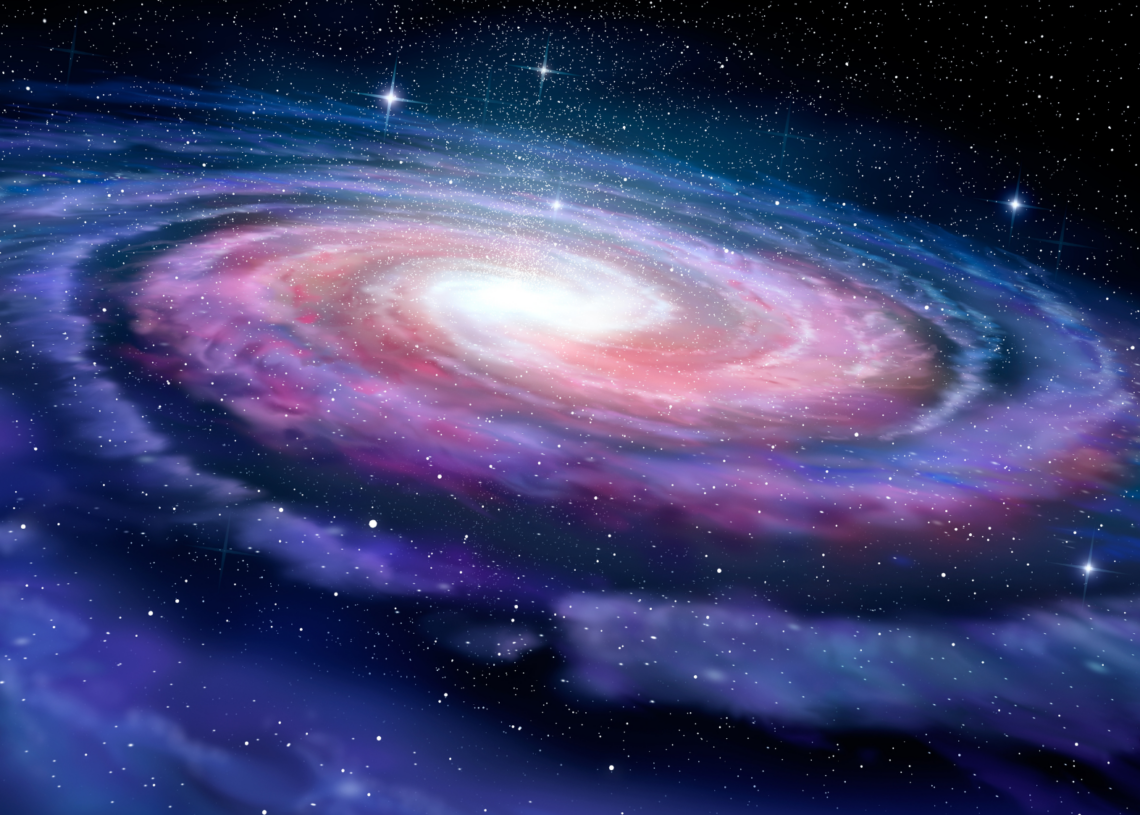
Our galactic home, the Milky Way galaxy, was a hungry fella several eons ago. Scientists observing clusters of stars hanging out near the Milky Way’s center found evidence suggesting that our galaxy once collided with and devoured a smaller galaxy about 11.8 billion years ago. The findings, published in Nature Astronomy and detailed on NASA’s website, push the known history of the Milky Way’s galactic gluttony back roughly 1.8 billion years.
The devoured dwarf galaxy is named Low-energy-Kraken-Heracles, or LKH. It got eaten alive yet is still named after two legendary fearsome mythological figures. It contained stars that were roughly 500 million times the mass of our own Sun and represented a huge chunk of the young Milky Way, which itself was still a rather large work in progress even 2 billion years after the Big Bang.
Scientists figured this out using observations from the Hubble space telescope in the European Space Agency’s Gaia mission. They examined 39 globular clusters in the Milky Way’s inner 20,000 light-years, looking at ages, chemical compositions, and movement of the stars hanging out near the galactic core, which essentially function like galactic archaeological dig sites. Most of the stars formed inside the QA galaxy, and some showed up during later mergers. The researchers found a third set: stars that were brought in with a merger from another dwarf galaxy, the funny-named Gaia-Sausage-Enceladus.
The Milky Way Is One Hungry Galaxy
This means that they found evidence of an even earlier small galaxy that the Milky Way devoured. If you’re imagining a kind of demolition derby of planets slamming into each other, an admittedly very cool mental image, the truth is that space is so vast, so in enormous, that stars and planets almost never directly collide with one another. But the gas clouds of these galaxies? They slammed into each other, triggering the formation of stars while also dumping gas and dark matter, which were exactly what a growing Milky Way galaxy needed.
The Milky Way galaxy later swallowed Gaia-Sausage-Enceladus and has spent the past 6 billion or so years slowly merging with the Sagittarius dwarf galaxy.
And LKH apparently wasn’t the last thing our galaxy ate. The Milky Way later swallowed Gaia-Sausage-Enceladus and has spent roughly the past 6 billion years merging with the Sagittarius dwarf galaxy. Galaxies gotta eat too.
The post The Milky Way Started Eating Other Galaxies Billions of Years Earlier Than We Thought, New Study Says appeared first on VICE.