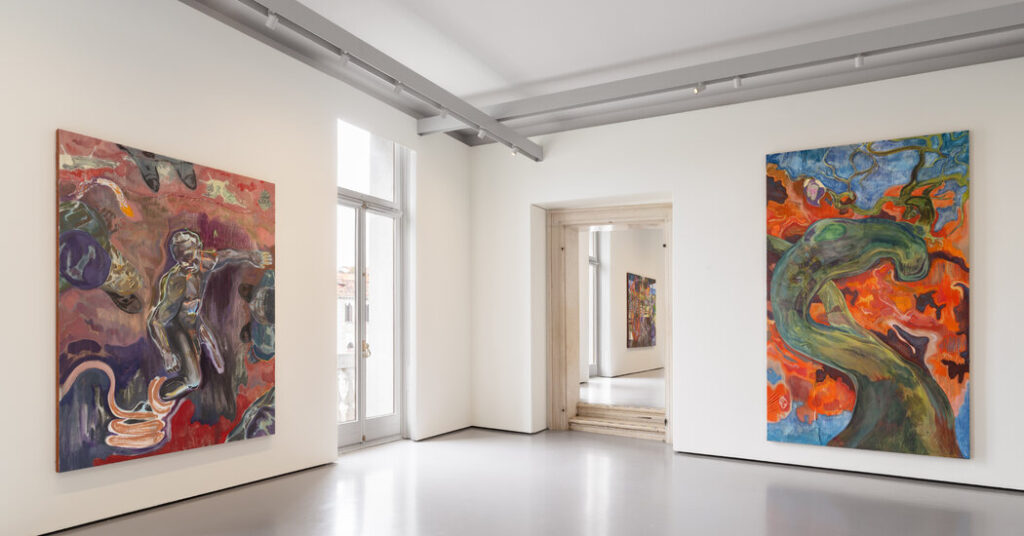
For the next eight months, the 18th-century Palazzo Grassi on the Grand Canal in Venice is offering visitors a striking and highly atmospheric visual experience of Africa.
Across two levels of the palazzo, the Kenyan British artist Michael Armitage is presenting 45 paintings and more than 100 studies and drawings. The show has been organized by the Pinault Collection, which manages the French billionaire François Pinault’s art collections and exhibition spaces, including Palazzo Grassi.
Armitage, 42, grew up in Kenya until the age of 16, then attended boarding school and art schools in Britain. He brings his dual African and European heritage to his paintings: They represent real or imaginary scenes set in East Africa, yet are rendered in a style that sometimes recalls Goya or Gauguin.
Unusually, the artist paints on bark cloth — made of the water-soaked bark of a ficus tree — which can have small cracks and even holes on the surface.
Armitage discussed this material, his family roots, and his recent move to Indonesia in a video interview, briefly interrupted by his 3-year-old daughter, from his childhood home in Nairobi, Kenya. The conversation has been edited and condensed.
You have chosen figurative painting as your main artistic discipline because you wanted to make something that was immediately recognizable and engaging. Why?
I started painting relatively young and always made paintings of people. When there was a figure, people would always comment and be engaged with it. They would say, “It feels like it’s alive,” or “It has a life to it.” I never understood it, and still don’t, but it was interesting.
The way I grew up, playing a part in a wider society and trying to be of use to others was an important part of life.
I wanted to make something that would engage with other people, so that I was participating in a kind of wider cultural and sociopolitical conversation. For me, the first audience that I thought about for many years was the Kenyan audience. And there was an immediate connection that people had to a figure.
Why do you feel compelled to make art that means something to your people and makes a contribution to your society?
It comes from the family that I grew up in. My maternal grandfather, Timothy Kamau, was a very well-known pastor here in Kenya. He ran the first African-owned radio station in the region, and his voice was very well known.
When I was young, I heard my mother and her 11 siblings tell stories. When they were children, they would have to get up at 3 in the morning, because people had heard their father’s voice on the radio and would turn up from all over, people they never knew. The family would have to cook for them, feed them, give them their beds.
This idea that you have a part to play within society is almost a sense of responsibility. I found a level of frustration with just sitting and making my paintings, and trying to only find my own way. It was very unfulfilling.
Your paintings often depict political events in Kenya. Why?
Fundamentally, we are all the same: We are all people. We should have equal rights to exist.
I do believe in freedom of expression. I do believe in people having different thoughts, however challenging or unpalatable that is, and finding a way of coexisting.
As an artist, you can create a space where radical ideas and radical ways of thinking can exist in a relatively safe way, within culture. It takes someone else to enact some idea for it to become anything but that.
You paint on bark cloth. Are there conservation issues around that?
One of the museums that had bought a painting of mine asked me what research I had done on conservation. I’d never done any, because I wasn’t trying to make something last forever. The museum then said that they had objects from South America made of bark cloth that were 2,500 years old and that were in better condition than cotton canvas.
I wouldn’t leave a painting outside in the rain and the sun. But it should be OK.
Talk about the Nairobi Contemporary Art Institute, the nonprofit visual-art space that you founded in 2020.
The Nairobi Contemporary Art Institute began with an event called The Gathering, where roughly 52 artists and practitioners from 12 different countries on the continent and the diaspora came together for an extended weekend. I had wanted to do that because, in eight years of studying in the U.K., I had never had a single tutor who was from Africa. I had very few conversations, unless they were back in Nairobi, with artists from the continent, and I personally wanted more. I had just had a [solo] show in 2015 at the White Cube Gallery in London, where my career started.
I asked people from the Kenyan art community what they wanted and needed. The most common thing that people said was a nonprofit space, and a different type of higher education.
I benefited hugely from being educated abroad and having a lot of access to museums and art collections. I knew how important it was to have access to a permanent collection. So I started thinking that it would be great if we had a permanent collection: somewhere that people could also see our own history and see the history of the region.
You recently moved with your family to Indonesia, where you spend most of the year in lush and beautiful natural surroundings. Will Indonesia start pervading your art, and will you start depicting it?
Yes. Two paintings in the Venice show are Indonesian landscapes.
Asia has such a rich and dense visual artistic history and a very specific language. A lot of the sociopolitical concerns are very similar to Kenya — much more similar than I had ever thought, as a tourist.
It’s the first time that I’ve lived somewhere where I’m totally a foreigner and don’t speak the language. Seeing all this similarity is just strange. I haven’t quite figured it out. I’m still working through things, painting my way through things.
Indonesia may be changing you as an artist. There is something different about your new paintings. The color palette has changed.
I agree. If I was ever painting a landscape with Kenya in mind, the immediate ground would be orange, or a type of orange. When I’m painting Indonesia — and it’s completely nonconsidered, it’s just what I chose — I put a purple base down.
Indonesia is a much darker place. You’re within the trees the whole time. You’re in a place where the elements are epic. Either the ground is shaking because there’s an earthquake, or there’s a volcano a couple islands across, or there’s a massive thunderstorm over you, or you’re within this dark volcanic rock that a lot of the buildings are built out of. It’s such a different kind of atmosphere.
The post Making Art With a ‘Sense of Responsibility’ appeared first on New York Times.