Over the next month, if you take a ferry from the center of Venice to the island of Giudecca and walk into a former 15th-century convent, you will find yourself figuratively plunging underwater.
The haunting songs of humpback whales will flow around you. A fish will sing its evensong from the sea grass meadows of the Mediterranean. Boats recorded from beneath the surface of the Venetian lagoon will buzz like insects. A galaxy of bioluminescent plankton will glimmer in the sloshing waves.
This audiovisual symphony is part of “As Above, So Below,” a collateral exhibit running during the first month of the Venice Biennale, from Saturday through June 8. The exhibition brings together works by seven artists and art collectives who combine cutting-edge science and technology with traditional methods. Their installations surround visitors with natural sounds, merge their perspectives with those of other species and take them on an immersive journey into the sea, the soil and even a tree to highlight humans’ interdependence with the natural world.
As Elizabeth Zhivkova, a co-curator of the exhibition, put it: “‘As Above, So Below’ emerged from a shared urgency to rethink our relationship with nature, not as something separate from us, but as an interconnected system in which human, ecological and cosmic rhythms reflect one another.”
In addition to the exhibition, “As Above, So Below” is an ongoing research project that includes artist residencies and a podcast featuring conversations with artists and ocean advocates.
The project was born out of a partnership between Zeitgeist19, an environmental curatorial collective founded by Zhivkova and the show’s other co-curator, Farah Piriye Coene, and One Ocean Foundation, a scientific conservation organization based in Milan.
The name, “As Above, So Below,” comes from the Principle of Correspondence in Hermeticism, a spiritual tradition that blends Greek and Egyptian philosophies. It serves as a reminder that everything is connected. “The sea, the soil, the atmosphere, the human body are not separate realms; they are part of one relational field,” Coene said. “The exhibition asks whether art can help us feel that relation again.”
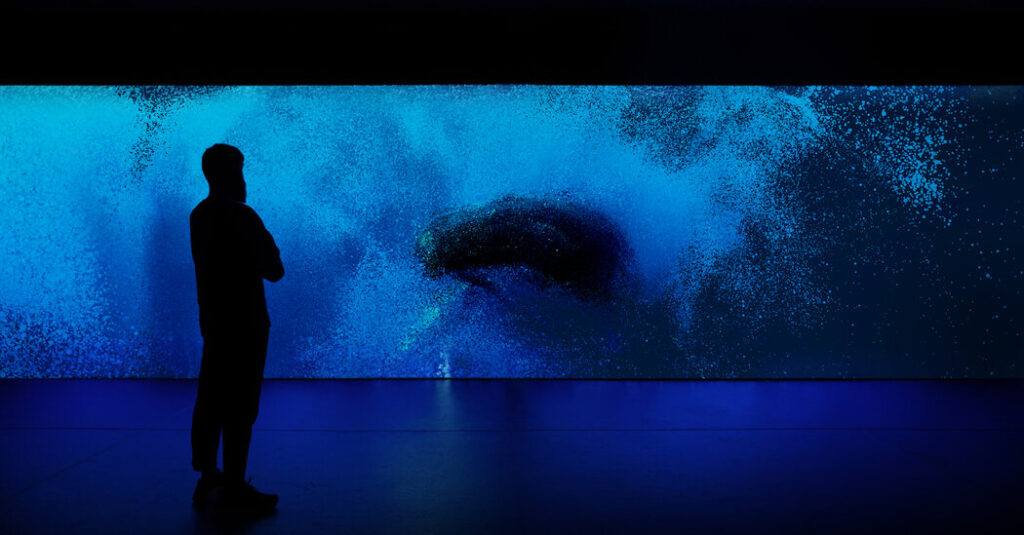
The exhibition’s setting in the former convent and church of Santi Cosma e Damiano — now a science and art innovation hub — fosters a contemplative atmosphere. In lieu of a central altarpiece, visitors encounter an immersive installation from the London-based artist collective Marshmallow Laser Feast, titled “Seeing Echoes in the Mind of the Whale.” In the work, a large-screen video immerses viewers in the sensory perspectives of a bottlenose dolphin, a humpback whale and a sperm whale as they dive and resurface to breathe.
The video plays recordings of dolphins’ trilling whistles, humpbacks’ meditative melodies and sperm whales’ Morse code-like clicks, which resonate throughout the space. To illustrate the use of echolocation to “see” through sound, these vocalizations are coordinated with visual effects. Shimmering swirls and pulsating pixels surround you, giving a sense of what bottlenose dolphins might “see” as they sweep sonar beams across colorful coral reefs, or what sperm whales might sense by blasting clicks to spy giant squid in the dark depths.
Ersin Han Ersin, one of the Marshmallow Laser Feast artists, explained in a video interview that the aim was for audiences to “disembody their own body, and momentarily embody what it is like to be a bottlenose dolphin or a whale.”
While visually speculative, the video is rooted in research. The members of the collective pored over scientific papers, compiled extensive hydrophone recordings and underwater videography, and collaborated with marine biologists and bioacousticians to dive into the sensory experiences of whales and dolphins, Ersin said.
In the process, he said, the artists became more sensitive to the ways noise pollution — the squeals of military sonar, the drumming of shipping traffic and the boom of seismic blasting to find fossil fuels — may be turning the ocean into an acoustic dystopia for animals and plants that live underwater.
“One part of me wants to scream that we are ruining these oceans, but the other part of me knows the best action is always cultivated from a place of love,” Ersin said. That is one goal of the installation, he added: To “make people fall in love with species that they never thought they can relate to.”
In another installation, “Fish String Theory,” Antoine Bertin, an artist who splits his time between Paris and Alicudi island, Italy, amplifies the surprisingly talkative world of fish. Bertin was inspired by reports of a “kwa” sound emanating from Mediterranean seagrass meadows. Scientists found that the kwa chorus most likely comes from scorpionfish. These venomous creatures have a muscular apparatus that functions like an internal violin.
Bertin made underwater recordings of scorpionfish and created fish-shaped sculptures with strings. When his recordings of scorpionfish play, the frequencies from the recordings activate electromagnets that vibrate the strings on the fish sculptures, creating a sound similar to a guitar or harp. The installation also includes Bertin’s underwater recordings of the Venetian lagoon, forming a dialogue between the scorpionfish song and the city’s aquatic soundscape.
Bertin is fascinated by the fact that life emerged in primordial seas, and said in an interview that he hoped that his installation would help people “return to the ocean as listeners.” His aim, he added, was to “create an experience that connects humans and fish in a sort of co-presence, to find out if we can resonate together.”
In “Water Older Than the Sun (Caspian),” the Kazakhstan-born artist Almagul Menlibayeva connects viewers to the Caspian Sea, which is shrinking because of climate change and water diversion — and being contaminated by drilling for oil and gas.
Menlibayeva pointed out that modern societies often see water as a resource to be used. She said in an interview that her installation positions water as an archive of deep time and as a “cosmic, alive entity.” As the title suggests, water is older than the sun because this cosmic compound formed as a result of supernovae explosions, then eventually came to Earth and condensed into oceans that gave rise to life. As such, “water has a memory,” Menlibayeva said, adding: “Water witnessed us as we appeared.”
At the center of Menlibayeva’s installation is a textile made from hand-sewn fabrics and A.I.-generated images of her artwork printed on synthetic silk that depict water, animals and robot-like humans. Fishing nets collected from the Caspian Sea dangle around the textile. Screens placed on the floor like a shoreline show surreal images, such as hands sewing water. Projected behind these pieces is “Requiem for the Caspian” by the London-based filmmaker Suad Gara, a short documentary that reveals the impact of the sea’s collapse on local people.
Just inside the entrance of the church, the Azerbaijan-born artist Elnara Nasirli has turned a reclaimed Italian olive tree into an instrument in “Whispering Forest.” Nasirli translated trees’ bioelectric rhythms into music and vibrations that softly play from contact points triggered by motion detection. Only by touching or hugging the tree, or leaning in very close and listening carefully, can visitors fully hear its whispered song.
Also in the exhibition, artworks bring viewers up close to underground mycelial networks, a holographic jellyfish and bioluminescent plankton that spell out “No blue, no green,” a quote from the marine biologist Sylvia Earle about the vital importance of marine ecosystems.
Altogether, the exhibition invites people to attune to the intelligence and voices of other species and, as Bertin said, to “stretch their sense of self to include the vastness of the ocean.”
The post In Venice, an Ocean-Inspired Exhibition Takes Visitors Under the Sea appeared first on New York Times.