GHOST STORIES: A Memoir, by Siri Hustvedt
Siri Hustvedt’s new memoir, “Ghost Stories,” about her life with Paul Auster, is a collage — a patchwork assemblage of letters, journal entries, emails, bits of personal journalism. It’s held together by her account of her grief in the wake of his death in 2024 from complications of lung cancer. Hustvedt’s stitching skills are nimble. This book is cohesive, melancholy, distinctive and — despite the occasional longueur or “lyrical” moment — genuinely moving.
When Hustvedt met Auster in 1981, she was a young writer who’d had a poem accepted by The Paris Review and an aspiring model. He’d not yet published his first novel. She was 26; he was 34. She was single. He was separated from the writer Lydia Davis, but they were still married. He had a 3-year-old son.
They’d soon marry and have a daughter of their own. Within a decade or so, after his three early post-existentialist detective novels were repackaged as “The New York Trilogy” in 1987 and made him a cultural hero, and Hustvedt issued her first novel, “The Blindfold,” in 1992, they would morph into probably the most glamorous, successful and envied literary couple in hothouse literary Brooklyn.
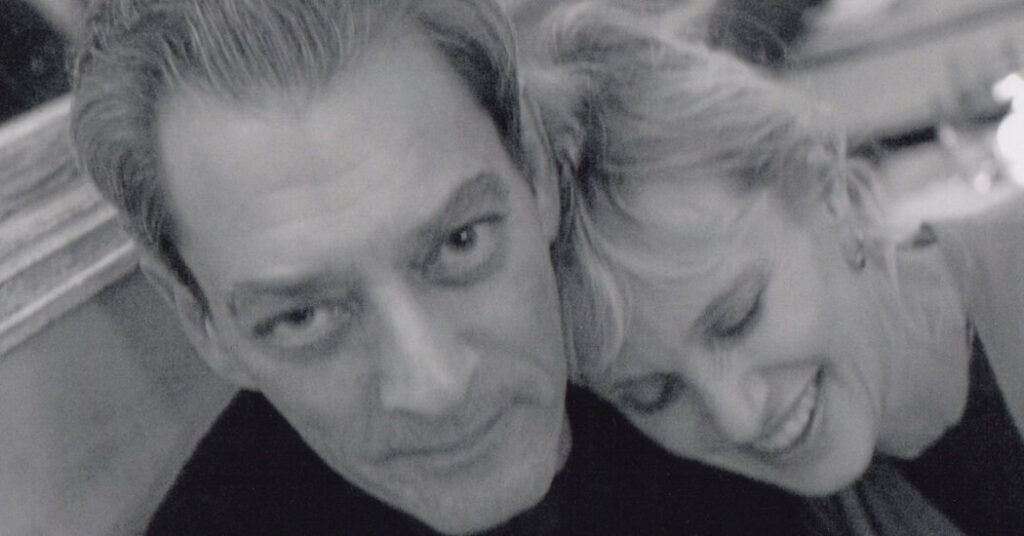
She was blond and he was dark-haired; they were almost photonegatives. She looked as if she’d been in Bergman films. He was, visually, America’s Camus — wary, heavy-lidded, wreathed in cigarillo smoke, an intellectual turned out in black Levi’s and sheepskin-lined leather jackets.
Hustvedt and Auster’s double-barreled impact could prompt strange reactions. Before their wedding dinner, Hustvedt writes, a poet friend of Paul’s lifted a glass and said, “To the bride and groom, two people so good-looking I’d like to slice their faces with a razor.” Hustvedt wasn’t surprised when he slowly faded from their lives.
Auster was diagnosed with cancer in January 2023, when he was 75. Hustvedt tells the story of his illness — the chaotic E.R. visits, the hair loss, the shrinking and then metastasizing of his tumor, the wracking immunotherapy, the wheelchairs, the inability to write and the gradual loss of language — largely by reprinting the matter-of-fact group emails she sent to close friends to keep them apprised of his progress.
These sorts of missives, as anyone who has written or received them knows, are an art form of their own. When delivering good news, Hustvedt urged caution. “There is an important difference between optimism and hope,” she wrote in one such email. “The optimist’s tendency to cheer every piece of good news and predict a good outcome is understandable but creates emotional swings that, at least for those who love the patient, are unsustainable. Hope, on the other hand, is necessary for living on.”
Auster was stoic about his illness, but restless and held captive in the borderless region he termed “Cancerland.” No longer able to write fiction, near his death he began to compose a series of letters to his grandson. These letters, which are largely about family history, are printed here and are models of that form: warm, direct, undogmatic.
Not everyone admired his novels, especially the later ones, and he feared his obituary. He wrote a note asking for a “rebuttal speech or two” at his memorial if his New York Times obit was “hostile.” It wasn’t. He asked to be, and was, buried in a pine box in Brooklyn’s Green-Wood Cemetery.
Hustvedt writes so intimately about their physical and intellectual companionship that she makes you feel, in a way not all memoirists can, the dimensions of the crater he left behind. She piles up details that supply crosshatching: his Luddite tendencies (no cellphone, laptop or email, and to the end he saved movies and shows on a DVR), the anxiety that made him show up hours early for flights, his leaping up from dinner tables to read favorite snatches of prose, the thousands of cigars he never regretted smoking, though he later turned to a vape pen.
The significant and the trivial mix, neither pushing the other aside. They read and edited each other’s work for more than 40 years. This memoir, Hustvedt writes, “will be the first book of mine Paul won’t read before it’s published.” She feels conflicted about his fame eclipsing her own and threatening to turn her into a “shawl,” someone always expected to wrap up and comfort a famous spouse.
Their lives were marked by tragedies and near misses. Daniel, Auster’s troubled son with Davis, died of a drug overdose in 2021, at 44, while facing charges of manslaughter and negligent homicide after the death of his 10-month-old daughter from heroin and fentanyl exposure. Hustvedt wonders if Auster’s acute distress weakened his immune system and opened the door to his illness.
She prints Paul’s account, from a deadline piece commissioned on 9/11 by the German newspaper Die Zeit, of how their 14-year-old daughter, Sophie, on her first day of high school, rode the subway from Brooklyn to Manhattan alone for the first time that morning, passing under the Twin Towers less than an hour before they fell to the ground.
Joan Didion, in “The Year of Magical Thinking” (2005), her memoir about her life after the death of her husband, the writer John Gregory Dunne, said about bereavement: “We might expect that we will be prostrate, inconsolable, crazy with loss. We do not expect to be literally crazy, cool customers who believe their husband is about to return and need his shoes.”
Hustvedt’s book is like Didion’s in tone: “Crazy with loss” is her state, too — and perhaps, as it was for Didion, almost literally so. She begins to think Auster has returned to her as a ghost. She regularly detects the scent of his Schimmelpenninck cigars in their Brooklyn house. They smell to her like solace.
She goes too deeply, for this reader, into the nature of ghosts. I wish her sense of humor were, even darkly, in evidence. She writes about laughing and says she is alert to humor but tends to be deadly serious on the page. This might be the place to remark that Auster’s and Hustvedt’s books have never quite been in my wheelhouse.
But “Ghost Stories” is almost exactly my kind of thing. It’s a grainy and resonant book about loneliness, despair and confusion. It’s close to a howl. It’s as if Hustvedt were standing alone on a pedestrian island while cars shriek past.
A line from one of her early love letters to Auster, printed here, captures this book’s earthy lament: “I miss your dark head in my bed.”
GHOST STORIES: A Memoir | By Siri Hustvedt | Simon & Schuster | 302 pp. | $30
Dwight Garner has been a book critic for The Times since 2008, and before that was an editor at the Book Review for a decade.
The post A Memoir of Grief, and the Ghosts That Linger After a Loss appeared first on New York Times.