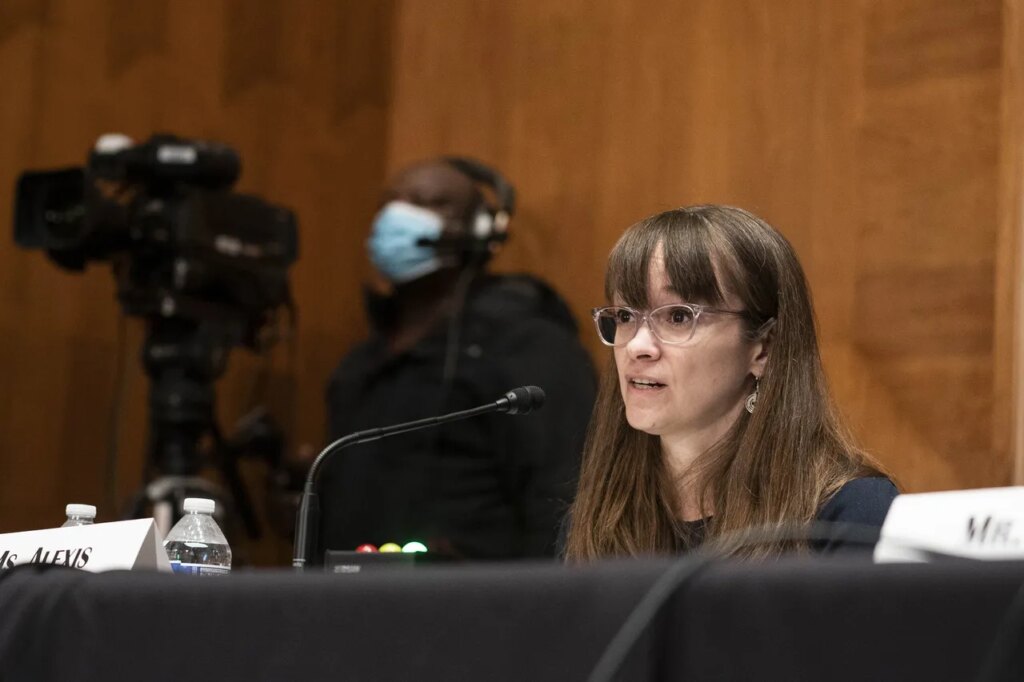
Alexis Goldstein had just dropped her toddler off at day care and was on her way back into the office when she ran into a group of people she had never seen before attempting to access equipment that appeared to be from the Consumer Financial Protection Bureau (CFPB). What ensued was a yearlong fight to save her job at the agency from Elon Musk’s so-called Department of Government Efficiency.
It was February 2025, and DOGE was conducting a wholesale assault on the US government. The operatives arrived at the CFPB on February 6. Goldstein whipped out her phone and started documenting the intruders; they turned out to be members of DOGE, including Jordan Wick and Jeremy Lewin. CFPB leadership alleged that Goldstein violated agency information security rules because the pictures she took included computer screens. After a year in administrative leave limbo, she was fired this past February.
Like the US Agency for International Development (USAID), DOGE targeted the CFPB early on, attempting to terminate more than 1,400 of its 1,700 workers in April 2025. Musk first acknowledged his intention to destroy the small consumer protection agency in November 2024, writing on X “delete CFPB.”
Days after her firing, Goldstein announced that she would run in a crowded race for the US House of Representatives as a Democrat in Maryland’s 6th congressional district against incumbent April McClain Delaney. WIRED spoke to Goldstein about her experiences in the government and with DOGE—and how her experience as a federal worker inspired her to run for office.
This interview has been edited for length and clarity.
WIRED: Can you walk me through the situation that got you fired?
Alexis Goldstein: DOGE arrived at the CFPB, and I was on-site that day because the union had been tabling in the lobby all week, trying to show people we were still there for them. We had gotten word that DOGE was probably coming that day. I had dropped my kid off at day care and was pushing my stroller through the basement when I saw some people I had never seen before who didn’t have CFPB badges but had a CFPB computer. I put my phone in the cupholder and started filming through the window, trying to be subtle, but they saw me and moved to a room that didn’t have a window.
So I went in and introduced myself and asked who they were, because we have all this training that says we are all responsible for safeguarding the sensitive data we have, whether it’s from consumers or the companies we regulate. I started filming and asking them their names and whether they’d had the proper training to handle our sensitive information. One of them ran out of the room immediately. Another one, Jeremy Lewin, the guy that dismantled USAID who looks approximately 18 years old even though he’s almost 30, ran into the corner, and they called security on me. [Lewin and CFPB did not respond to a request for comment.]
You were put on administrative leave for a year before being fired. What was that like, and when did you find out you were fired?
Answering this is a little hard, because they fired a third of the CFPB the next week. So I just got fired with everybody else, then we got unfired, then we got fired again, then we got unfired. It wasn’t really until around May that I was in limbo on my admin leave specifically.
In some ways, I wasn’t worried about my own situation. I was worried about everybody’s. There was only a court order keeping the CFPB open. At one point it went to the DC Circuit, and we were waiting for their decision. Every day that passed, people would be like, “We made it through another day!”
My situation didn’t become a real stressor until the inspector general asked to speak to me at the end of June. I thought it was going to be a productive conversation, because they were investigating DOGE. But they were like, “Isn’t what you did as bad as what DOGE did? If they had a computer open and your camera caught a tiny bit of that computer, didn’t you do the same thing, if you’re saying that we should be concerned that DOGE shared information?” It was a very hostile interview, and I felt like I was being scapegoated.
Then you don’t hear from them. They go away and do their thing. I didn’t know what was going on until December, when I got a letter that was a proposal to fire me. In that letter was a document from the inspector general saying they found no wrongdoing. But between July and December, I had no idea. I didn’t do anything wrong, and I knew that. But in this environment, that doesn’t matter.
What data were you worried about DOGE accessing?
Broadly, everyone was worried about the same kind of stuff they were worried about DOGE getting at other agencies, like the Social Security Administration. But at the CFPB, the kind of personal data we have is more like what is happening to you in your most vulnerable financial moment. You are facing foreclosure, and there’s a lot of personally identifiable information that goes into that if you call our foreclosure hotline.
For me specifically, one of the projects I worked on was an inquiry into big tech-payment platforms like Apple Pay, Google Pay, Cash App, and all of that. We had been going back and forth with very fancy attorneys from Apple and Amazon, and they would constantly tell us how sensitive the data we were asking for was. They made a big deal about trade secrets and how their nightmare was that it would be compromised in any way.
So when there was all this reporting before the inauguration about Elon Musk coming in with DOGE, and he wants to launch X Money, which is a payments platform—I was worried they were going to get essentially all of the trade secrets of every one of Elon’s potential competitors. You could create a monopoly with that kind of information. [X Money, Musk’s banking tool, could soon launch publicly, Bloomberg reported last week.]
How has DOGE’s influence at the CFPB affected the agency? How is this harming consumers?
They’ve essentially halted the work of the CFPB. There are 18 different consumer finance laws that the CFPB is responsible for enforcing, meaning going in and examining companies to make sure they’re obeying the law. That’s not happening. It hasn’t been happening. Nobody is minding the store.
I think Russell Vought failed spectacularly in his goal of making the public hate government workers. But he succeeded very well in traumatizing the federal workforce and in pausing the work of the CFPB. That is a really dangerous thing to do, especially at a time when prices are so high. If you get an overdraft fee of $20 that’s an error, or a late fee and you weren’t actually late—30 bucks is a lot of money to a lot of people right now. Vought’s been very successful at making life more expensive for millions of people and at making it easier to financially scam Americans. [Vought did not respond to a request for comment.]
When did you realize you wanted to run for office?
It’s something I always thought about but that seemed really difficult and out of reach, because we don’t have public financing of elections federally. This past year, I started to think about it seriously, because I was so mad. The CFPB union was constantly going to members of Congress and asking them to do more. Some were like, “What do you want us to do? We’re not in the majority.”
The whole experience of 2025 really made me think I could do a better job of fighting for people—not just federal workers, but everyone—than at least my member of Congress is doing. I just didn’t see enough fight in many elected officials. There’s all these people running toward danger—some very overtly, some very quietly through whisper networks, food drives, fundraisers for families that have had someone snatched by ICE. I was frustrated by the disconnect between the courage I see all around me and what I see in elected officials.
I also think there’s a lot of, “We just have to get rid of Trump and things will go back to normal.” I don’t think that’s enough. We need to ask what the conditions are that led to Trump in the first place and how we treat those root causes. It’s not just about flipping the House.
What do you want to accomplish in office?
I would try to join the House Financial Services Committee. I worked on a piece of legislation with Alexandria Ocasio-Cortez’s office about billionaire family offices. People talk a lot about private equity and how it controls the economy. But there’s this giant invisible whale of money that’s even bigger—family offices. It sounds very cute, but it’s basically Elon Musk’s and Jeff Bezos’ personal investment fund. The Democrats made a decision in 2010, when they passed Wall Street reform, to add a little oversight to hedge funds and private equity funds, but they decided not to do that for all family offices.
But aside from that kind of minutia, I just know what it’s like to be targeted by the Trump administration. I was the chair of the LGBTQ affinity group at the CFPB. I’m queer. I have kids. This is all very real for me. What I’ve seen from Democrats for a while is things like, “We can throw trans people under the bus, because maybe that will help elections, and we’re better than the alternative.” My assessment has always been that that makes you look weak. If you’re willing to abandon people in your coalition, it doesn’t make you look savvy. It makes you look cowardly and weak.
I’ve worked on Wall Street. I’ve worked in the government. I’ve worked at a nonprofit trying to pass tougher rules on banks and Big Tech. I joke that I’ve cased the joint, and now I’m ready for the heist—except it’s not a heist, because it’s our money. They stole it first. I want to redirect funding away from the billionaires and toward everybody else, so that life is a little bit easier for us.
The district you’re running in has a lot of government workers. What have you been hearing about from them about DOGE throughout your campaign?
When I talk to people, they’re mad. And if they’re not mad for themselves, they’re mad for someone else. Someone in their family works for the government, or someone in their friend circle does, and everyone has a horror story. Someone who had to retire early, or someone who got fired, or someone who hasn’t been able to find work.
If Democrats take back the House, what does rebuilding the CFPB and the federal work force look like?
The CFPB union is not waiting until the midterms. Every time there’s a must-pass piece of legislation, they’ve been saying, “You need to put full CFPB funding restoration on this.”
For the federal workforce at large, we’ve got to better enshrine the right to unionize. If the Democrats retake the House, they need to work with the rank-and-file workers and the unions, not just the political appointees and agency leadership. Part of that is about passing things like the Protect America’s Workforce Act, which did pass the House. I’ve just seen in the last year the power of people coming together in a union, even if they haven’t formed the union yet. That’s one of the most important things Congress needs to do to restore the government—make sure the workers themselves have a say at the table.
The post A Federal Worker Was Fired for Filming DOGE. Now She’s Running for Congress appeared first on Wired.