Jack Thorne, who co-wrote last year’s prize-winning “Adolescence,”returns with another story of fractured childhood with an admirable, engrossing new adaptation of William Golding’s much-taught novel of boy castaways, “The Lord of the Flies.” (Not to be confused with “The Lord of the Rings,” though I keep typing that by mistake.)
Published in 1954, Golding’s book has an unstated Cold War backdrop — there is passing reference to an atom bomb and “the Reds,” and an old-fashioned animated atom glimpsed through static at the head of the series. The boys, who are British and range in age from 6 to 12, are being evacuated to somewhere — none of them really knows, and it’s not clear anyone else does, either — when their plane goes down on an uncharted desert isle. (The logo on the aircraft is Corinthian Air, make of that what you will.)
The great British stage and screen director Peter Brook (“Marat/Sade,” “The Mahabharata”) filmed a version in 1961 (released in 1963) that somehow found its way onto American broadcast television in my youth that disturbs me still. A coed Filipino version was made in 1975, and a prosaic Americanized take in 1990. In some way Brook’s powerful film, shot in black and white, still feels definitive, even after watching this new series, premiering Monday on Netflix, though it’s a streamlined telling and much of the dialogue was improvised.
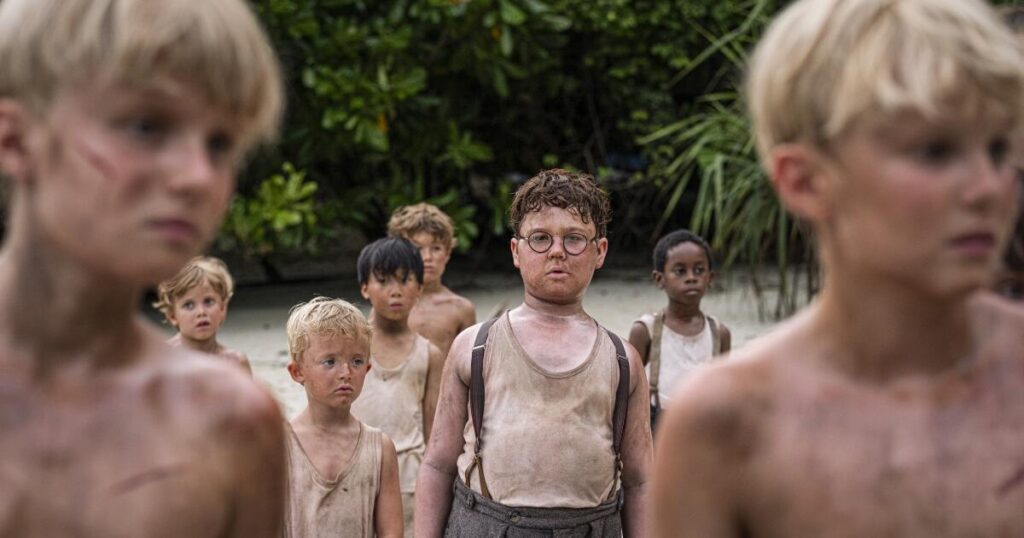
Our main characters are older boys Ralph (Winston Sawyers), Piggy (David McKenna), Jack (Lox Pratt) and Simon (Ike Talbut). Each has an episode named for him — as with “Adolescence” it’s a four-part show — the overlaid shifting focus fitting quite well into the novel’s chronology. Ralph is good-hearted and reasonable and about to grow up; Piggy, chubby, bespectacled, asthmatic, stands for mocked intelligence; Jack, increasingly Ralph’s nemesis, is a budding authoritarian, who arrives with a complement of caped and capped choirboys under his command; and Simon, who, in the novel, seems to suffer from epilepsy, is the story’s Prince Myshkin, sensitive and spiritual. (We’ll see him photographed from above, floating in a crucifixion pose.)
It’s hard to know what, if anything, to call a spoiler in a series adapting a 75-year-old fiction routinely, or once routinely, assigned in high school, but I’ll keep mum about the fate of any particular characters and the castaways as a whole for those yet to savor the story’s dark charms.
In many respects, this “Lord of the Flies” is truer to the book than the Brook film. Much of Golding’s dialogue appears here, with all the signal events present and accounted for, though Thorne adds quite a few scenes and events, for dramatic effect or to draw three lines under a point, or to make the good guys better and remind you that the bad guys are scared little boys beneath the bluster and war paint. Suitcases are discovered, containing plot devices. There are interpolated bits of backstory to explain character — Simon and Jack would be left at school over Christmas, like young Scrooge in “A Christmas Carol,” by their parents (abusive and cold, respectively).
Piggy, whom Golding gives no other name, gets one here — Nicholas — albeit held back until later in the series. (Though Ralph is the main protagonist, Piggy — onscreen anyway, in a deep performance by McKenna — reads as the secret central character, and Thorne expands his presence in the narrative far beyond the text.) He’s the one who thinks about keeping the water supply sanitary, and in Thorne’s version, he tells stories to calm the little children, including that well-known folk tale of apocalyptic mass hysteria, “Chicken Licken.” (a.k.a. “Chicken Little.”) He also sings Groucho Marx’s “Hooray for Captain Spaulding” (“He went into the jungle, where all the monkeys throw nuts / if I stay here, I’ll go nuts”) as he wanders through the jungle, which marks him a boy of refinement. (Other Groucho references will come, more dramatically.)
Director Marc Munden seems to be aiming for art here — fair enough — which at times comes across as arty. Between explosions of action, it’s willfully slow, which I suppose life on a desert island might be. (That’s why people are always being asked what books and records they’d bring.) He embraces the island’s offer of crabs and birds and insects, rotting fruit and rotting flesh, photographed close up by cinematographer Mark Wolf, who provides interstitial portraits of various boys, in slightly wide angle, staring at the camera. In one scene it lingers for what struck me as an inexplicably, even discomfitingly long time on the handsome face of a young sociopath pranking a pair of little kids with small stones.
Colors are heightened — by manipulation or because that’s just what the jungle’s like, I don’t know which. Sometimes the forest greens turn red to emphasize extreme states of mind and signal hallucinations. The musical score, by Cristobal Tapia de Veer (“The White Lotus,” which it occurs to me as I write, is a kind of adult take on “Flies”) takes a modern classical approach — not your usual TV miniseries music. It all can feel a little heavy-handed, but extremity does suit the story. Above all, Munden and his crew have done a fine job of wrangling good work from masses of kids, some quite little, in what must have been challenging conditions.
“There was the brilliant world of hunting, tactics, fierce exhilaration, skill,” wrote Golding, “and there was the world of longing and baffled common sense.” On one side, doing the dull work of democracy — “I want to be a good chief,” says Ralph, voted into the office early on, “and we need to be good campmates.” On the other, falling in line behind a power-drunk bully to whom rules don’t matter. (Hmmmm.) But whether you take it as a literary thought experiment regarding pre-teen psychology or an allegory (alarmingly still apt) of the ways humanity conducts itself in this world — those keeping the signal fire lighted versus those busy stabbing things with pointed sticks — it’s not a happy tale.
The post Jack Thorne’s ‘Lord of the Flies’ is a timely, engrossing miniseries true to novel appeared first on Los Angeles Times.