“You’re acting as if I’m old,” my mother said.
“Mom, you are old!”
My mother’s footsteps slowed beside mine as we walked through the Stanford campus. She looked crestfallen.
Before you make assumptions about what a jerk I am, let me tell you that my mother is 85. A healthy 85, thank God, but 85 nonetheless. My father is 87. This puts them squarely in the range of “old.” And I should know — I am a palliative and critical care physician who has accompanied hundreds, if not thousands, of people through old age, serious illness and death.
I’ve become a fierce proponent of facing your aging and mortality and planning for it — what we in the medical profession call advance care planning. While my parents are supportive of my work, they don’t appear to have gotten the memo.
I’d ask them: “What if you break a hip or have a stroke? How will you get upstairs to your bedroom?” But the conversations never really went anywhere.
I know how high the stakes are. I have watched too many people die badly. Some in hospitals and intensive care units, where they receive an ever-escalating series of interventions, regardless of their prognosis. Others in nursing facilities because their own homes, where most people say they want to die, cannot accommodate their needs, or there’s no one there to provide care.
My parents, both retired physicians, will likely avoid the first scenario. They watched many of their own patients waste away on ventilators. Even though they won’t engage in frank conversation on the matter, they’ve made it clear they don’t want to die that way.
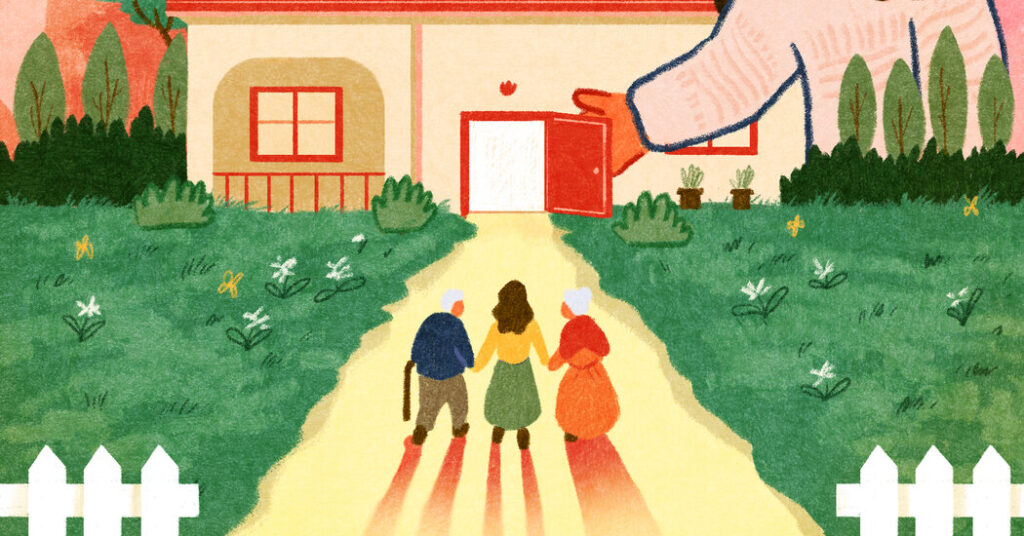
What concerns me most for them is the second scenario. They assume that they will be able to remain at home until they die. With their labradoodle, their cozy living room, their sunny patio. Their privacy. Their autonomy.
I’d assumed it, too. I still saw them as the marathon runners they had once been. But then I watched my father wrestling garbage cans to the curb, something he used to do with ease. And I saw my mother reaching across the top of a dark and rickety set of basement stairs for her broom. I realized my incredibly capable mother was also an elderly woman with osteoporosis, one fall away from life in a nursing home. And I knew that would kill her.
Then came frustration: Why was I the one who had to burst their bubble? Why did I have to ask them how they would get upstairs to their bedroom if one of them broke a leg or had a stroke? Why did I have to make them visualize their lives in a nursing home, the plastic mattresses, the fluorescent lights, the red Jell-O cups?
The short answer is: Because our health care system is not doing enough to help people plan for the latter part of their lives. And this sets people up for crises that could have been averted. When it comes to the elderly, life can turn on a dime. Older bodies are weaker, less resilient and slower to heal. A simple fracture can leave you lying on your back for prolonged periods of time. This increases your risk of pneumonia because it’s harder to cough properly and clear your lungs. Pneumonia can lead to a breathing machine and the intensive care unit. Very often, families are stunned. The person came in independent and healthy. How could this have happened so quickly?
In these kinds of situations, a little advance care planning can go a long way, and doctors should play an important role in making sure that happens, whether it’s to bring clarity about future medical decisions, to emotionally prepare patients and families for unexpected transitions or to suggest putting up a grab bar in the shower, which can significantly reduce the risk of falling. Sadly these conversations are far too rare. It’s true that Medicare counts advance care planning conversations as a billable “procedure.” But the reimbursement is woefully inadequate. And when you’re running between patients, there’s always something that feels more important.
How can we get health care practitioners to prioritize this effort? By paying for it properly. If Medicare, the largest insurer of our aging population, pays almost $2,000 for a 30-minute cataract surgery, then surely it can pay more than $85 for 30 minutes of counseling on this vital topic. That investment would save Medicare a whole lot more — people who experience end-of-life planning conversations tend to choose less interventionist and more home-based approaches.
We also need to do a better job of teaching physicians and other clinicians to seek out and engage in these challenging conversations. Let’s start by selecting medical school applicants with traits that include curiosity, compassion and emotional courage. These are among the most important conversations of a lifetime, and all doctors should possess the skills and desire to conduct them.
And for those, like my parents, who want to remain in their homes as long as possible, Medicare should see an opportunity. If it pays to increase the success of aging in place, costly trips to the emergency room and hospital will be avoided. The cost of installing a grab bar or stair ramp is a lot lower than an admission for a hip fracture. Providing more training to in-home caregivers has been shown to decrease visits to the emergency room and hospitalizations.
Planning can make the difference between the way you want to live and the way you have to live. I want to help my parents prepare now, so that they aren’t caught by surprise by a potentially rapid medical deterioration. A few small changes to their home and habits will make it much more likely that they can remain at home, even if they lose physical mobility.
Thankfully, my love language of meddling and nagging are paying off, and my parents recently seem to be coming around — their handyman installed a grab bar in their tub last week.
Jessica Nutik Zitter’s latest film, the “The Chaplain and the Doctor,” explores her relationship with a hospital chaplain.
The Times is committed to publishing a diversity of letters to the editor. We’d like to hear what you think about this or any of our articles. Here are some tips. And here’s our email: [email protected].
Follow the New York Times Opinion section on Facebook, Instagram, TikTok, Bluesky, WhatsApp and Threads.
The post My Job Is to Help Plan for Old Age. Why Is It So Hard With My Parents? appeared first on New York Times.