Two months into the war in Iran, President Trump is confronting the complicated reality of a conflict that has proved costly, deeply unpopular and lacks a clear endgame.
Energy markets are in turmoil. The Pentagon has given its first public estimate of the war’s cost: $25 billion so far. Key Republicans in Congress are growing impatient. And Mr. Trump is lashing out at foreign allies, like Germany, who have shown no interest in joining the fight.
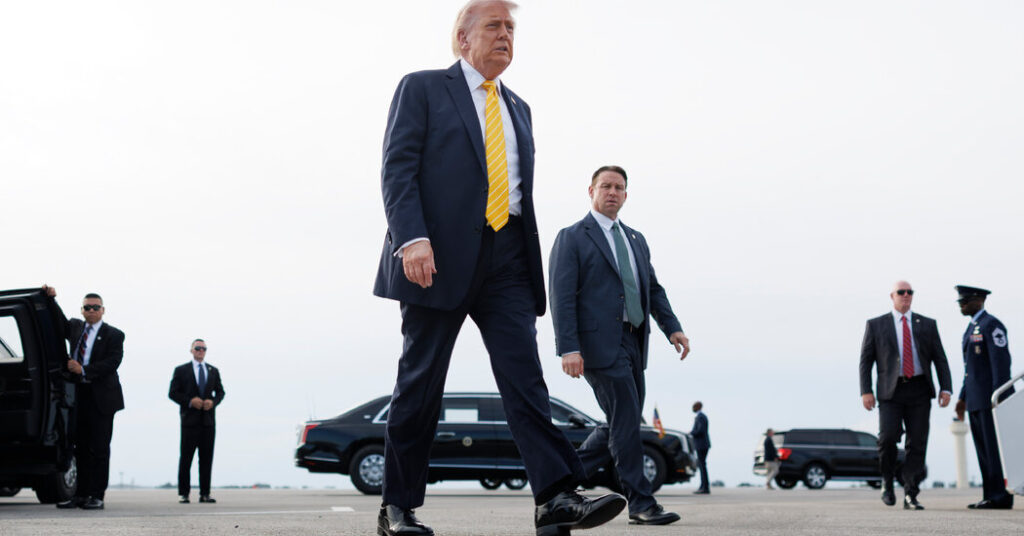
Speaking to a crowd of supporters on Friday, Mr. Trump insisted he had no regrets.
“I did something that was, I don’t know, foolish, brave, but it was smart,” Mr. Trump said at The Villages, a retirement community in a solidly Republican area. “I would do it again.”
Still, Mr. Trump’s predictions of a relatively short-term conflict with minimal economic consequences appear to be crumbling around him.
Mr. Trump has repeatedly defended the war, which he launched alongside Israel on Feb. 28, and said it is imperative that Iran never has a nuclear weapon. The United States and Israel have taken out military targets and killed senior Iranian leaders — including the Supreme leader — but the government there remains intact and able to inflict pain on the United States.
As the conflict continues, Mr. Trump has encouraged Americans to keep things “in perspective,” citing the long wars in Vietnam and Iraq to suggest that U.S. involvement in Iran is “not very long at all.”
Just three weeks ago, Mr. Trump said Iran had agreed to all of his demands and he suggested a breakthrough was near. Iran would work with the United States to remove its enriched uranium, energy prices would drop and a growing global crisis with potential severe political ramifications would subside.
None of that happened.
Mr. Trump has issued mixed messages about the future of the war, arguing that Iran wanted to make a deal while also saying that the leadership in Tehran was so “disjointed” that it was hard to tell who was calling the shots. He also said it’s not worth having his envoys travel 18 hours on a plane to negotiate a deal that might not come together.
And on Friday, after saying he was not satisfied with Iran’s latest proposal to reopen the Strait of Hormuz, Mr. Trump said, “frankly, maybe we’re better off not making a deal at all. Do you want to know the truth? Because we can’t let this thing go on.” On Saturday, he appeared to double down, saying on social media that he was reviewing Iran’s latest proposal though he couldn’t “imagine that it would be acceptable.”
Mr. Trump has said his model for Iran was the U.S. operation in Venezuela in January, when U.S. forces toppled Nicolás Maduro. But the two scenarios are very different. In Venezuela, only Mr. Maduro was ousted, while much of the rest of the government remained in place and was willing to work with the Trump administration. That is not the case in Iran, in part because Iran’s leadership oversees extensive military capabilities.
For the moment, the two sides appear to be locked in a test of wills. Washington has maintained a blockade on Iranian shipping as Iranians have refused to accede to his demands to turn over enriched uranium. Mr. Trump on Friday described the U.S. Navy as acting like “pirates” as he celebrated the takeover of one of Iran’s cargo ships. On Saturday, a senior Iranian general said that renewed confrontation between Iran and the United States was possible, according to a report from the Fars news agency. Mr. Trump has also acknowledged that military strikes might start up again. He told reporters in Florida on Saturday that a resumption of military strikes in Iran is a possibility, though he wouldn’t give details. “But you know, it’s a possibility that could happen,” he said.
The Strait of Hormuz is expected to remain effectively closed for weeks, raising the prospect of prolonged high energy prices. Despite Mr. Trump’s claims of gas prices dropping soon, Secretary of Energy Chris Wright acknowledged last month they could remain elevated for the rest of the year.
The closure of the strait also complicates Mr. Trump’s high-stakes trip to China in two weeks. President Xi Jinping has demanded the United States reopen the waterway through which China imports about a third of its oil and gas.
The war has deepened Mr. Trump’s fissures with global allies. After German Chancellor Friedrich Merz said Mr. Trump was being “humiliated” over the war with Iran, Mr. Trump lashed out at the leader and his administration announced it would withdraw thousands of troops from Germany. He suggested he might do the same for Italy and Spain, which have both distanced themselves from the war.
The president has declined to ask Congress for permission to continue the war, despite passing the 60-day statutory deadline to do so on Friday. The administration has argued it does not need such approval because the cease-fire essentially stopped the clock.
Just hours after the letter was sent to Congress, the president undercut his own argument.
“You know we’re in a war,” Mr. Trump said in Florida. “Because I think you would agree we cannot let lunatics have a nuclear weapon.”
Some Republicans balked at the stopped-clock argument as concerns increase over the cost of the war, just six months from midterm elections in which Republicans are expected to suffer losses. Earlier this week, Pentagon officials said the war had so far cost $25 billion — roughly the cost of expanding Obamacare subsidies that were at the center of the extended government shutdown last year.
Mr. Trump has responded by repeating over and over again — including at a state dinner with the royal family and in a speech about tax cuts in Florida — that the war is worth any surge in gas prices if it means shutting down Iran’s nuclear capabilities.
Most polls, however, have shown the war to be unpopular among Americans.
Matthew Bartlett, a Republican strategist and former State Department official who worked in the first Trump administration, said the inconsistent messaging will likely not satisfy voters.
“The messaging has been more than a mess,” Mr. Bartlett said. “It’s worth noting this week the political, economic, and even diplomatic aspects continue to get worse. The trajectory was down across the board and that is not a good thing as we dive into another week and even month of war.”
Zolan Kanno-Youngs is a White House correspondent for The Times, covering President Trump and his administration.
The post Trump Faces the Complicated Reality of a Costly, Unpopular War in Iran appeared first on New York Times.