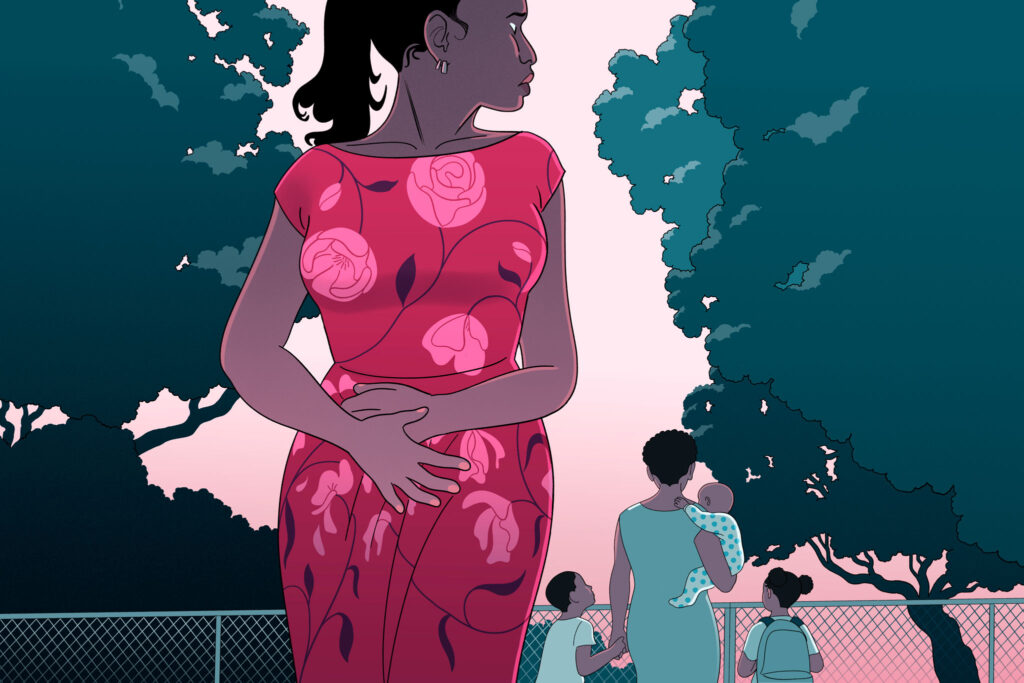
After taking a break from college and giving birth to her son, Brittany Pope graduated and got a job with benefits. Then, at age 28, she became pregnant again, much to her and her longtime partner’s delight.
But this pregnancy was more difficult than the first one. Pope had intense abdominal pain. She vomited in the car on the way to meetings. When she got home from work, she would collapse on a recliner from fatigue. Medication for morning sickness did not help.
Doctors found cysts on her ovaries, and she had a miscarriage. The cysts did not appear to be cancerous, but her bloating and pain continued after the pregnancy, and her periods became irregular, coming roughly every three months. In the days before each period, it felt as if she was having contractions.
Doctors monitored her cysts with imaging tests, and some said she should undergo a hysterectomy, or removal of the uterus, possibly including the removal of her ovaries and fallopian tubes.
But Pope, the youngest of nine siblings, didn’t want to eliminate her ability to expand her family.
“I was so young,” she said. “Was that really the only option?”
Specialists eventually zeroed in on a rare condition that explained her symptoms, leading to a different kind of surgery.
Anatomical discovery
Pope, now 36, hoped to have several children. She and her male partner have been together since they were 17.
After putting college on hold and having her son in 2011, Pope got a psychology degree in 2017. She started working at an agency that oversees services for people with intellectual disabilities, a job she still holds.
Pope’s periods had been regular but always marked by heavy bleeding. When she had her son, she began to learn why. Doctors tried to induce her labor, but they couldn’t get her water to break. As they performed an emergency Caesarean section, they determined she had a septate uterus, a rare birth defect in which the uterus is divided into two parts by a membrane called a septum.
Several years later, during an ultrasound to look for fibroids in early 2018, the Erie, Pennsylvania, resident was diagnosed with uterus didelphys, an even rarer congenital abnormality. It involves two separate uteruses that resemble bananas instead of one that looks like a pear. The condition sometimes includes two cervices, which Pope was found to have.
Uterus didelphys doesn’t preclude healthy pregnancies but can cause heavy periods because each uterus can shed its lining simultaneously during menstruation. Sometimes, however, the wombs bleed at different times.
In November 2018, Pope was excited to learn she was pregnant. But the miscarriage, which occurred the following month just before she was hospitalized for blood clots in her lungs, initially made her wary of becoming pregnant again. Over the next four years, she saw at least eight doctors in Erie and the Pittsburgh area for her bloating and pain, which worsened during the intervals between her irregular periods.
The doctors ruled out ovarian cancer and said she might have polycystic ovary syndrome, a relatively common condition in which multiple cysts, often driven by male hormones such as testosterone, can cause irregular periods. She took Midol for the pain, but it didn’t help much. By the time the doctors suggested a hysterectomy, she wanted to have more children. As they ordered an MRI and periodic ultrasounds, she grew frustrated.
“My problems were getting worse, and all they wanted to do was monitor it with pictures,” she said.
High hormone levels
In October 2022, Pope went to Cleveland Clinic, an academic medical center less than two hours west of Erie. The first doctor she saw was Stephen Mooney, a reproductive endocrinologist, or obstetrician-gynecologist who specializes in treating infertility and hormone disorders.
Mooney noted that Pope’s blood tests showed high levels of four hormones: testosterone; the female hormone estrogen; prolactin, which stimulates breast milk; and 17-hydroxyprogesterone, or 17-OHP, a steroid produced by the adrenal glands. Her 17-OHP level was nearly eight times above normal. Her estrogen level was more than 20 times too high.
“I’ve seen all of those hormones elevated individually, but it’s unusual to see all of those elevated at the same time and to that magnitude,” said Mooney, who now runs a private clinic south of Cleveland.
He treated her with dexamethasone, a steroid medication that should have decreased her testosterone and 17-OHP levels but didn’t.
Pope faced a setback in October 2023, when her right ovary went into torsion, or twisted on the tissues supporting it, cutting off its blood supply and causing severe abdominal pain. In Erie, she had emergency surgery to remove her right ovary and fallopian tube — reducing, but not ending, her chances of becoming pregnant.
After she recovered, she saw Laleh Razavi, an endocrinologist, or hormone specialist, at Cleveland Clinic. Razavi wondered whether Pope’s high 17-OHP level might stem from a late-onset form of congenital adrenal hyperplasia. The condition, typically found soon after birth, throws off the balance of hormones produced by the adrenal glands, which sit atop the kidneys. But tests Razavi ordered, including gene sequencing, were negative. Despite being born with only one kidney, Pope has two adrenal glands.
Razavi ordered an MRI of Pope’s head, which in November 2024 showed a small tumor on her pituitary, the pea-size gland at the base of the brain that makes or controls many hormones. Pituitary tumors are somewhat common, but most don’t produce excess hormones. Unless they cause headaches or impair vision, they are typically monitored and not surgically removed.
But some pituitary tumors generate prolactin, and Pope’s high level of the hormone was causing her to produce breast milk. When doctors gave her cabergoline, a drug that reduces prolactin production, her level dropped and she stopped making milk. But in a follow-up MRI in July, her pituitary tumor looked the same, even though cabergoline should have shrunk it.
Meanwhile, the ovarian cysts on Pope’s left side had grown to 22 centimeters, about the size of a soccer ball. Was her pituitary tumor somehow feeding that growth? A group of doctors met to discuss her case.
“It is extremely rare to have a pituitary tumor that makes excess signal that activates the ovaries,” said Varun Kshettry, a neurosurgeon at Cleveland Clinic who took part in the discussion. “Nobody had seen that before … but it is the only thing we were left with.”
Amid lingering uncertainty, Kshettry operated in October, working through Pope’s nostrils to remove the tumor without needing to go through her skull. Tests showed the tumor was a functional gonadotropic adenoma, which means it was producing follicle-stimulating hormone, which overstimulated her ovaries and drove her estrogen levels sky high while also increasing her testosterone and 17-OHP. This type of tumor is thought to account for less than 1 percent of all pituitary tumors, according to Kshettry and Razavi. Pope’s tumor wasn’t producing prolactin, as initially suspected, Kshettry said, but it may have increased her level of that hormone by blocking the release of another hormone, dopamine.
Return to normal
Soon after the tumor was extracted, Pope’s hormone levels returned to normal. Her estradiol, the main form of estrogen, dropped from 11,378 picograms per milliliter a year before surgery to 41 pg/mL a week after the procedure. She started to have regular periods again. Her ovarian mass shrank to 7 centimeters, about the size of a tennis ball, and her abdominal pain vanished.
“I feel good,” Pope said recently. “I’ve been stretching and doing sit-ups, stuff I hadn’t been able to do in so long.”
A CT scan last month showed that her mass has shrunk even more, to normal size, and she’ll go in for blood tests again soon. If the results show healthy hormone levels, Razavi said Pope will be considered healthy enough to try to become pregnant again. Pope said she would like to try later this year.
Pope wishes it hadn’t taken nearly seven years after her miscarriage to find the root of her problem. But she is glad she resisted getting a hysterectomy. Removing her ovaries probably would have reduced her pain and complications, but it would not have addressed the source of her problem, Razavi said. The pituitary tumor would have continued to cause hormone imbalances that would have affected her in other ways, the doctor said.
Pope said that regardless of whether she has more children, she’s glad she retained the possibility of fertility.
“They wanted to take that option from me because it was easy for them,” she said. “But it feels good just knowing I have that option.”
David Wahlberg has been a medical reporter for 30 years, including at the Atlanta Journal-Constitution and the Wisconsin State Journal in Madison.
Submit your solved medical mystery to [email protected]. No unsolved cases, please. Read previous mysteries at wapo.st/medicalmysteries.
The post Doctors told her to remove her uterus. The real cause of her pain lay elsewhere. appeared first on Washington Post.