BACKTALKER: An American Memoir, by Kimberlé Williams Crenshaw
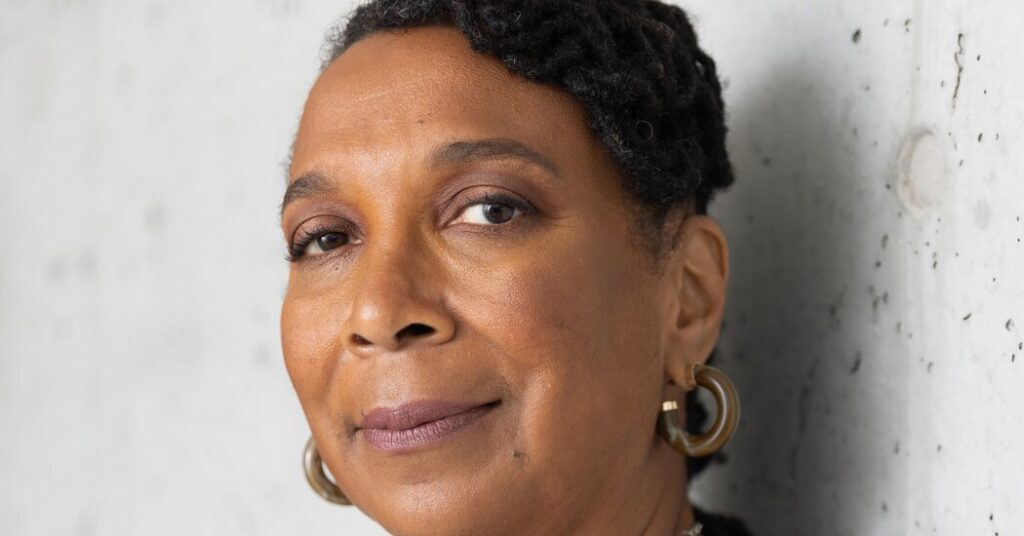
Calling someone a backtalker is not usually a compliment. It suggests they’re transgressing social mores that govern their tongue. Kimberlé Williams Crenshaw, the author of the memoir “Backtalker,” would beg to differ. She grew up in an aspirational Black household in 1960s Canton, Ohio, where energetic debate at the dining table was encouraged.
“Backtalker” charts Crenshaw’s extraordinary journey from precocious child to renowned public intellectual. Today, she is a Columbia University law professor who is closely associated with a set of ideas about inequality known as critical race theory. She is also the architect of one of the theory’s chief pillars, intersectionality, a term she coined in 1989 to urge us to consider the ways that bigotries rooted in gender, race and class overlap.
In the past three decades, propelled by fights over policing, workplace discrimination and the meaning of America’s founding moment, her ideas have flown from the fringes of academia to the heart of public and political discourse. Critics increasingly attack Crenshaw’s theories as divisive forms of indoctrination and anti-American. But to admirers, they offer a means to dismantle systemic racism to ultimately achieve racial justice.
Despite their present-day status, the earliest passages of “Backtalker” suggest that Crenshaw’s ideas about bigotry don’t originate in some close study of case law; they’re rooted in her basic disposition. “Being a backtalker is like being lactose intolerant,” she writes. “There are things that I cannot digest.”
Crenshaw inherited this quality from her mother, Marian, who schooled her to always be alert to discrimination. “Be aware, and be prepared,” is Crenshaw’s summation of her mother’s advice. This mind-set, she notes, eventually became known as “woke.” Decades later, the term would be seized on by detractors and used as a slur, but in 1960s Ohio, it perfectly encapsulated Marian’s self-assured approach to white bigotry.
The Crenshaw family fortitude was mixed with a deep sense of fragility. In 1969, when Crenshaw was 10 years old, her father, Walter, died tragically from a mysterious ailment following a family camping trip. Crenshaw recalls finding a devastating entry on her mother’s calendar: “Walt Died today, and my life ended with his.” Marian was thrust into “an entirely different narrative now,” Crenshaw writes: the “single Black mother.” Crenshaw, for her part, became the hyper-vigilant daughter who lived with the daily terror that her mother would “disappear in an instant, just like Daddy.”
Shockingly, just a few years later the family suffered another fatality when her older brother, Mantel, was shot in a campus dispute. Crenshaw’s sparse recollection of Mantel’s funeral is of a girl “who was not there” stepping out from a hearse. “I knew she wasn’t there,” Crenshaw explains, “because she was me.”
Looking back, Crenshaw suggests that her traumatic childhood inspired her compassion for marginalized and invisible people. Even as we see the pall of sadness lift — Crenshaw has some fun when she works as an undergrad “smooth-groove cupid” D.J. on late-night radio — the theme of repressed pain persists throughout her Ivy League education in the 1970s and ’80s.
In these college chapters, the book’s velocity matches her quest for a language to challenge the calls for race and gender blindness that had become a popular solution to inequality in America. We see the earliest seeds of intersectionality as Crenshaw confronts a loophole in the legal system whereby courts denied Black women their standing to sue over gender discrimination, because, as Crenshaw puts it, judges believed that “white women’s experiences were capacious enough to represent all women,” but Black women’s experiences were not.
The insights she gleans from personal turmoil are just as rich. At a bruising inflection point in her early 20s, Crenshaw is exposed to the uncomfortable reality that a shared race or gender does not necessarily equate to empathy and solidarity. She recalls a college relationship with a “revolutionary wannabe” whom she names B.F.H., or “Boyfriend From Hell.” After a bad breakup, B.F.H. assaults her and, in a furious fit of pique, attempts to throw her out of a high window.
That the precise prose of this account, and numerous other anecdotes, is written with the kind of titanic certainty that would sway a jury is expected; what’s surprising, however, is Crenshaw’s candor in revealing her vulnerability and disappointments. In the aftermath of the assault, she grieves not the failed relationship with her boyfriend but rather the faltering sisterhood of a Black leftist friend called Naimah, who persuades her not to cooperate with the police to prosecute B.F.H., and then doesn’t return Crenshaw’s calls when B.F.H. starts stalking and harassing her.
Crenshaw pulls similar threads, a decade later, from the saga of Anita Hill. In 1991, Hill was preparing to testify that her colleague Clarence Thomas, on his way to becoming the second Black Supreme Court justice, had sexually harassed her at work. Crenshaw, who crossed paths with Hill a year earlier, quickly traveled to Washington to support her. Crenshaw is aghast remembering how Thomas successfully cast himself, especially with Black men and women, as the victim of a “high-tech lynching” while his supporters framed Hill as an “angry and sexually deviant Black woman.”
Better examples of solidarity were surely to come with the election of Barack Obama — or so Crenshaw hoped — but she was quickly disabused of her optimism when President Obama refused to call out the biases within the criminal justice system after the 2012 killing of Trayvon Martin. She is of course more alarmed by the retreat from serious civil rights advocacy, or even history, that has accelerated under President Trump, with the threat of consigning her decades-long work to the dustbin.
In 2022, Crenshaw received a prestigious award, formally “recognizing lifetime service to legal education.” Invoking Toni Morrison’s 1995 essay “Racism and Fascism” in her acceptance speech, Crenshaw warned that “changing the rules about what racial histories can be taught, and what experiences can be acknowledged, is not a healthy feature of a robust democracy. It is a symptom of a dying one.”
Still, her memoir ends with the author finding strength in the sounds she remembers from her childhood — her father’s singing, her mother’s piano — and a rousing call to see the story of the future as one in which “the spirit of freedom was nurtured by talking back.”
BACKTALKER: An American Memoir | By Kimberlé Williams Crenshaw | Simon & Schuster | 377 pp. | $30
The post She Helped Come Up With Critical Race Theory. What Moved Her to Do It? appeared first on New York Times.