State lawmakers in New York are considering several proposals to tax the rich, including a tax on luxury second homes and changes to a tax credit favored by the wealthy.
Mayor Zohran Mamdani’s preferred option — raising personal income taxes for millionaires — has support in the State Assembly and Senate, and is backed by more than 60 percent of New York City voters. But Gov. Kathy Hochul firmly opposes the idea.
Whatever happens in this year’s budget deal, Mr. Mamdani will most likely keep pushing to raise income taxes, in no small part because the success of his universal child care plan, his signature policy proposal, depends on it.
The mayor’s plan is simple: increase the city income tax rate by two percentage points for those who earn $1 million per year or more, from 3.88 percent to 5.88 percent — the equivalent of a 51 percent increase. Doing so could raise an additional $3 billion in revenue annually.
A household that earns $1 million per year would pay $20,000 more in city taxes, while one earning $10 million per year would pay $200,000 more. The plan would affect about 34,000 households, a group that is small but important to the city budget.
Mr. Mamdani, a democratic socialist, has argued that millionaires can afford to pay more to improve New Yorkers’ quality of life. He said recently that he was more concerned about struggling families leaving the city because they could not afford to stay than he was about the possibility that rich New Yorkers would depart.
“For all of that conversation about this imagined exodus, we have to reckon with the very real exodus that we are seeing in this city: an exodus of working-class people,” Mr. Mamdani said.
But Ms. Hochul, a more moderate Democrat who is up for re-election in November, has repeatedly expressed fears that wealthy residents would decamp to lower-tax states like Florida.
“I need people who are high net worth to support the generous social programs that we want to have in our state,” she said at a forum in March, urging wealthy residents to “go down to Palm Beach and see who we can bring back home.”
Will millionaires accept higher taxes?
New York City already has the nation’s highest income taxes for the highest earners, with households that make more than $25 million per year paying a combined state and city rate of 14.78 percent. Some experts worry about the effects of raising taxes further.
But research shows that past tax increases by states have not led to an exodus of wealthy residents. And millionaires have many reasons to stay in New York City; taxes are just one factor guiding where people decide to live.
The mayor’s office often points to research by the Fiscal Policy Institute, a left-leaning think tank, which found that wealthy residents of New York were less likely to move out of state than those in other income groups, and that they did not leave in large numbers after a major tax increase in 2021. City officials also highlight how wealthy residents are paying less federal taxes under President Trump’s “big beautiful bill.”
Other states have raised income taxes on millionaires, including New Jersey in 2020 and Massachusetts in 2022, and did not see significant departures. In Massachusetts, lawmakers approved a 4 percent tax on incomes over $1 million, and revenue has exceeded expectations.
California and Washington have recently moved to tax the rich, driven by concerns over growing income inequality in America.
Economists and other experts have long debated what level of taxation might affect migration.
Cristobal Young, an associate professor of sociology at Cornell University who studies tax-driven mobility, said that past increases did not lead to wide-scale migration, and the impact of Mr. Mamdani’s plan on millionaires would be minimal. But he noted that the mayor has called for a higher rate than other localities in the United States.
“It’s really important to continue to study and monitor carefully what is the effect as you push the rate to higher levels than what we’ve seen in the past,” he said. “We don’t know if there might be some nonlinear place where the straw that breaks the camel’s back kicks in.”
Mr. Young said that a combined federal, state and local income tax rate of 66 percent could be a threshold at which tax increases are no longer productive, pointing to a model called the Laffer Curve. The combined rate in New York City is still far from that, at roughly 51 percent for the highest earners.
Other experts believe that the threshold would be higher in a city as appealing as New York City. They also note that in the 1950s, the top federal income tax rate exceeded 90 percent.
Gabriel Zucman, an economist at the University of California, Berkeley, who appeared with Mr. Mamdani on Tax Day, said research clearly showed that the rich would not leave en masse.
“It is largely indeed a myth, and it’s more than that — it’s frankly almost propaganda,” he said. “There’s not a zero response. But it’s very small.”
Steven Fulop, president of the Partnership for New York City, an influential business group, said he was worried about the effect a tax increase could have on New York’s competitiveness with states like Texas.
“New York City has a lot of really special attributes, and that is hard to replicate,” he said. “But at what point does the cost-benefit analysis tilt the other way? Nobody knows for certain.”
Some rich New Yorkers have left already. Mr. Trump famously changed his primary residence to his Florida estate in 2019, and more wealthy residents followed during the pandemic. Stephen Ross, the real estate developer, moved to Florida in 2021 and encouraged business leaders to join him.
Still, many wealthy residents have deep roots in New York: jobs, family, homes, ties to their neighborhoods, enthusiasm for the city’s restaurants and its arts institutions.
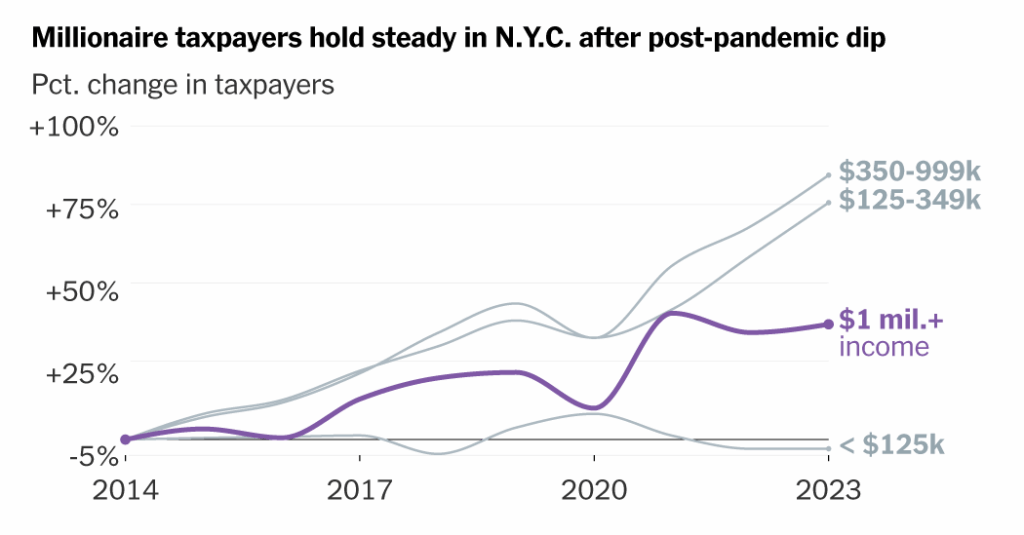
The number of millionaire tax filers in New York City has grown over the last decade, from about 25,000 in 2014 to 34,300 in 2023, the last year for which data was available.
There was a slight dip in 2022 after the disruption of the pandemic. But the figure is rebounding, even after a state tax increase.
What would the tax increase pay for?
Mr. Mamdani says his income tax proposal could raise $3 billion per year. He wants to spend it primarily on free child care.
The city is currently using $1.2 billion in state funding to pay for an expansion of free child care to some 2-year-olds. The city already offers free preschool for 3 and 4-year olds, and Mr. Mamdani wants to eventually provide free child care to every child under 5.
Mr. Mamdani will need billions more to keep adding child care seats, as well as to pay for other priorities like free buses and affordable housing. He also wants to increase the city’s corporate tax rates to raise another $1.5 billion to pay for his policy ideas.
What are some alternatives to taxing the rich?
Some experts have called for alternative strategies to secure a similar amount of money to plug the city’s budget deficit and to pay for child care: cutting city spending, boosting efficiency or raising revenue in other ways.
Andrew Rein, president of the Citizens Budget Commission, a nonpartisan think tank, said that the city had a spending problem, not a revenue problem.
“We keep adding programs, and a lot of these are great,” he said. “We never made an effort to cull spending to make government more efficient.”
The city’s roughly $127 billion budget has soared over the last two decades, fueled in part by strong economic growth and an influx of federal funding during the pandemic.
Mr. Rein suggested a list of cuts that could save billions: ending the mandate to lower class sizes at public schools; limiting housing vouchers; reducing funding to schools to match declining enrollment; modernizing city contracts through procurement reform; consolidating union benefit funds; working with unions to improve efficiency and hiring.
Mr. Mamdani has embraced some of those ideas. He also signed an executive order to create a “chief savings officer” at every agency to “streamline processes and eliminate waste.”
Urban planners have floated ideas that include a proposal to expand parking meters that could generate $1.2 billion per year.
And conservative voices, including Bruce Blakeman, the Republican candidate for governor, and the Manhattan Institute, a think tank, have called for lowering taxes instead of raising them.
The prospect of spending cuts has been met with fierce opposition by groups that work with the one in four New Yorkers who live in poverty.
Christine Quinn, president of WIN, the city’s largest provider of shelter for homeless families, said that freezing housing vouchers would hurt homeless children who are “not a budget line item.”
“Cutting back this program will cause more human suffering and trauma and add to homeless numbers in the future,” she said.
Emma G. Fitzsimmons is a public policy correspondent for The Times, covering New York City.
The post Do Higher Taxes Drive the Rich Away? Mamdani’s Plan Revives the Question. appeared first on New York Times.