Reid Kennedy, an Airbnb host in Minnesota, found a mission in a bottle of Pepsi.
Three years ago, the jazz drummer who rents a room in his St. Paul home discovered an abandoned soda in the fridge he shares with guests. Instead of drinking or tossing it, he decided to give it away.
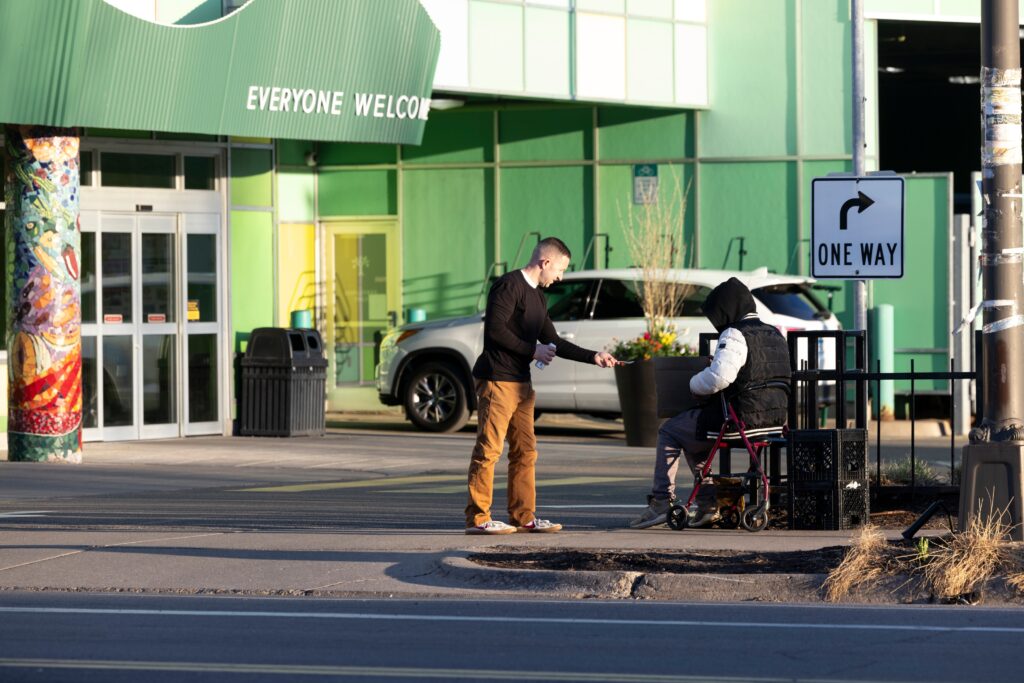
On a hot July day, Kennedy drove the frosty 16-ounce soda to an area where people facing housing challenges in the Twin Cities often congregate. He approached a man living in a tent. The beneficiary graciously accepted the gift before cheekily requesting that, next time, Kennedy should bring an entire Pepsi truck.
The experience was transformative for Kennedy and his Airbnb leftovers.
“Walking away from that Pepsi delivery, all of a sudden I was like, ‘I want to feel this feeling again,’” said Kennedy, 42, who also teaches at the University of Minnesota and St. Olaf College. “And then it dawned on me: I should be doing this anytime there’s something left behind.”
In the warmer months, when his Airbnb business picks up, Kennedy’s larder starts to fill up with other people’s groceries. Since the Pepsi challenge, he has made 16 deliveries, which he shares on Instagram. He records the entire odyssey, from his tidy home where he reveals the featured item, to the grocery store where he purchases extra ingredients to chef-up or replace some of the leftovers, to the final destination: the receiving arms of strangers.
“It always depends on what gets left over, but I’ll be out there handing it out, trying to put some good out in the world,” Kennedy said.
Last weekend, he returned to the kitchen, and the streets of the Twin Cities, for Season 4 of his Instagram series, “AirBnB Leftovers.”
Repacking leftovers into theme meals
In the company’s ground rules for hosts, Airbnb does not offer any suggestions on how to handle items intentionally or accidentally forgotten by guests. The owners or cleaners can decide whether the products end up in the trash or are paid forward to future guests, friends, family members or a charity.
A number of short-term rental forums and Facebook groups provide resources for hosts or guests who wish to donate to a food bank or through a community-share app such as Olio. Kennedy, however, wanted to take it to the next level, assembling customized care packages to hand-deliver to people experiencing food insecurity.
“I could turn this into something better than pouring [the leftovers] down the drain,” said Kennedy, who has been renting a private bedroom to visitors for about 10 years. “I could deliver things with a unique twist or some effort behind it, and go above and beyond to do something special for people.”
Kennedy’s process begins as soon as the traveler checks out. While cleaning the unit, he collects any forgotten items and starts envisioning how he can build a theme menu around a star leftover, often supplementing it with a grocery run. He has developed blueberries three ways (fresh blueberries, muffin, oat bar), prompted by two half-finished pints of berries, and a mango medley (yogurt, soft drink, smoothie, roll-up, freeze-dried, chips with salsa and a whole mango) out of slices of the tropical fruit. For six packages of string cheese, he assembled four charcuterie boards featuring the cheese, Larabars, a beef stick, crackers, guacamole and dried fruit on a wooden cutting board.
“It was fun to be creative in that way,” he said, “and figure out how could I dress up string cheese and deliver something that people didn’t expect.”
Provisions that are open, partially consumed or alcohol-based do not meet his food safety standards. He will use these as menu-planning ideas, swapping them out with safer alternatives.
“Sometimes the original item doesn’t quite translate to a handout,” said Kennedy, who will often poll his followers for meal-planning suggestions, “but it serves as the inspiration for what comes next.”
For instance, he distributed an assortment of healthy drinks, such as flavored sparkling water and kombucha, in lieu of three cans of black cherry hard seltzers. He reimagined a partial loaf of bread and jar of strawberry jam as 14 almond butter-and-berry-jam sandwiches. Based on feedback from his online community, he chose the almond spread as a safer alternative for people with peanut allergies.
Kennedy admits that cooking isn’t his forte. But he has been experimenting in the kitchen for the greater cause.
“I had never made Mexican street corn salad before,” he said, referring to a dish that incorporated three ears of a guest’s corn. “So this pushes me out of my culinary comfort zone, which is good.”
As an ode to Chinese fried rice leftovers, he rustled up a batch of rice, beans and vegetables and packaged the mixture in takeout containers sourced from a local restaurant. He inscribed each box with an uplifting message composed by his friends and social media followers.
“You are your superpower. Let your light shine always,” wrote Shawn Tanaka, an Airbnb regular from Colorado whose leftover peaches appear in Episode 3.
A jackpot of snacks
In late March, Kennedy received a windfall of snacks from a guest who was in town for an independent film shoot.
The visitor left behind a craft services haul. The stash included mini-bags of Doritos, Cheetos, pretzels, chocolate chip cookies and Lay’s potato chips; snack cups of Pringles; boxes of Kellogg’s pastry crisps and protein bars; Cajun snack mix; spiced apple cider packets; and, coming full circle, a 16-ounce bottle of Pepsi.
“This could last a good long time, or I could be delivering things for 48 hours straight,” Kennedy said.
For the first installment of “AirBnB Leftovers” this year, he selected the strawberry pastry crisps and assembled a strawberry-centric snack box of fresh strawberries, Siggi’s strawberry smoothie, strawberry yogurt and Annie’s strawberry fruit snacks. He packed the items in storage containers, a Christmas gift from his mother. As usual, he covered the $50 grocery bill with profits made from his Airbnb rental.
“I tend to not really think about that a whole lot,” he said of the additional expenses, including gas. “What takes over is the creativity and the fun aspect of putting together a specialty menu.”
Dispersing the reimagined leftovers
When choosing recipients, he said he looks for clues that the person might need nourishment. The most obvious is an individual holding a sign asking for help, but he will also seek out people who are standing on a freeway ramp soliciting handouts or are lugging around all their belongings.
“I would feel very bad about approaching someone who I thought looked a certain way but is just fine,” Kennedy said. “So what guides me to the right people are those visible signs.”
Once he finds a person who fits this criteria, he will politely introduce himself, but minimizes the amount of small talk out of respect for their privacy.
For Episode 4, Daniel Fritz-Staddon accompanied Kennedy on the distribution leg of the journey. Instead of leaving the donations in one place, the musicians drove around for hours, dispersing the mango samplers across several areas impacted by homelessness and food scarcity.
“We could have just given everything away in 40 seconds,” Fritz-Staddon, 39, said, “but Reid wanted to find individuals versus groups of people.”
For his most recent outing in April, Kennedy spent roughly three hours and covered about 10 miles distributing six parcels between downtown St. Paul and Minneapolis. Two of the recipients shared their first names, one thanked him with a “God bless,” and another asked him, “Where’d you get all this stuff?”
“I told him, ‘Hey, I made it for you,’” Kennedy said.
The post This Airbnb host turns leftovers into meals for people in need appeared first on Washington Post.