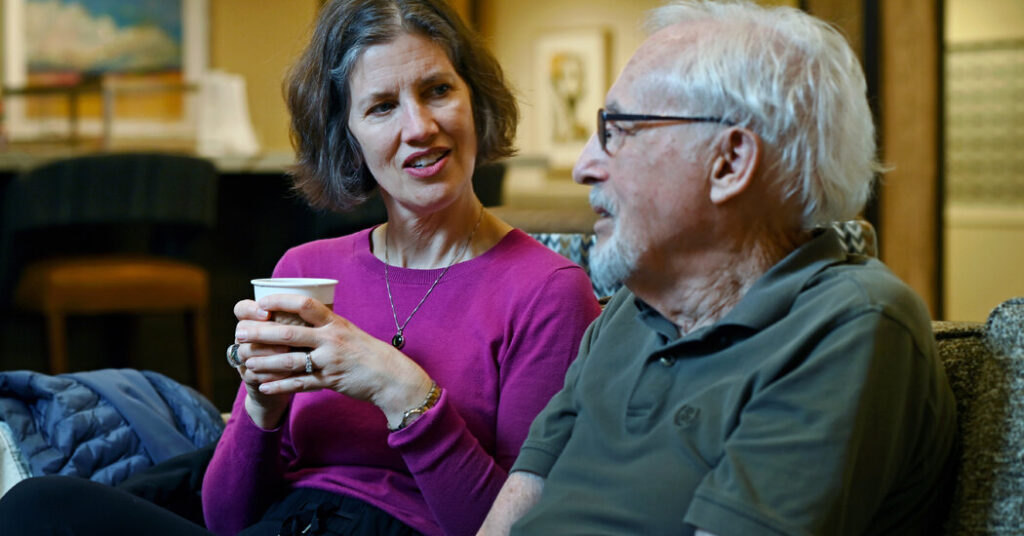
Shortly after Sarah Coomber moved her parents into a retirement community and started sorting through her childhood home, she discovered the mold.
Seeing those telltale spots was only the beginning of an enormous undertaking that involved hiring contractors to remove sections of walls and flooring and clean the entire house. When Ms. Coomber, who is 56, described the ordeal to a colleague, he reassured her that she was not alone.
“Now I see so many people are going through this, and they always have been,” she said.
Last year, about 11,400 Americans, on average, turned 65 on any given day. That wave of aging is continuing this year, too. Families, particularly those headed by members of Generation X, are confronting what older relatives may need and from whom — whether loved ones or professionals. It is the part of retirement no one wants to consider, yet for many it will touch every facet of life, like finances and health care, and the most fundamental questions of where and how to live.
Retirement in very advanced age is a possibility that longevity experts say could become a reality for more Americans than most people realize. Surya Kolluri, who leads the TIAA Institute, the research arm of the retirement plan provider, warns that many Americans underestimate how long they could live.
In a 2025 survey by the institute, only 33 percent of respondents answered correctly when asked how long a 65-year-old typically lived. The answer: For a woman, the average is 87 years and for a man, 84.
Despite recent reports of a decline in average life expectancy, the chance that someone who is 65 reaches 90 can’t be overlooked: It’s 40 percent for women and 30 percent for men, Mr. Kolluri said.
“We are racing toward 100-year lives,” he said.
When The New York Times asked readers about their own experiences, dozens of stories came flowing in: a relocation that revealed a painful illness, a son’s need to sell his house, spouses arriving at a tough realization. Here is what some of them shared.
You may have to help pay their bills.
When Paul Stanley’s mother was diagnosed with cancer, he and his sister initially took turns checking in. But with a demanding career as a software engineer and his mother’s increasing health care needs, Mr. Stanley knew she needed more care than they could give. At first, he and his sister relied on in-home aides, but it became expensive — about $10,000 a month — and insufficient after their mother had a hip replacement and needed round-the-clock care. So with their mother, now 83, they found an assisted-living community near her home in Florida.
“Putting a parent in an assisted-living facility is one of those things that you usually see in a movie and the person hates it and it’s terrible,” said Mr. Stanley, 41, of Berkeley, Calif. “But my mom knew that she needed the help, and she had struggled for long enough that she appreciated it.”
Understanding their mother’s limited resources, Mr. Stanley and his sister, who lives in Atlanta, each contribute $1,900 a month to help her cover her bills. Mr. Stanley and his partner even sold their home and became renters to free up money and time.
“We’re fortunate that we can generally afford my mom’s care,” he said. “But it competes with kids’ college funds, retirement and homeownership.”
Your mother’s dream could be your burden.
When Jenn Adrien’s parents uprooted themselves in their 60s from their Tacoma, Wash., community and moved to what they called their dream home 2,000 miles away in rural Illinois, “it was a big shock,” she said. Most of their family lived in the Tacoma area.
Her mother “didn’t consult any of us,” Ms. Adrien, 51, added. “She just did it.”
Although Ms. Adrien, who still lives in Tacoma, and her brother visited, they missed what she now suspects were some early signs that their parents were struggling. It wasn’t until their new neighbors called that she learned her parents needed help or were in a hospital. Her mother had several operations, and her father, who had kidney failure from diabetes, was in and out of the hospital.
“It had been my mom’s dream to live in a nice house and have lots of land,” Ms. Adrien said. But there were downsides — long drives to doctors, for one. “It was really neat to see my parents flourish in their retirement, but then the reality seeped in of what it’s like to care for a 4,000-square-foot home for two people and what it is like to live in a rural area.”
Your career may suffer.
At the start of the Covid-19 pandemic, Ms. Coomber and her husband hatched a plan to move from Washington State to Moorhead, Minn., to be closer to her family and, she hoped, get help with their son, who has special needs. She recalled asking herself, “Why are we so far apart?”
Ms. Coomber’s parents were getting older, and she had noticed her mother was forgetful sometimes when they talked on the phone. Soon after moving, however, Ms. Coomber became concerned when she saw her mother losing interest in what had been lifelong pleasures in gardening, cooking and seeing friends.
“For me, it was a little bit of a selfish move, that I was coming back to get help,” she said. “But once we got here, we really started to see my mom’s dementia was worse than I realized.”
In 2022, her parents agreed to some in-home care, but it was inconsistent, and Ms. Coomber urged them to consider moving to a retirement community. Not long after the move in March 2023, Ms. Coomber’s mother’s health declined. She advanced to hospice care and eventually died. A month later, her father had a stroke.
For Ms. Coomber, helping her parents so much cut into her work as a writer and took over entirely. On top of health concerns, she had to sort through what she calls their “very full home” of more than 30 years.
“I have felt many times my life is on hold, my career is on hold,” she said. She writes as a freelancer now, including a Substack column called Sandwich Season, which focuses on her experience assisting two generations. “And yet here I am writing about it,” she added. “Maybe I end up helping other people.”
You need a support network.
In 2020, Ram Rajagopal and his wife, Nidhi Gupta, faced a challenge: Mr. Rajagopal’s mother moved in with them and their two young children in Upper Saddle River, N.J. Mr. Rajagopal, a management consultant in the technology industry, and Mrs. Gupta, a physical therapist, felt the stress mounting. They all seemed to be waking one another up in the middle of the night.
“It’s difficult for your partner to love your parent the way you do,” Mr. Rajagopal said of those days together. “And they’re seeing your parent at their most weakened state — difficult, cantankerous and needy.”
But that experience caring for his mother, who died in 2022, is now helping Mrs. Gupta and her parents, who increasingly need assistance. They are still active, but Mrs. Gupta’s father had extensive surgery last summer and a tough recovery.
“I say to Ram now, some of the stuff that I didn’t quite understand when his mom was going through it, now I see,” she said. “He’s able to help me probably better than I was able to help him now that I’m having that experience.”
Mr. Rajagopal and his former classmates at the University of Pennsylvania’s Wharton School have a WhatsApp group, Elder Care Connect, where he offers support and advice. “I don’t know if it’s an uptick or that people need to connect, but people are going through the same stuff,” he said.
You should take a hard look at yourself.
It is impossible to predict how each person will age, but watching how your parents and grandparents did may lend valuable insight for your own future. Hal Hershfield, a professor of marketing and behavioral decision making at the Anderson School of Management at the University of California, Los Angeles, studies how envisioning your future self can help you plan. He describes older relatives’ experiences as either associative or dissociative, or behaviors and habits that you choose to emulate or avoid entirely.
“To some extent, your parents are the closest proxy for your future selves,” Dr. Hershfield said.
He said optimism bias leads us to be overly positive about our projections. For some people, he added, watching a parent falter could offer a realistic counterpoint to a rosy view of the future.
Dr. Atul Gawande, a surgeon at Brigham and Women’s Hospital in Boston and the author of “Being Mortal,” said discussing preferences with family members was a vital part of helping them sustain a fulfilling life, especially those with serious health problems. He recommends a series of questions, called the Conversation Project, to help guide family decisions. The questions include: What does a good day look like for you? What activities bring joy and meaning to your life? If your health gets worse, what are your most important goals?
“It’s almost embarrassing that it took me writing a whole book, interviewing 200 families and patients and scores of experts, to come to a pretty simple conclusion,” Dr. Gawande said. “People have priorities in their lives besides just living longer, and in order to understand what those priorities are, you need to ask them.”
For Ms. Coomber, seeing her parents struggle prompted conversations with her husband about what the two of them want. An overstuffed house isn’t on the list.
“We’re setting deadlines,” she said. “By the time we’re 65 or 70, we’re going to downsize the heck out of the situation.”
The post 5 Money Lessons From Readers in the Trenches of Elder-Parent Care appeared first on New York Times.