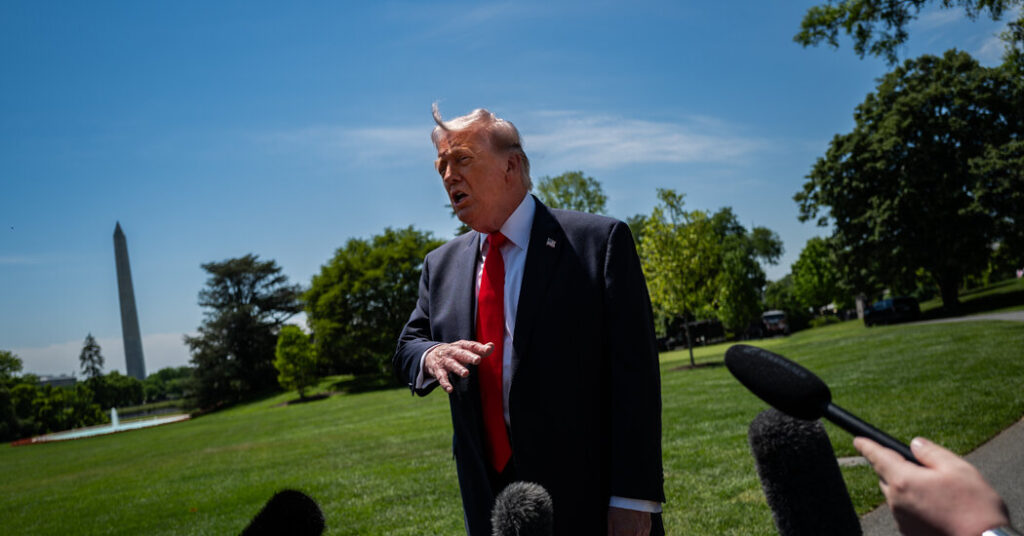
President Trump’s vision for his National Garden of American Heroes is growing larger and most likely more expensive than his initial estimates, with the latest plans calling for reflecting pools, dining facilities and an amphitheater alongside 250 life-size statues of notable Americans.
The plans have expanded to the point that they could require significant redevelopment of West Potomac Park, an area of mostly sports fields near the National Mall, according to documents obtained by The New York Times. The statues alone could cost more than the $40 million approved for the project by Congress, according to the Trump administration’s estimate.
Based on the latest renderings, the Garden of Heroes could rank among the more expensive and time-consuming projects Mr. Trump has undertaken as he works to remake the nation’s capital in his own style.
Construction has yet to begin, raising questions about whether Mr. Trump will run out of time — and money — to deliver on his ambitions before the end of his second term. If Mr. Trump were to solicit donor funds, as he has done with his ballroom project, it could renew ethical concerns about attempts to court favor with the White House.
The latest drawings depict a “Heroes Walk,” connecting themed areas dedicated to categories of American figures, including politicians, soldiers, scientists, activists, artists and athletes. The set of honorees is eclectic: George Washington, Ronald Reagan and Amelia Earhart are on a list circulated by the administration, along with Elvis Presley, Kobe Bryant, Alfred Hitchcock, Dr. Seuss and others.
Accompanying the statues would be formal gardens, reflecting pools and plazas arranged in a style reminiscent of classical European planning traditions, according to renderings reviewed by The Times. The Trump administration has yet to settle on a final plan or submit it to any oversight board.
One of the most prominent features in the plans would be a large amphitheater carved into the landscape at the water’s edge, suggesting the space is intended to function both as a performance venue and as a ceremonial gathering place.
The plans also include cafes and open recreational spaces.
“President Trump’s National Garden of American Heroes will be built to reflect the awesome splendor of our country’s timeless exceptionalism,” said Davis Ingle, a White House spokesman. “President Trump continues to beautify and honor our nation’s capital during America’s historic semiquincentennial celebration.”
Proposed in his first term, Mr. Trump initially hoped to have the project completed by July 4 of this year, the 250th anniversary of American independence. But administration officials are now hoping to have a few dozen statues ready to unveil in time, with the remainder of the project to be completed by the end of Mr. Trump’s term.
Sanitizing History
Mr. Trump first proposed a Garden of Heroes during his first term, at a time of widespread protesting over the murder of George Floyd in police custody. Protesters had toppled statues of Confederate generals and leaders, and in some instances vandalized monuments to national icons like George Washington and Abraham Lincoln.
Mr. Trump denounced those actions as attempts to “erase our values” and he signed an executive order authorizing the monument garden. The election of Joseph R. Biden Jr. as president interrupted those plans, but since Mr. Trump took office for a second time, he has taken the project up again in earnest.
Paul M. Farber, the director of Monument Lab, a nonprofit public art, history and design studio based in Philadelphia, noted that the description of the historical figures being honored portrays a sanitized version of American history.
Mr. Trump’s executive order detailed most of the figures to be featured with statues, and a White House task force overseeing festivities for the country’s 250th anniversary also published a list, with biographies of those selected.
The description of Martin Luther King Jr., for instance, praises the civil rights leader for having a “can-do” spirit, but makes no direct mention of the racism that he fought.
“To not name the injustice that made people ‘significant Americans’ is a sanitizing of the history,” Mr. Farber said. “Whether it’s Ida B. Wells-Barnett or Frederick Douglass, when you look at the fine print, you understand the Faustian bargain here, which is representation at the cost of real history.”
Under the “journalists” category, there are two honorees: Edward R. Murrow of CBS, and Alex Trebek, who hosted the game show “Jeopardy!”
The National Endowment for the Humanities has solicited “preliminary concepts” for individual statues from artists who must be American citizens. Mr. Trump has directed that subjects be depicted in a “realistic” manner, with no modernist or abstract designs allowed.
Artists who are selected will receive awards of up to $200,000 per statue, which must be made of marble, granite, bronze, copper or brass. (That price is a relative bargain. Outdoor public sculptures can cost roughly $1 million each to produce in cities like New York.)
Still — even if the statues cost $200,000 each, for a total of $50 million — there is not enough money appropriated by Congress to pay for them. And then there is the matter of the redevelopment of the land, the reflecting pools and all the rest in the latest plan.
Hurdles Ahead
Since the start of his second term, Mr. Trump has embarked on what he has characterized as an effort to beautify the nation’s capital. He has run into hurdles.
The president is in the midst of a legal battle over whether he can unilaterally build a $400 million ballroom at the White House with donor funds, after he abruptly demolished the historic East Wing. He is also in court fighting to close the John F. Kennedy Center for the Performing Arts, which he has renamed the Trump-Kennedy Center, for a major renovation. He has proposed building a 250-foot triumphal arch near Washington’s border with Arlington, Va. Next to his proposed garden is a golf course that Mr. Trump wants to make into a luxury destination.
His plans for the Garden of Heroes have yet to go before any review panel.
Should Mr. Trump leave office without finishing his signature projects, the next administration would be faced with choices about whether to finish them or abandon them.
It’s an issue other countries have faced as well, said Ken Lum, a sculptor, professor and Chair of Fine Arts at the University of Pennsylvania Stuart Weitzman School of Design.
“I don’t think it’s like the Sagrada Familia in Barcelona, where it was this great project of Gaudi and people said, ‘No, we must finish this,’” Mr. Lum said. “I think there’s going to be a lot of debate in terms of, ‘We don’t need to finish this. Maybe we should even take it down.’”
Mr. Trump has tapped several people closely associated with the National Civic Art Society, a nonprofit that endorses traditional styles of architecture, to oversee the Garden of Heroes, according to three people close to the project.
The garden would most likely need to overcome some legal hurdles, including the possible need for exemption under the Commemorative Works Act, which restricts what can be built around some federal lands in Washington. The site’s proximity to the Potomac also could introduce concerns about ecological disruption.
Mr. Trump appears to have left himself room to make five last-minute nominations; there are only 245 people in a list the administration distributed. The White House did not reply to questions about whom he would choose to fill extra slots.
In an interview with The New York Times in January, Mr. Trump described his plans for the Garden of Heroes as “beautiful.”
“That’s going to be most likely right on the Potomac River,” he said, adding: “It’s going to be a beautiful complex. You’re going to have the hall of — you know, it’s — we’ll call it a hall. We call it a lot of things, but the memorials or statues are going to — it’s going to be beautiful.”
Luke Broadwater covers the White House for The Times.
The post Trump’s Vision for ‘Garden of Heroes’ Keeps Getting Bigger and Higher in Cost appeared first on New York Times.