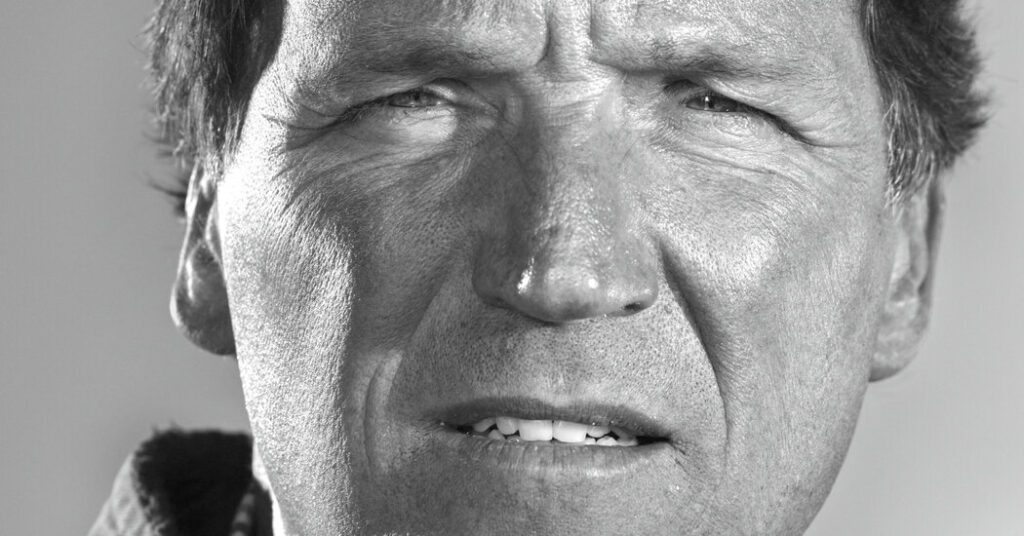
Tucker Carlson was once one of Donald Trump’s biggest fans. From his Fox News days to “The Tucker Carlson Show” that he hosts now to the campaign trail, he had been a loud and high-profile cheerleader. But all of that changed in February, when the president decided to attack Iran, something Carlson vehemently opposed. He now says he regrets supporting Trump and has become a vocal and influential critic of the administration on his podcast.
To understand this break with the president and what it portends for MAGA, I traveled to Maine to sit down with Carlson for The Interview. Here are some of the key moments from our conversation.
Carlson spoke about Trump’s ‘spellbinding’ power.
Carlson believes Trump “had no choice” but to join Israel in attacking Iran and said that Trump was a “slave” to and “hostage” of the Israeli prime minister, Benjamin Netanyahu.
Carlson thinks that no one in the Trump administration wanted to go to war but they were either cowards or gave in to Trump’s “spellbinding” power. “I think it probably literally is a spell,” he said. He elaborated: “You spend a day with Trump and you’re in this kind of dreamland. It’s like smoking hash or something.”
On his show, Carlson has referred to some of Trump’s comments about Iran on Easter Sunday as “evil.” Though he softened those statements by saying that “there’s a lot of evil” in everyone and denied speculating that Trump is the Antichrist on his own show (even though he did), he said that he wanted his “audience to see what’s happening now in terms beyond just material.” He continued, “I just want to make the point repeatedly again and again that there are unseen forces that act, that there is a spiritual realm, and we are subject to those forces for good and bad.”
He also offered a “theory” that he called “probably insane” that “a lot of people in Trump’s immediate orbit have been hurt — and really hurt,” including by getting cancer.
His rupture with Trump reached its peak on Easter, but he said he has had reservations for years.
On Easter Sunday, Trump posted a threat to Iran, saying that if it didn’t open the Strait of Hormuz, “you’ll be living in Hell — JUST WATCH! Praise be to Allah.” Carlson called it an “attack on Jesus.”
That’s a moral crime. So to brag about that, and then to mock Islam? I don’t think you should mock people’s faith. I don’t care if it’s Judaism or Christianity or Islam. It’s especially galling as a Christian.
While Carlson’s Easter rupture with Trump was his first significant public attack on the president after years of supporting him, I asked if he hadn’t privately had reservations about Trump for quite some time and referred to text messages that he had sent in 2021 stating, among other things, “I hate him passionately.” He answered, “of course,” but that he had “sublimated them or rationalized them away or focused on areas where I agreed with him.”
He regrets hosting Nick Fuentes on his show but said Mike Huckabee and Ted Cruz are far worse.
Carlson dismissed the uproar that came after he had Nick Fuentes, an influential white nationalist, on his show, saying, “He didn’t get us into war with Iran.” He reserved choice words for Senator Ted Cruz and Mike Huckabee, the American ambassador to Israel, who he said were both calling for “killing kids” (both men denied this) and were responsible, along with Trump, for “making this moment possible.” He also called Cruz “repulsive, disgusting.”
Like if you entered a men’s room and Ted Cruz was there, you would be like, I can hold it, I’m leaving.
Though he downplayed Fuentes’ influence on our politics and characterized his antisemitic and racist views as “naughty,” he told me he regretted having him on his show because it distracted from the bigger issues.
Carlson said JD Vance is in a ‘tough spot’ but the Iran war is politically ‘dooming anyone connected to it for the foreseeable future.’
Carlson was credited with getting Trump to pick Vance as his vice president, and he spoke protectively about his friend, who he said had been subject to “nonstop treachery” by “neoconservatives” inside the White House. He also said that the right-wing personalities Mark Levin and Laura Loomer “have been out for Vance from Day 1, big time.” Both Levin and Loomer denied that.
Carlson said Vance was in a “tough spot” because his long-stated foreign policy views were contrary to the administration’s actions in Iran. Carlson said of Vance that he “couldn’t be a bigger fan of him as a man, but I think anybody connected to this is going to have a hard time explaining it, because how is this good for the United States? It’s not.”
The post Takeaways From The Times’s Interview With Tucker Carlson appeared first on New York Times.