I just got back from a three-day swing across Maine, home of the hottest Senate race in the country — at least for this week.
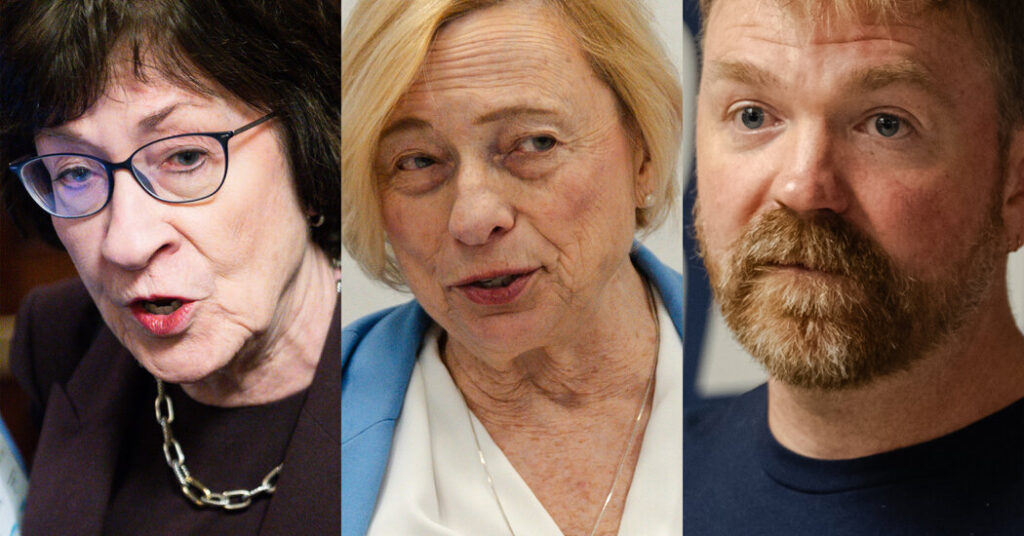
As you probably know by now, Gov. Janet Mills, 78, abruptly exited the Democratic Senate primary contest yesterday, effectively handing the nomination to Graham Platner, 41, a progressive political newcomer who is an oysterman and a military veteran. He is set to go up against Senator Susan Collins, 73, a Republican, in a general election that Democrats must win to retake the Senate.
My colleague (and travel buddy) Lisa Lerer and I had some political takeaways for you this morning about what the shake-up in the Senate primary tells us about the mood of Democratic voters, and what we know about the scorched-earth race to come.
Tonight, I wanted to share with you a few other things I learned, rooted in reporting and observations from the ground and interviews with both Platner and Mills.
The anti-establishment mood is palpable, and it’s propelling Platner.
There’s a lot of talk these days about whether Democrats are having their own anti-Washington, throw-the-bums-out Tea Party moment, about 16 years after the movement on the right radically reshaped the Republican Party.
I think it’s too soon to say whether that is a fair comparison, much less whether it is a winning strategy for Democrats. But in major competitive primary contests so far, Democratic voters have made clear that they are excited about younger candidates, and are receptive to political newcomers who vow to take on both President Trump and the Democratic establishment.
At an American Legion hall on Wednesday in rural-feeling Sabattus, Maine, several attendees said Platner’s outsider status was central to his appeal.
“People like me are looking for candidates that are out of the norm,” said Beth Borrus, 65, of Greene, Maine. “I’m done with where this country has gone.”
After Platner delivered remarks making exactly that point — “I’m running for the U.S. Senate because I think we need to do politics fundamentally differently,” he told a crowd heavy on older voters — he sat down with me and Lisa at the bar upstairs.
He told us about the oyster harvesting calendar and talked about building a political movement rooted in “a coalition of working power.”
“Yes, it’s about beating Susan Collins come November,” he said. “It’s also about building something that’s going to be there afterwards.”
That kind of movement politics worked for Mayor Zohran Mamdani in New York City, and to some degree for Senator Bernie Sanders of Vermont, to whom Platner has tied himself closely. It will be fascinating to see how it plays in a marquee Senate battleground.
Collins brings home the bacon, and voters seem to know it.
Collins, the senior senator from Maine, has a lot working against her this year.
She’s a Republican in a state where many voters despise Trump and can’t wait to vote against anyone in his party. She’s been in office for three decades and is in her seventies, as the calls for generational change grow louder.
But Collins, the chair of the Senate Appropriations Committee, is also known for securing millions of dollars for projects across the state. I don’t usually hear voters in other states bringing up their senators’ earmarks — so I was surprised to hear a number of voters volunteer their impressions about what she had done for Maine.
“Senator Collins has been huge for the seafood economy here in Maine — I mean, massive,” said Damian Brady, a professor at the University of Maine who studies aquaculture and said he leaned Democratic. “How do you weigh what she can bring in the next six years against what a new candidate would?”
Before Mills’s exit, her lack of momentum was clear.
I talked to Brady at a Portland brewery as Mills made the rounds on Monday evening, beer in hand.
Officially, the governor was there for a campaign meet-and-greet, but it didn’t feel much like a traditional political event. She did not deliver remarks, her supporters were mixed in with other attendees and she kept something of a low profile, chatting with brewery-goers and sampling their fries. But she did not appear to be making a hard sell for her candidacy, at least in the conversations I overheard.
It was a similar story earlier in the day, when she presided over a round-table discussion focused on housing policy. In theory, it was a campaign event, but it could have easily been a government-side policy summit.
That night, Lisa and I asked if she thought she had momentum in the race.
“Momentum?” she scoffed. “I believe I’ll have votes on June 9. That’s the important thing.”
We asked if she planned to drop out ahead of the primary on that day.
“I’m not dropping out,” she said. “Why would I drop out?”
Less than 72 hours later, she did just that.
quote of the day
“I’d take 52 seats from California.”
That was Representative Terri Sewell, a Democrat from Alabama and a member of the Congressional Black Caucus, suggesting bluntly that as the redistricting wars ratchet up, her party should try to redraw California’s House districts so that Democrats could win all 52 of them.
After the Supreme Court’s decision to upend a key provision of the Voting Rights Act, my colleague Nick Corasaniti writes, the expected flood of new congressional maps is likely to produce fewer competitive districts, fewer ways for voters to hold elected officials accountable and more polarized politics.
One Number
$3.5 million
That’s how much a California tech billionaire, Chris Larsen, is planning to spend to help Alex Bores, a congressional candidate in New York who is at the center of a proxy war over artificial-intelligence regulation. My colleagues Shane Goldmacher and Nicholas Fandos explain why the race, one of the most expensive House Democratic primary contests in the country, is so important.
ONE LAST THING
One thing is uniting America: Distrust of data centers
Americans of all political persuasions seem to be souring on A.I. data centers, my colleague Sabrina Tavernise reports. In states like Michigan, Maine and Virginia, resistance to the sprawling, energy-gobbling facilities is growing, with Republicans strategizing with Democrats on Signal chats and Facebook pages about pushing back.
As Charlie Berens, a comedian in Wisconsin, put it: “This is the most bipartisan issue since beer.”
Taylor Robinson contributed reporting.
Katie Glueck is a Times national political reporter.
The post What the Maine Senate Race Feels Like on the Ground appeared first on New York Times.