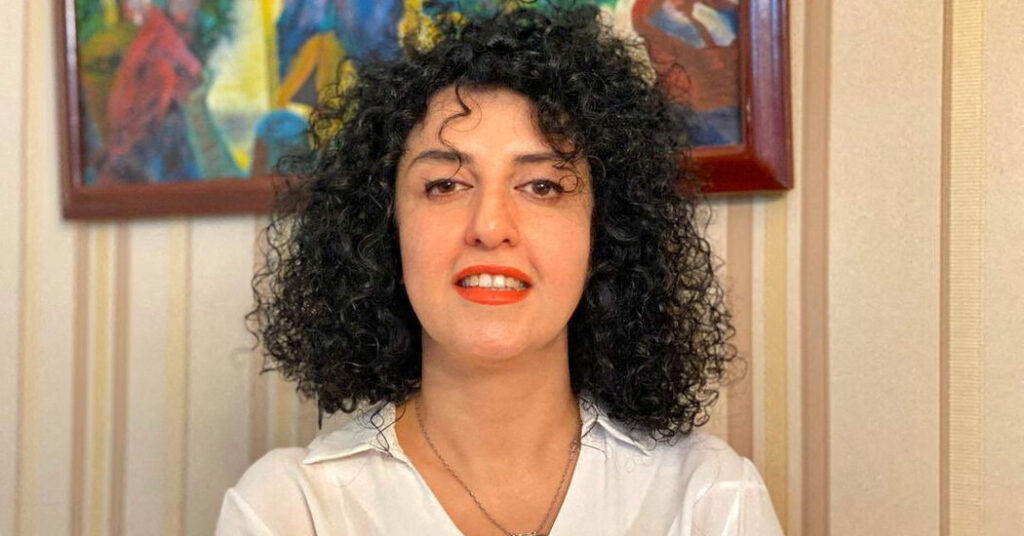
Narges Mohammadi, an Iranian Nobel Peace Prize laureate and prominent human rights activist, was transferred to a hospital in the city of Zanjan, where she was in prison, after collapsing and losing consciousness on Friday, according to a statement by her family.
Ms. Mohammadi is currently in the hospital’s intensive care unit. But the judicial authorities have refused requests from her family and her lawyer to transfer her to a better-equipped hospital in the country’s capital, Tehran, where she could be cared for by her longtime cardiologist, according to a statement by her foundation, the Narges Foundation, and her husband, Taghi Rahmani.
Mr. Rahmani said the family fears for her life and has pleaded for mercy from the Iranian authorities. Iran’s mission to the United Nations said it had no comment on Ms. Mohammadi’s health situation.
“We are extremely worried about her; she has collapsed and lost consciousness several times, and her life is in danger,” Mr. Rahmani said in an interview from Paris, where he lives in exile with the couple’s children. “Our request is basic and urgent: send her to a hospital in Tehran immediately.”
Ms. Mohammadi’s health has been deteriorating rapidly for the past few months, but on Friday, she experienced extreme pain in her chest and fainted, said her lawyer, Mostafa Nili, in a post on social media.
Ms. Mohammadi, 54, suffers from chronic heart problems and has also had a lung embolism and headaches from ill treatment in prison, including beatings by prison guards, Mr. Rahmani said. In the past, prison authorities have refused to transfer her to a hospital and treated her instead in the prison’s primitive clinic, he said.
In response to this latest health emergency, Mr. Nili, her lawyer, said that the authorities in Zanjan and Tehran have refused Ms. Mohammadi’s request to be transferred to the capital for medical treatment.
Ms. Mohammadi, known for her tireless pro-democracy activism, has spent much of her adult life in and out of prison in Iran’s authoritarian theocracy. She had been sentenced to 10 years on charges of threatening national security. But in February a court sentenced her to an additional seven and a half years because of her continued opposition to the government. She was arrested again in December, while on a yearlong furlough from prison because of her health, after she delivered a fiery speech critical of the government at the funeral of a fellow activist.
The judicial authorities jailed her in Zanjan, a city northwest of Tehran, where she has no family and where prison conditions are much worse than in Tehran. In late March, she had a heart attack and lost consciousness in prison and was refused proper medical care at a hospital.
In 2023, while she was imprisoned, the Nobel Committee awarded her the Peace Prize, noting “her fight against the oppression of women in Iran and her fight to promote human rights and freedom for all.”
In recent weeks, as the world has focused on the U.S.-Israeli war against Iran, the authorities in Iran have intensified crackdowns on dissent. Every few days, reports have emerged of arrests of student activists and journalists. Iran has executed 22 people in the past six weeks, some were protesters in anti-government demonstrations that swept the country in January, and dozens more are at risk of execution, according to the Center for Human Rights in Iran.
On Thursday, Sasan Azadvar Junaqani, a 21 year old from Isfahan, a central city in Iran, was executed, according to media reports and rights groups. He was arrested in January for participating in nationwide protests and accused of throwing a stone at security agents, according to Iran’s judiciary reports. Mr. Junaqani, a karate athlete who participated in tournaments, was charged with “moharebe,” or being “the enemy of God,” in a speedy sham trial, according to HRANA, an Iran-focused human rights group in Washington D.C., and media reports.
Omid Memarian, a senior fellow and an Iran expert at Dawn, a Washington D.C. think tank focused on U.S. foreign policy, said the treatment of Ms. Mohammadi and the recent executions were all part of a wider campaign of intimidation.
“The wartime security environment has significantly increased the risks of activism in Iran, giving the government a broader pretext to use violence and making the level of repression, outside peak protest moments, considerably harsher than before the war,” said Mr. Memarian.
Farnaz Fassihi is the United Nations bureau chief for The Times, leading coverage of the organization. She also covers Iran and has written about conflict in the Middle East for 15 years.
The post Jailed Iranian Nobel Peace Prize Winner Hospitalized in Critical Condition appeared first on New York Times.