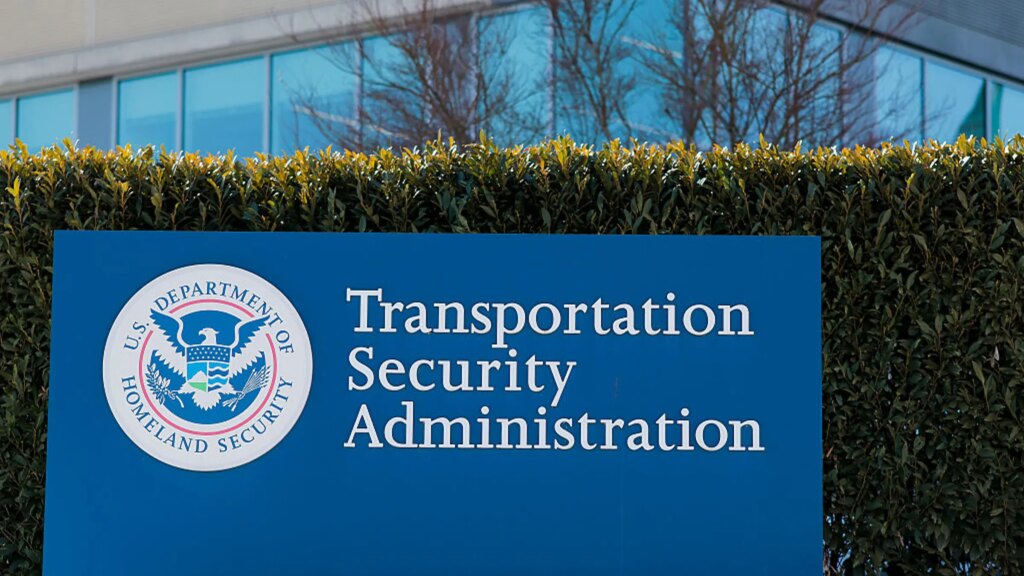
The partial government shutdown that left the Department of Homeland Security (DHS) unfunded for 75 days ended on Thursday. But the toll it has taken on the Transportation Security Administration (TSA) may still be felt for months to come, experts have warned.
The most visible impact of the shutdown occurred at airports, where staffing shortages among TSA employees caused lengthy delays for passengers. TSA agents are required to work during a lapse in appropriations even if they’re not receiving their paychecks because they’re considered to be essential workers. But many agency staffers called out of work to take on other paying jobs, leaving airports across the country understaffed and travelers waiting in security lines for hours. Last month, President Donald Trump ordered DHS and the Office of Management and Budget to use existing funds to pay TSA staffers, and in the days after officers began receiving their paychecks, security wait times appeared to ease at several airports.
But many TSA agents left their jobs entirely during the shutdown. On Thursday, a TSA spokesperson told TIME that more than 1,110 officers have quit since the shutdown began on Feb. 14. And the spokesperson stressed that replacing those staffers would take time, since new hires have to undergo “4-6 months of training to perform regular airport duties.”
DHS similarly emphasized that training timeline when reporting that more than 1,000 TSA agents had left their jobs in a post on X earlier this week, warning that “ahead of the FIFA World Cup and summer travel, this loss has SIGNIFICANTLY decreased TSA’s ability to meet passenger demand and left critical gaps in staffing.”
The number of agents who quit amid the lapse in appropriations alarmed aviation experts. Speaking to TIME on Wednesday, before the House passed a bill to fund much of DHS and Trump signed it into law, experts warned that the shutdown could have a lasting impact on air travel—even after it ended.
The rate at which TSA officers have quit their jobs in recent weeks is higher than the agency’s average. In 2024, the agency reported an officer attrition rate of about 8.6%. That averages out to roughly 11 officers quitting each day, according to Sheldon Jacobson, an aviation security and safety expert and professor of computer science at the University of Illinois Urbana-Champaign.
“It doesn’t mean that every day has that number—some days will have two, some days will have 12—but it averages out over any extended period to around 11 people per day,” he said. In comparison, 1,110 officers quitting since Feb. 14, as the TSA has reported, averages out to about 15 people per day.
Jacobson also pointed out that the attrition rate was not steady during the shutdown, but notably jumped in more recent days; on April 20, DHS reported that more than 830 TSA agents left their jobs, which means that 280 quit just in the less than two weeks that have passed since then.
“When you go from 830 people [on] April 20 to now 1,110, that rate is now over 30 per day,” Jacobson said. “Now we’re getting into significant reductions in permanent staff. That’s a problem.”
“When you look at it over a shorter horizon, the most recent horizon, you start to realize that people are now leaving the force significantly. And that will have long-term implications for TSA—not just today, but in three months, four months,” he continued.
Daniel Bubb, a commercial aviation historian and former airline pilot and professor in residence at the University of Nevada, Las Vegas, said that if airports are understaffed, travelers may once again see hours-long security lines. But, on top of that, he worried about the toll that understaffing could have on working agents—and airport security.
“It’s deeply concerning because now you have a smaller number of TSA agents who still have an enormous responsibility,” he said. “They may have to work longer hours, and so I somewhat compare this to air traffic controllers, where you have a shortage of controllers, and when that happens, you have controllers who have to work longer hours, and that’s where mistakes are made because now they start getting tired, they start missing things. And we could potentially see that with TSA agents.”
Bubb also expressed concerns that TSA might struggle to replace the officers who have quit the force because people may perceive the job as too unstable, given that officers worked without pay for weeks during this recent shutdown.
The full government previously shut down just months before the lapse in funding at DHS as well, causing staffers at TSA and other federal agencies to miss multiple paychecks last fall. TSA has reported that about 1,110 officers left their jobs at the agency during the fall shutdown.
The appropriations bill Trump signed on Thursday will fund most of DHS, including the TSA, through Sept. 30, by which point Congress will have to approve another funding measure to keep the department open. The standoff between Democrats and Republicans over immigration enforcement that sparked the recent partial shutdown, meanwhile, has still not been resolved; Immigration and Customs Enforcement and parts of Border Patrol will not receive funding under the bill passed this week. Republicans are now separately seeking to set aside an additional $70 billion for immigration enforcement.
Trump’s March order to pay TSA officers—and his subsequent order, issued days later, that directed DHS to restart compensation for employees across the department—with existing funds during the latter part of the shutdown did lead to staffers receiving paychecks again, even before Congress passed the measure reopening DHS. But last week, Homeland Security Secretary Markwayne Mullin warned that the department would run out of money to pay employees in that manner by the beginning of May.
“I think just passing a bill itself is not going to be enough,” Bubb told TIME ahead of the funding measure’s passage. “There is some convincing that has to be done here too to reassure people—not just the agents who are going back to work, but others who might be interested—saying, ‘Yeah, there is stability. We have a backstop in place. You’re going to get a consistent paycheck, and it’s a good job.’”
The post The DHS Shutdown Is Over, But Its Impact on the TSA—and Air Travel—May Persist appeared first on TIME.