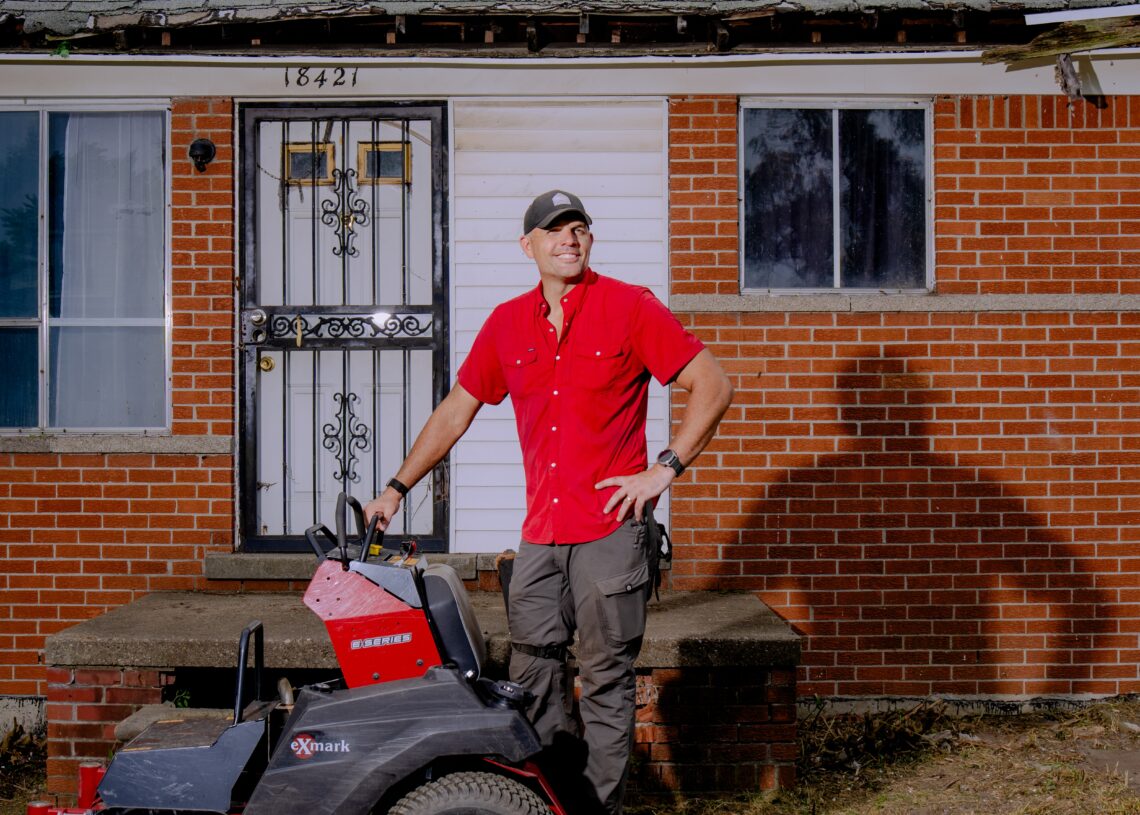
Three years ago, Sean Stockman mowed a lawn in Detroit and it changed his life.
Stockman, 44, was two decades into a stable corporate job with an automotive company. He noticed an out-of-control lawn in his neighborhood and decided to take it upon himself to mow it.
“I thought it’d be relaxing for me, like a stress reliever from work,” he says. He was also inspired by a friend with a popular YouTube channel showing videos of yard transformations. Stockman filmed the cleanup and put the video online. Today, he has more than a million subscribers on YouTube. Income from sponsorships and ads allowed him to leave his desk job, and he now creates lawn care content full-time.
“I think the genre started with these videos where you see something chaotic and you watch the process, and chaos becomes organized and there’s this satisfaction,” Stockman says. “That’s what people like so much.”
The videos typically begin with shots of a property so overgrown that it’s hard to see the house or driveway. In time-lapse, chest-high weeds and brambles give way to neatly cropped grass. Sidewalks and paths are unearthed with a shovel. Vines are pulled away from fences, and sometimes trees are even felled.
There’s quite a bit of demand for yard-makeover content like Stockman’s. The friend who inspired him, Al Bladez ― that’s his real last name ― also has more than a million YouTube subscribers. Martin and Daniel Hernandez, a father-son duo in Texas, have 600,000 plus. Tim Parker, an Australian creator known as “Tim the Lawnmower Man,” has about 3 million followers across social media platforms.
Then there’s Spencer Bosley, the 26-year-old Wichita landscaper behind SB Mowing. He is the indisputable leader of the pack with 55 million followers and more than 3 billion annual views on his channels.
But it’s not all about views and followers. It’s about doing something meaningful for people in the creators’ communities. Some find their properties by crowdsourcing ― they ask followers to submit yards for consideration. Others simply knock on the front door and ask whether it would be okay to start trimming. Most of the out-of-control yards belong to people in need, and the mowers don’t charge a dime.
“This has all morphed from just cutting tall grass for the shock-and-awe video ― though I still do crazy yards ― into a reminder that people are good and they want to help each other,” Stockman says. “I really want to focus on this idea of sustainability. I can come in and do all this work, and that’s no problem. I’ll reset your property. But how can we get you back on your feet?”
Kevin Hansen, a 35-year-old who started mowing lawns for free in Tulsa six years ago, feels similarly. “A lot of people are struggling just to make ends meet. Lawn service is costly, and a regular push mower now costs more than $500. Sometimes it’s older people who are on a fixed income, or who are physically not capable of taking care of it.”
Before he ever mowed a yard for free, Hansen had a lawn care business and a YouTube following on the channel Lawn Care Juggernaut, where he offered aspiring landscapers advice on starting a business.
Hansen’s first free mow was at a vacant property near his home that he simply wanted to take care of. After he finished, he told his wife he felt called to do the charitable work, though she cautioned that his audience might not like it. “The YouTube niche for lawn care creators at the time was, ‘How much can you make per hour?’” Hansen says. “At the time, I was pretty worried that I was going to lose subscribers putting it on YouTube saying I cut something for free.”
Instead, Hansen’s following grew, as did his philanthropy. The new wave of watchers didn’t care about the free mows. They just “wanted lawn care without commentary, tips and tricks,” he says. “I was like, that sounds boring to me, but whatever. So I started The Boring Channel as a joke.” Now the YouTube channel has more than 700,000 subscribers, and Hansen is still not charging clients.
For many on the receiving end, free lawn service means a massive burden lifted. And some creators are taking things further. In January, Bosley started a GoFundMe to cover repairs and accessibility upgrades at the home of an elderly woman whose yard he had done. It has raised close to a million dollars. This spring, it happened again: A fund to help a new widow with dental and medical care raised nearly $680,000.
Stockman’s viewers have donated money to replace one man’s stolen lawn mower so he could resume caring for his property himself. They’ve also raised enough to buy a client a car and to provide an elderly woman with a new wheelchair and install a ramp into her home.
“I just did a GoFundMe for a mother with three kids. Her roof had tarps on it, holes in it, it was terrible,” Stockman says. “I set the goal at $25,000 for a new roof, and within 24 hours it was at $58,000.” It was enough to cover the roof plus new siding, windows and air conditioning.
Hansen says he has done hundreds of lawns free of charge. In the colder months, he travels to Southern states to find properties in need. “I’m like a storm chaser, but I’m chasing tall grass,” he says.
It’s not always simple, however, to get a homeowner to agree to let Hansen mow. “In the beginning … a lot of people thought it was a scam,” he says. “Nine times out of 10 you’d knock on the door and people would turn it down. Now it’s about fifty-fifty, and more people say, ‘Oh, I’ve seen that on social media.’”
Many of the creators know one another: Stockman and Bladez are frequent collaborators, and Hansen and Bosley sometimes work together on challenging properties. Hansen has mentored a number of creators in the niche, and the videos’ impact resonates offscreen, too.
“I get so many emails that say, ‘Sean, I saw this overgrown property. I went and cut it for free, it felt so good, it really helped this family,’” Stockman says. “With all the bad news in the world and the doomscrolling, you can kind of forget that when you go out and serve somebody else, it actually fills you with life and energy and happiness, and it can be contagious.”
Hansen gets similar messages, too, from all around the world. “I started something in Tulsa, cutting lawns for free, and now on every livable continent in the world there’s somebody doing it on social media,” he says. “But for everybody that’s doing it on social media, there’s more that are getting inspired, and they’re going out and helping people in their neighborhood, without a camera.”
The most rewarding part of Stockman’s work isn’t the views, likes or subscriber count.
“The best thing is when somebody comes out and sees their property after I finish,” he says. “People can feel real shame about an overgrown property. Everyone in their neighborhood sees it, and they feel so embarrassed. But the pride that gets restored is the best part. These are the spaces we live in. We want them to be comfortable and clean, and this is a small thing that really can make a big difference.”
The post These landscapers are mowing the extra mile — and changing lives appeared first on Washington Post.