In Hollywood, everyone is fretting about how a company like Paramount will handle a debt load of $79 billion once it acquires Warner Bros. Discovery, while Netflix gets scrutinized for spending $20 billion on films and shows this year.
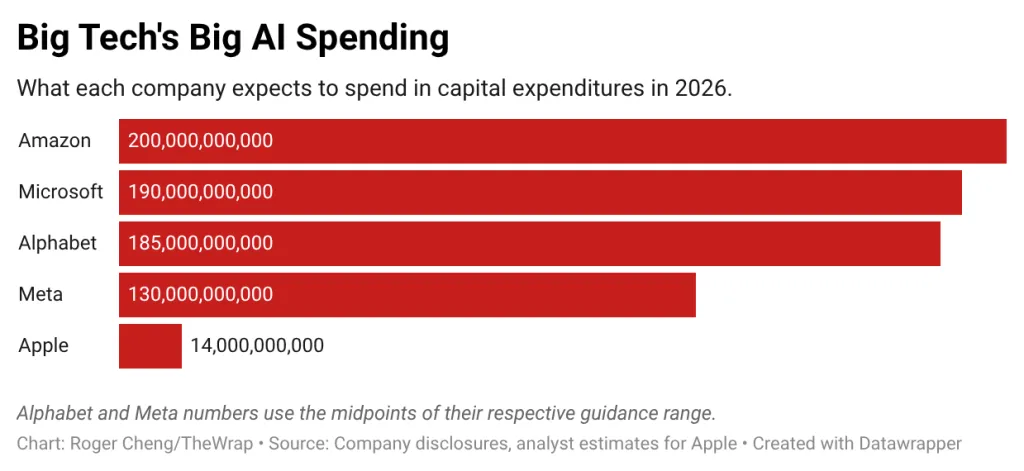
But in Silicon Valley, no one blinked when Google parent Alphabet on Wednesday upped its annual capital expenditure forecast range to between $180 billion and $190 billion. In fact, shares rose 10% the day after its earnings report. But hey, what’s another $5 billion?
Google isn’t an anomaly. That same day, Meta increased its 2026 capex range by $10 billion to as much as $135 billion, while Microsoft had already forecast spending $190 billion. Amazon is spending an eye-watering $200 billion.
The only exception is Apple, which is projected to only spend $14 billion, and the company continually gets knocked for its lack of direction and investment in AI.
The numbers, which are so dizzyingly high that it’s difficult to fully grasp their scale, underscore the stakes of the AI arms race at a time when the technology is poised to disrupt everything — including jobs in the media and tech world. The rising numbers also illustrate how staying in the race is getting only more expensive, especially as companies look to one-up each other and, more broadly, stay ahead of China.
“If you’re a hyperscaler like Google, Amazon or Microsoft, the insane price of AI infrastructure is a rational investment, because you’re selling that compute at a profit,” said Avi Greengart, an analyst at Techsponential. “There’s a risk of overinvestment, but given the potential — and health of their underlying businesses — it would be worse to underinvest if the bull case for AI is true, and then never be able to catch up to demand and lose to rivals who did.”
Those figures, many of which came out this week through various Big Tech earnings reports, are a bet that AI will play a central role in our lives and how businesses operate in the future, and that companies will pay big bucks over time to utilize AI capabilities that are just starting to bubble up. In Hollywood, that’s manifesting itself with AI generation tools that do everything from adding foreign language dubbing and subtitles to whole settings, as in the case with Doug Liman’s AI-enabled film “Bitcoin: Killing Satoshi,” while newspaper chain McClatchy is using a Claude-based tool to generate articles from its reporters’ work.
Despite the hand-wringing in the entertainment community, studios and media companies are diving headfirst into utilizing AI, but all of that processing power will require the kind of capacity these tech companies are investing in.
And it’s not going to be cheap.
Where is all this money going?
When you type a prompt into Gemini or ChatGPT, there’s a cost in terms of energy and money that’s estimated to be as much as 3 cents and .34 watt-hours of electricity. That doesn’t seem like much, but multiply that times the billions upon billions of prompts imputed each day — ChatGPT alone has around 200 million daily active users — and those needs start to add up.
That’s why companies like Meta, Alphabet, Amazon and Microsoft are pouring money into infrastructure like data servers or components like graphics processing units and memory chips to build out the capacity — as well as energy sources to power all of it.
They’re all betting that the use of AI will only grow exponentially, and want to be the ones able to provide those services.
“The trend over the last few years seems clear that we are seeing an increasing return on the amount that we can improve engagement for people and value for advertisers,” Meta CEO Mark Zuckerberg said on the company’s earnings call Wednesday. “This encourages us to continue investing heavily in what we expect will provide increasing value over the coming years as well.”
Beyond serving prospective customers, the extra capacity is critical to further developing the capabilities and smarts of its foundational AI models. Because Alphabet is publicly traded, we have more insight into the amount poured into Gemini. We have less clarity from companies like OpenAI (ChatGPT) and Anthropic (Claude), which are privately held startups, although it’s highly likely their investing heavily too.
“The capex overhang is massive with AI investment still growing,” said Maribel Lopez, an analyst at Lopez Research. “The 2026 numbers are astronomical.”
What’s the payoff?
Ultimately, these companies are less interested in individual services and more focused on developing a broader relationship with businesses and individuals. Meta developed that connection through Instagram and Facebook, while Google does it with YouTube and search. Apple, notably, has the strongest loyalty among its customers through its family of phones, tablets and computers.
Given everything AI has the potential to do, tech companies see the technology as the most effective way to cement that relationship.
“Right now, our apps primarily help people accomplish three important goals: connecting with people, learning about the world and entertainment,” Zuckerberg said Wednesday. “But we’ve always wanted our apps to understand more of people’s goals so we can help improve their lives in all the ways that they want.”
There are early signs of success, such as Google seeing demand for cloud services and paid subscriptions for its Gemini business, which is a big part of why its shares rose Thursday.
“AI solutions have become our primary growth driver for cloud, for the first time in (the first quarter) revenue from products built on our Gen AI models grew nearly 800% year over year,” Alphabet CEO Sundar Pichai said on his call.
That trend is expected to lead to a more sticky relationship between Google and its customers.
“I do believe enterprise buyers will be hooked on AI and that this will lead to sustainable cloud revenue and new chips will make the cost of AI lower, but I think it will take a while to get there,” Lopez said.
In contrast, Meta shares dropped nearly 9% on Thursday on its forecast for higher investment in part because it is focusing its AI on its ad business and has been less clear about when it will push out its highly touted “AI agents” for business and personal use.
The exception is Apple, which abandoned its own efforts to build a foundational model and is buying access to Google’s Gemini to augment its own AI experiences. But that doesn’t mean it’s not spending money on the technology.
“We believe AI is a really important investment area for Apple, and we’re going to be doing that incrementally on top of what we normally invest in our product roadmap,” Chief Financial Officer Kevan Parekh said on its earnings call.
Still, it’s an outlier in a world where every other well-funded company is pouring every cent into AI.
“Apple is betting that owning the customer is more important than the underlying AI model. We’ll have to see how that plays out,” Greengart said.
What’s the hidden cost?
All of this money flowing into infrastructure and components is particularly jarring because it comes at a time when layoffs in the media and tech industries are also soaring.
At the same time Amazon is spending $200 billion in capital investments, it’s also laying off 16,000 workers. And while Zuckerberg stressed the human-centric approach to AI, the company plans to cut 10% of its staff next month, with its chief people officer telling employees that it wasn’t ruling out deeper cuts.
For all the fear that Hollywood is feeling about AI replacing acting, writing and directing gigs, it’s already happening in a host of other fields.
All of that investment in components is also having a ripple effect on the public. Another big theme across all of the tech conference calls was the shortage of components like memory chips or nodes used in powerful processors. Apple CEO Tim Cook said that its Mac Mini and Mac Studio are hard to find now because they’re seen as optimal devices to create AI agents.
But the higher demand for those components means fewer supply for other devices, which is expected to lead to higher prices for anything needing those components, which includes phones, televisions, appliances and more.
Because things weren’t too expensive already.
The post $190 Billion Is a ‘Rational Investment’? Why AI Spending Is Skyrocketing | Analysis appeared first on TheWrap.