On a chilly afternoon in Cornwall, England, a mist settled over the Lost Gardens of Heligan, a once-abandoned Victorian estate that has been revived as a majestic botanical landscape.
A forest of rhododendrons was in full bloom. A field of lettuce was waiting to sprout. And inside a conference center fashioned from prefabricated structures, Bill McGlashan huddled with two dozen of the world’s pre-eminent soil scientists.
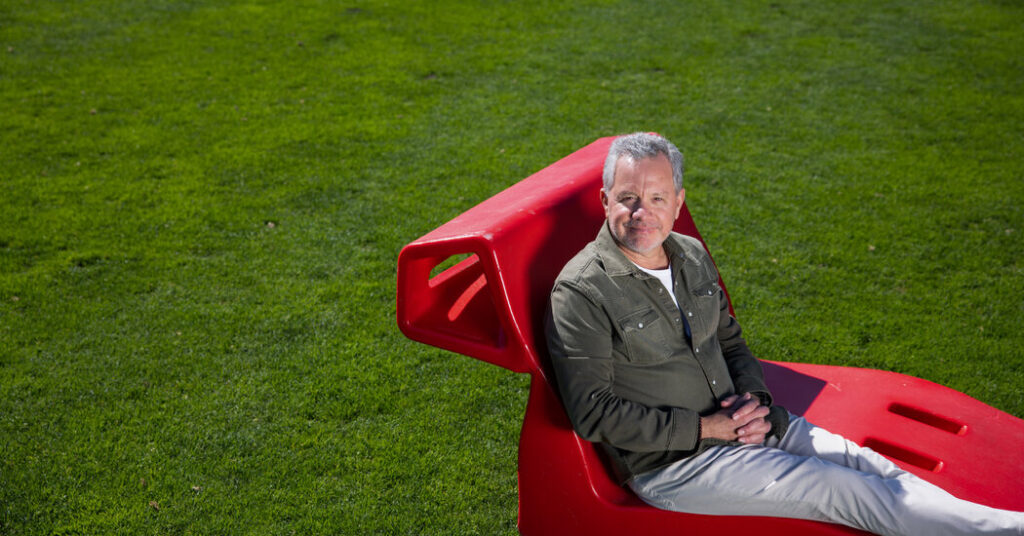
McGlashan, 62, was a long way from his home in Northern California, and the odd man out in this room. A private equity titan who made a fortune buying and selling companies, McGlashan has no background in biology. Instead, he was the money guy among a gaggle of Ph.D.s, having convened this group to support his new start-up.
The company, Oath, makes a fine white powder composed of dozens of species of microscopic organisms. When applied to crops including coffee and soybeans, the product improves yields and quality, reduces fertilizer and water usage, and may help the soil absorb more carbon dioxide, according to early research.
McGlashan says that if all goes as planned — by no means a sure thing — Oath could help feed the world, improve the lives of farmers and make a big difference in the fight against climate change.
But Oath is more than just a new business venture for McGlashan. It’s also an attempt to rewrite the first line in his obituary.
Five years ago, McGlashan pleaded guilty to wire fraud as part of Operation Varsity Blues, the F.B.I. sting that targeted wealthy parents who were paying to get their children into top universities. Suddenly, his name was associated not with the $2 billion fund he created to invest in socially responsible businesses, but with a scheme that confirmed the public’s worst suspicions about the duplicity of the elite.
He was fired from TPG, the Wall Street behemoth, and stripped of more than $100 million in compensation. He spent three months in prison during the pandemic.
With plenty of money left in the bank, McGlashan could have whiled away his days in luxury. But now, after years of meditation retreats and hikes through the woods, he was gambling on an improbable comeback selling microscopic organisms and talking about dirt.
The venture was also a test of whether his commercial partners, and the public, could look beyond his past transgressions. With the right kind of company creating the right kind of social good, could McGlashan transform himself from a villain, reviled for cheating the system, into a savior of sorts?
If so, he would be a savior with his eye on the bottom line. As the scientists ate scones with jam and hashed out a new set of protocols for measuring the health of soil, McGlashan roamed the crowd, eavesdropping and offering unsolicited advice.
He piped up when a group of professors started discussing a laborious series of field tests. “It has to be financeable,” he announced to the room. “It has to make business sense.”
It wasn’t enough for whatever they cooked up to be good science, or even good for the planet. It also had to be profitable. It had to be a win-win.
A few weeks before his time in England, McGlashan and I took a hike through the hills of Mill Valley, a tony enclave north of San Francisco where he has a home on a 20-acre compound. This was our first time meeting in person, and I wanted to understand his path to such high highs and such low lows.
As we began walking, I asked McGlashan where he was born.
He replied, “My dad went to Yale.”
His response was an early indication that even as he tried to put the Varsity Blues scandal behind him, he remained preoccupied with pedigree.
McGlashan was, in fact, born in Fullerton, Calif. Like his father, he went to Yale, and he then attended Stanford’s Graduate School of Business before beginning his career in private equity.
His father was an anti-nuclear-weapons activist, and McGlashan said he inherited a sense of moral responsibility. That was partly why, after a dozen years at TPG, he helped create the $2 billion Rise fund in 2016, aiming to address “various societal challenges globally while delivering strong financial returns.”
The billionaire founders of TPG liked the idea of doing well by doing good, and gave McGlashan room to run. He enlisted the U2 frontman Bono, raised a couple of billion, and soon was investing in clean energy and financial firms. The fund returned a healthy profit to investors, thanks in part to its stake in Everfi, an educational technology company.
McGlashan’s reputation for earning gobs of money, ethically, made him popular on the Davos circuit, as he made clear during our walk. A compulsive name dropper, he mentioned his ties to Fareed Zakaria, Cyrus Vance, Bill Draper, Matt Damon, Mitt Romney, Marc Benioff, Bono, the Edge, Sheryl Sandberg, Laurene Powell Jobs, Jeff Skoll, Richard Branson, Mo Ibrahim, Brian Moynihan and Edward Norton. All in one hour.
As he built Rise, McGlashan was also trying to help get his eldest son into college. His son hoped to go to the University of Southern California and attend a technology and business program named after the record producer Jimmy Iovine and Dr. Dre.
Looking to smooth the way, McGlashan paid $50,000 to William Rick Singer, an educational consultant who ran a side business helping rich parents buy spots for their children at top schools. That fee allowed his son to take the ACT at one of Singer’s centers, where the results were corrected by a proctor before they were submitted. The score submitted was 34 out of 36, placing McGlashan’s son in the top 1 to 2 percent of test takers nationally.
For McGlashan, paying to inflate his son’s test scores was just another transaction. He knew Singer was gaming the system, but it seemed like a small price to pay for a big win.
“I was living this incredibly harried life,” he said. “It was about a five-minute decision” to send his son there.
According to an affidavit prepared by the F.B.I., Singer then pressed McGlashan to donate $250,000 to U.S.C. to effectively guarantee his son’s admission. The “side door,” as Singer called it, involved creating the illusion that his son, who didn’t play football, was a talented kicker.
“Pretty funny,” McGlashan told Singer on a call secretly recorded by the F.B.I. “The way the world works these days is unbelievable.”
As we made our way through a grove of old growth redwood trees, McGlashan told me that once he understood the breadth of the scheme, he cut ties with Singer and never followed through with the “side door” plan. McGlashan’s son later took the ACT on his own and was admitted to the University of Wisconsin at Madison.
The day after our walk, McGlashan and I went to lunch at an upscale Mexican restaurant. Over guacamole, he made a confession.
“I wasn’t totally honest with you yesterday,” he began.
The story he had told me was not entirely true. In fact, he had actively pursued the “side door,” going so far as to stage photos of his son playing football. It was only when he realized his son would have known about the plan that he backed out.
The truth was all there in the F.B.I. affidavit. But given the opportunity to tell me his story, he had smoothed out the rougher edges.
McGlashan was still coming to terms with his journey, and was still, at least on some level, an unreliable narrator.
“The process of owning what happened is still ongoing,” he told me.
In the predawn hours of March 19, 2019, eight F.B.I. agents wearing bulletproof vests descended on McGlashan’s Mill Valley compound and banged on his front door. His wife arrived first and demanded to see their badges. When McGlashan showed up moments later, he told her to let them in. They placed him under arrest.
McGlashan initially believed it all had to do with TPG. Maybe someone there had done something. It was only when he arrived at the federal courthouse in San Francisco and spoke to another parent who had used Singer’s testing service that he understood what was happening.
“You know what this is, right?” the parent said.
“No,” McGlashan replied.
“It’s Rick,” the parent said. “The college thing.”
Operation Varsity Blues became a cultural flashpoint. In a country riven by income inequality, the scandal seemed like proof that the system was rigged against ordinary people, and that wealthy individuals like McGlashan played by a different set of rules.
As McGlashan departed TPG, the firm said in a statement that his behavior was “inexcusable and antithetical to the values of our entire organization.”
Other defendants fought the charges, and some cases stretched on for years. But in 2021, McGlashan decided to plead guilty.
“I’m guilty of having done this, and I’m OK paying this price,” he told me.
On June 1, 2021, McGlashan reported to federal prison in Tucson, Ariz. His wife and two of his three children accompanied him, hugging and crying as they watched him enter the barbed wire compound. He was given a Bible, but officials confiscated his reading glasses. “I was afraid,” he said. “I was deeply sad.”
For his first 23 days behind bars, McGlashan was kept in solitary confinement because of social distancing policies brought on by the pandemic. Inmates in nearby cells screamed through the night, and one bashed his head against his bunk until he was removed by guards, covered in blood.
“There was this sense of: Oh my God, what’s happening? What have I done to myself?” he said.
But as the weeks went on and he leaned on his years of meditation practice, he arrived at a spot of “complete equanimity.”
“I was just there, present,” he said. “I had zero fear from then on, and what emerged was more compassion.”
McGlashan was released after three months and returned to Mill Valley, where he walked the hills, trying to make sense of the moral collapse that had landed him in prison.
“I’ll never forget sitting here on the top of this mountain thinking, Am I ever going to be able to help in the things I care about again?” he told me during our hike. “Am I done?”
Then McGlashan heard about a tantalizing business opportunity.
The Oath offices occupy a light-filled flat in the Presidio, a former Army base in San Francisco that has been repurposed as a mixed-use development. Sculptures made of giant dried fungi adorn the walls, and a collection of scientists work in sleek cubicles.
When McGlashan first heard about the product that would become Oath in 2021, it was little more than a curiosity. Scientists in Australia had developed a mixture made up of hundreds of microscopic organisms that, when applied to crops, delivered measurable increases in yield and other benefits.
The compound had limited distribution, and even its creators didn’t fully understand how it worked. But McGlashan sensed potential.
He enlisted a team of researchers to study the microbes, and in 2023, he acquired the technology. Since then, he has raised $50 million, hired staff and set up offices in San Francisco, Washington, D.C., and Rwanda. The company has sequenced the genomes of hundreds of microbes, and is using artificial intelligence to figure out what effect each one has on various plants.
In trials of Oath, soybean yields improved as much as 83 percent. Corn yields climbed up to 116 percent and potato yields 160 percent. In North Carolina, trees treated with Oath grew shoots that were anywhere from 25 to 83 percent higher than those of untreated trees.
In Spain, trials on spinach and lettuce reduced water usage by 30 percent without decreasing yield. In California almond fields, Oath reduced water usage by 17 percent, while increasing the amount of moisture retained by the soil.
“It’s totally blow-you-away kind of data,” said Jo Handelsman, a researcher at the University of Wisconsin who advised President Barack Obama, and is not taking money from Oath.
As he got the company going, McGlashan cherry-picked investors and advisers from his expansive Rolodex. In addition to the Edge and Bono, backers include the actor Edward Norton and the musician Dave Matthews, alongside a constellation of finance firms and wealthy executives. Anne Finucane, an adviser to the Rise fund, and Christiana Figueres, the former United Nations climate leader, joined the board.
McGlashan also sought out scientific credibility. In 2024, he invited a dozen soil scientists to watch U2 play at the Sphere in Las Vegas, all expenses paid. The group dubbed themselves the Soil Stars and began offering Oath their expertise.
Now, after years of tests, Oath is ready to start selling to the public. Large-scale application of the product begins this summer in Rwanda. The team is working on a consumer-friendly version and is in talks with Walmart for distribution.
As part of the media plan, McGlashan invited The New York Times to write about him and his new company. But Oath faces several serious challenges even beyond McGlashan’s own narrative.
For starters, microbial fertilizer alternatives are not new. Many farmers apply single-strain microbes to their crops, and other start-ups, including Pivot Bio and Loam Bio, are developing similar products. Some have shown encouraging results, but none have delivered radical breakthroughs.
What’s more, soil science is notoriously difficult, often yielding uncertain data. At the company’s invitation, independent groups of academics and government scientists have participated in trials, but no peer-reviewed research has been published.
“Farmers have been promised a lot of ‘bugs in a jug’ that are going to transform agriculture and double their yields,” said Michael Grunwald, the author of “We Are Eating the Earth” and a critic of modern farming practices. “And it hasn’t happened yet.”
On the sidelines of the event in Cornwall, where the group had reconvened, I asked Jack Gilbert, deputy director of the Scripps Institution of Oceanography and the chief scientist at Oath, if the Las Vegas junket was a red flag.
“Of course it was,” he said. “I have a reputation. I can’t be seen to be associated with bullshit.”
Tom Crowther, an ecologist and another of the Soil Stars, as well as chief ecologist at Oath, chimed in. “Bill was the bigger red flag,” he said.
But both Gilbert and Crowther, along with more than a dozen other top academics, have chosen to look past McGlashan’s transgressions.
“Whatever he’s done in the past, fine,” Crowther said. “Right now he’s coming from a genuine place.”
That seems to be the prevailing view among those involved with the company. As the meeting of scientists wound down, McGlashan ushered a special guest into the conference room: the Edge, wearing his signature black beanie and sunglasses.
The Edge, who is listed as a co-founder of Oath, joined the group for a conversation about the importance of soil health and then for a family-style dinner of steak, grilled vegetables and red wine. With McGlashan out of earshot, I asked him if he was at all turned off by McGlashan’s brush with the law.
“No,” he said. “We were very sympathetic and he’s very upfront about it all. I’m sure a lot of people got caught up in that. It’s just unfortunate.”
The next day, the group departed Cornwall. Most of the scientists made the five-hour journey back to London by train. But McGlashan and the Edge skipped the queue.
They were headed to a private dinner being held in their honor at a mansion in Notting Hill. After saying their goodbyes, they were driven to a nearby airport, where they handed off their luggage and boarded a private jet.
David Gelles reports on climate change and leads The Times’s Climate Forward newsletter and events series.
The post After Prison, a Financial Titan Plots an Unlikely Comeback appeared first on New York Times.