Every one of the bicycles had a story — a brief one with a beginning and middle but no end.
A small white sticker on its frame gave its owner’s name, date of birth and date of admission to Los Angeles General Medical Center. It didn’t say what happened after that. All that is certain is that the owner arrived at the hospital on a bicycle and, for whatever reason, left without it.
“It’s a bit of a morbid story, but I like that kind of stuff,” said Olin Reyes as he spun a wheel on one of the bikes hoisted on a portable rack he had lugged to a musty suite of windowless rooms deep inside the basement of the former General Hospital.
The 94-year-old edifice, looming majestically over Boyle Heights, stopped taking patients nearly two decades ago. But the adjacent new county General, formerly Los Angeles County+USC Medical Center, had used its empty rooms to manage a side effect of its mission to serve all who appear at its door: patients often arrive on bicycles or wheelchairs, and leave without them. Whether they exit on foot, by ride-hail, in a family car or body bag, is unrecorded.
The hospital simply put identifying stickers on the bicycles and entombed them far from public view. That practice came to an end last year when work began to gut the old monolith in preparation for it conversion to housing as the centerpiece of a health-themed redevelopment of the 42-acre Eastside campus.
As the hospital was being readied for its new life, Reyes was piecing together a parallel story of rebirth, one bicycle at a time.
Night after night after closing his Boyle Heights bicycle shop, Reyes brought his equipment down the long, dark corridor leading to the bikes — initially about 280 of them — that were tossed in piles over the years.
There he conducted his own brand of triage. First he moved the hopeless cases — frames dented, forks bent, gears rusted — into one room and their cousins the wheelchairs into another, leaving about 90 that could be saved. Then the salvage work began, popping off wheels, dropping chains and pulling cables as necessary from the discarded ones to replace lost or broken parts on the keepers.
Some had been there so long that corrosion was destroying them. But the banged-up condition of others gave Reyes an insight into their former owners.
“A big percentage of them were belonging to unhoused,” he said. Seeing names on them struck him.
“I got a little emotional thinking maybe I worked on some of these bikes or we sold these bikes,” he said. “I wondered what happened to these people. I was inspired to fix them because it really goes with our ethos to get people on bicycles, give people second chances.”
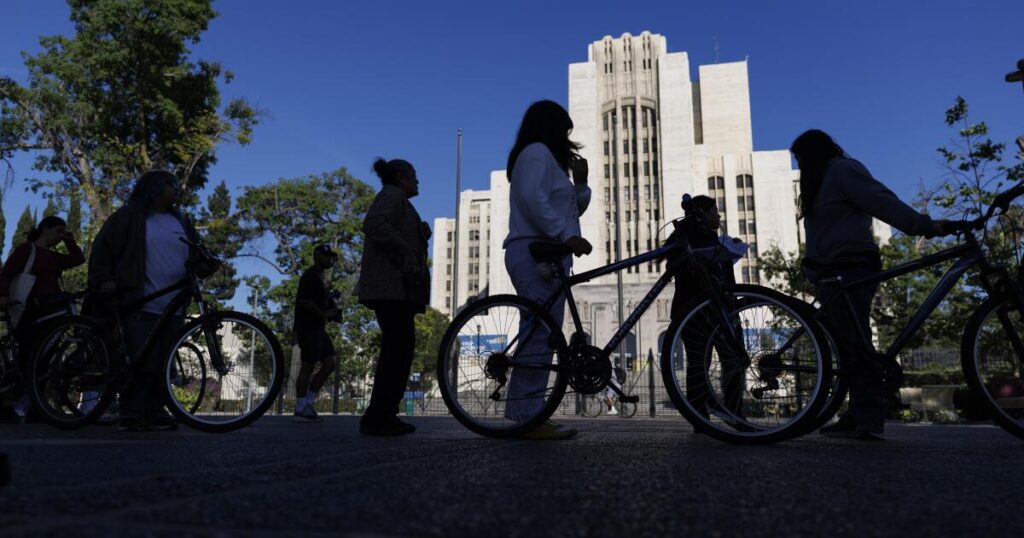
That work came to fruition last week — on Earth Day — as people from Boyle Heights and environs got their pick of 45 refurbished bikes that were hauled down the football-field-long basement hallway to be displayed in front of the grand entrance, adorned with Art Deco detail and sculptures of Hippocrates, Pasteur and seven other medical pioneers.
The bicycle giveaway had its origin last year as Centennial Partners, the development group that won the bid to remake the campus, began the first phase of that multiyear project— removing furniture, fixtures and medical paraphernalia that had been gathering dust for nearly two decades in the 19-story building.
The bicycles caught the eye of project director Giovanna Araujo as she was scoping out the basement for sites to bore holes for geotechnical testing.
“I just happened to go to that corner of the basement and open that door and see all the bikes,” Araujo said. “It came to me immediately. We must absolutely salvage these bikes. They need to be back in the world.”
Araujo was committed to keeping landfill waste from the giant cleanup to a minimum. She hired a refuse removal firm that specializes in recycling. It is warehousing usable items, from file cabinets to the operating table in the surgical theater, and will distribute them to nonprofits primarily in Mexico.
A room full of abandoned bicycles presented an opportunity closer to home.
“We thought, ‘Let’s partner with a local bike shop,’ ” said Eddie Pech, a USC real estate student who interned at Centennial Partners and has now been hired as assistant project manager.
Using Google Maps, he made a list of nearby shops and began cold calling.
Reyes was the only one who stepped up.
In December, he brought a team of about a dozen volunteers for the first round of repairs. Centennial Partners paid for parts, and Reyes and his helpers donated their time.
Over several nights, they produced 42 working bikes. Those were given away as Christmas gifts.
To finish the job, Reyes returned in April with a stripped-down crew and a better deal. He and a part-time employee, Lucio Rosas, billed for their time and materials.
In the sepulchral room, with lighting barely strong enough to cast shadows in the gloom, Reyes and Rosas set up their racks on opposite ends of the main room and worked in silence except for the occasional clattering of a dropped tool. Wearing a surgical mask to hold off the dank air, Reyes chose a bike and, before going to work on its components, performed the last rite for its former life. He peeled off the sticker that told its owner’s truncated story, rendering it now anonymous.
Reyes and his assistant have their own story of renewal.
Reyes said he always had a fascination with bikes but was surviving on odd jobs when the pandemic derailed his plan to open a music venue. Seeing that bicycle shops were doing well, he found a vacant storefront on Whittier Boulevard a block east of the Sixth Street Bridge and opened shop in July of 2020.
He has an unusual business model, finding bikes at yard sales and sometimes making bulk deals, refurbishing them and selling far below what they would cost new.
He also opened his doors to the community as “third place” for events like a cumbia night to raise funds for Palestinians.
Rosas was a neighborhood kid who dropped out of high school during the pandemic and started coming to the shop to work on his low rider bike.
“We saw ourselves in him,” Reyes said. “So we decided to help him out.”
He did an internship and earned a job.
“His people skills have improved a lot, and his critical thinking skills,” Reyes said.
Rosas now has a GED and is taking classes at the East Los Angeles Skills Center.
Returning nine nights to the dungeon-like workshop, Reyes and Rosas pieced together the 45 bikes for the final giveaway.
“We’re approaching this like we would at the shop,” he said one night while at work shortening a chain from a discarded bike to fit the one on his rack. “This one, when I grabbed it, I could tell it could be done under a certain amount, right from experience. It’s under $100.”
He prioritized that one above the one next to it that had a bent wheel and frame.
“This is at least a $180 job,” he said. “We put that aside and used the parts.”
The product of their work was a collection of bicycles of all brands, types and sizes: 21-speed road bikes, one-speed cruisers with wide handle bars and pedal brakes, mountain bikes with thick frames and front shocks and even a child-sized BMX.
That little one was taken early by 10-year-old Vivian Orozco, who arrived with her mother, Vanessa, and aunt Beatrice Gonzalez in a pickup truck. Vanessa picked out a street bike for her son too, who couldn’t come. Before they piled them both into a pickup truck, Beatrice gave a grinning Vivian her first riding lesson, fast-walking beside her on a wobbly course across the hospital courtyard.
Two volunteers with the cycling advocacy group People for Mobility Justice handed out helmets and lights to everyone who took a bike.
“Bicycles are vehicles,” volunteer Kalayaan Mendoza advised one new owner. “White light in front, red in back.”
Wielding a pocket Allen wrench, her colleague Estefany Rodriguez adjusted seat heights and brake handle alignments on Vivian’s new ride.
Eleventh-graders Desery Alsaro and Remidee Patino learned about the event on their school website. They said they didn’t have bikes but were attracted to the idea of sustainable transportation.
“We didn’t put much expectation into it,” Alsaro said. “We thought like, ‘Oh, they’re going to be used bikes but they’re going to be good bikes that work.’ ”
The bikes they left with were new to them, at least.
“I’m actually really satisfied with my bike,” Patino said.
For a young Lincoln Heights couple, the giveaway offered more than just two free bikes. Jose Diego had been unenthusiastic about wife Renee Dominguez’s suggestion that they take up cycling to break him out of his sedentary ways. But a free bike tipped the scale.
“Got to get rid of the panza,” Diego said, rubbing his only moderately round belly.
Araujo, who attended the event to witness the culmination of the program she called “my baby,” said renewal of the bicycles symbolizes her vision of “circularity” for the the hospital itself, known in the community as the Great Stone Mother.
“She’s going through a healing journey,” Araujo said. “She has had a chapter of 100 years. She was built with a very clear mission that no one would be denied care for lack of means. The need for her to fulfill that mission has changed. And so she needs to transform. And as she’s healing, I’m healing with her. I feel really connected.”
There’s no reason to think the bicycles will stop coming, but what happens to them will have to change.
A “standardized, time-limited approach to managing unclaimed belongings” is now being implemented, said County General spokeswoman Connie Castro.
“Disposition may include donation, recycling, or disposal, depending on the item’s condition and usability,” Castro said.
That suggests that, for the bicycles, no matter the fate of their last owners, there’s still the possibility of a second life.
The post At L.A. County General, salvaging the bicycles that patients left behind appeared first on Los Angeles Times.