The Race That Shows What the G.O.P. Is and ‘Everything It Could Become’
Oregon’s Democratic governor is likely to win re-election, but how voters pick from the ideological array of Republicans challenging her could offer a glimpse at the party post-Trump.
May 1, 2026
In electoral politics, Oregon is small and reliably Democratic, but this year’s Republican primary for governor offers something unusual. It will be a clear look at what the life of the party might look like after President Trump leaves the stage.
Republicans haven’t occupied the Oregon governor’s mansion in almost 40 years. But plenty of Oregonians are Republican, and the range of candidates in the May 19 primary makes it an early test of the broader question facing the party nationally: Does it want to stick with Mr. Trump’s confrontational, hard-right populism or embrace pragmatism and a gentler approach?
The ballot includes a social media influencer charged in the Jan. 6, 2021, attack on the Capitol; an old-school Chamber of Commerce moderate with an N.B.A. back story and a lineup of business supporters; and an array of social conservatives aiming to carry on Mr. Trump’s policies, but with a more conciliatory demeanor.
“Our voters are getting to see everything this party is, and everything it could become,” said Gabriel Buehler, a party organizer in Washington County, Ore., a bellwether mix of suburbs, microchip plants and farm towns.
Republicans make up less than a quarter of Oregon’s electorate, which has produced a familiar pattern; the closed primary empowers the most conservative voters, yielding nominees who then struggle when their audience grows in size and ideological diversity.
To break the repetition, some of the state’s most important business leaders, including the Nike founder Phil Knight, recruited and are funding former N.B.A. center Chris Dudley, a wealth manager in his post-playing life who lost the 2010 governor’s race by less than two percentage points.
Towering over his opponents on debate stages, Mr. Dudley speaks in measured tones and offers textbook Republican talking points — if the textbook were written by Mitt Romney. He wants to focus on “the issues that matter here in Oregon,” such as test scores and job creation.
On the other end of the spectrum, David Medina was charged in the Capitol attack and later pardoned. He has appeared on right-wing TV and podcasts criticizing Portland, Oregon’s largest city, as “godless,” and said at a March debate that Republicans should fight back against Democrats who call people like him “a bigot, a racist, a white supremacist, a Christian nationalist.” Oregon’s Republican Party leans older and less social media savvy, so Mr. Medina’s showing will indicate whether it has room for an incendiary, internet-age approach.
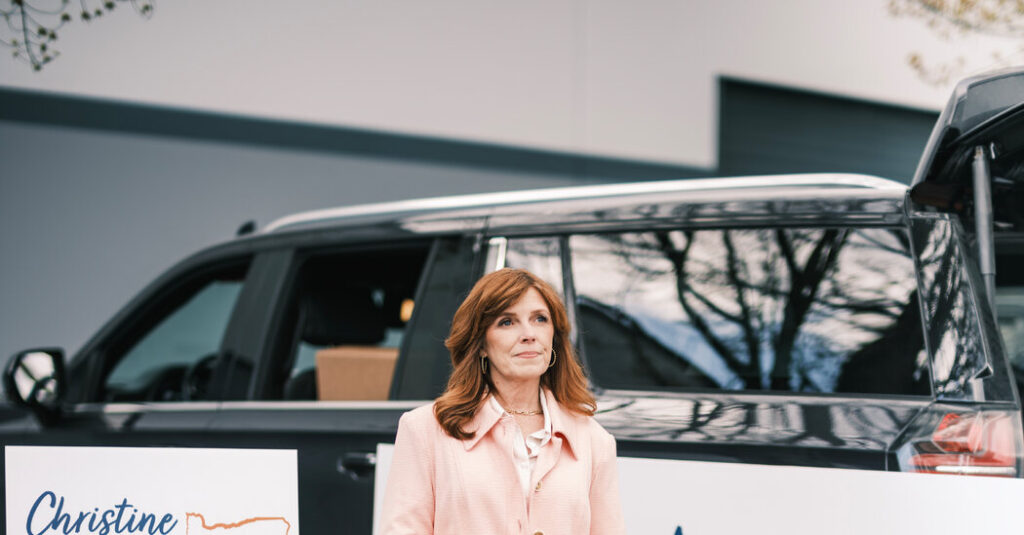
In the middle is Mr. Dudley’s real rival in money and name recognition, Christine Drazan, a state legislator who lost a race for governor four years ago. Ms. Drazan, who calls herself a faith-driven conservative, is aligned with the Trump wing of the Republican Party. She was the only candidate to bring up one of the touchstones of this political moment, transgender athletes in scholastic sports, at an April 16 debate.
Still, she’s pragmatic about what a Republican executive can accomplish on social issues in a liberal state. She’s transparent with voters about her support for restrictions on abortion, for example, but also her agenda if elected, she said.
“I want to lower the cost of living here,” she said in an interview. “That is the fight I am going to take on.”
Early primary polls have shown Ms. Drazan with a significant lead, though many voters are undecided. Another social conservative, the state legislator Ed Diehl, has been polling even with or slightly ahead of Mr. Dudley though his fund-raising can’t compare.
All that points up Mr. Dudley’s problem, as he and his backers try to maneuver the Republican Party away from Trump-era populism. Voters want what they want.
Mr. Dudley has been diving into social issues as he struggles to gain momentum, despite having the primary’s largest war chest, thanks to a $1 million donation from Mr. Knight.
After the state’s largest anti-abortion group jointly endorsed Ms. Drazan and Mr. Diehl, Mr. Dudley texted supporters to say, “Personally, I am pro-life,” contradicting an interview he gave the nonprofit Oregon Journalism Project in October in which he described himself as “pro-choice.” One of his first video ads focuses on barring transgender girls from school sports.
“As a Republican here, you’re so dependent on what happens nationally that it almost doesn’t matter where you stand,” said Knute Buehler, a former Republican state legislator who ran for governor in 2018.
That year, he was leading or close in polls until the confirmation hearings for Supreme Court Justice Brett Kavanaugh polarized the country around the sexual abuse accusations against him.
The Kavanaugh confirmation hearings galvanized some Republicans, but in Oregon, Mr. Buehler said, “we just watched my numbers drop every day.”
“You can raise all the money, build an excellent team and hit the right issues,” he continued. “But every election is nationalized now.”
Primary ballots in Oregon hit the mail this week.
Anna Griffin is the Pacific Northwest bureau chief for The Times, leading coverage of Washington, Idaho, Alaska, Montana and Oregon.
The post The Race That Shows What the G.O.P. Is and ‘Everything It Could Become’ appeared first on New York Times.