When the weather turns warm in Kentucky, longtime emergency department physician Ryan Stanton braces for the same springtime mystery: patients with fatigue, body aches and low-grade fevers who don’t yet realize a tick may be to blame.
This year, those cases are arriving earlier — part of a larger-than-usual spike in tick bite-related emergency visits across much of the United States, according to data reported to the Centers for Disease Control and Prevention. Weekly visits are the highest reported since 2017 in all regions except the area that includes Texas, New Mexico, Oklahoma, Louisiana and Arkansas, according to CDC’s tick bite data tracker.
Tick experts say several factors are driving the increase. An early spring has brought ticks out sooner than usual. And their survival and abundance vary from year to year.
“Any time the temperature is above freezing, it’s a good time for ticks to come out,” said Alison Hinckley, a CDC epidemiologist. Hinckley said that temperatures going above freezing earlier in the U.S. could be one reason for the increase in tick activity.
The tick population is also expanding into new geographic areas because of milder winters, earlier springs and warmer temperatures. Growing awareness of tick bites and the diseases they spread may also be changing how people seek care, experts say.
“So it’s complicated,” Hinckley said.
The national program that collects emergency department data saw cases begin to ramp up in March, reporting 28 bite-related incidents per 100,000 visits on March 15 and 114 per 100,000 visits by April 12, according to the most recent data. Tick season tends to peak in late May, according to the program’s data.
It’s too soon to know whether the trend will hold. But public health experts are using the data to raise awareness.
“March is when we really start to see the numbers pick up, and [tick activity] runs all the way through until about October,” said Stanton, who has worked as an emergency department doctor for 21 years. “Most of us have been inside for the winter and cooped up and ready to get out and about. There’s a lot more opportunity for exposure in the early spring: The ticks are out and about, the grass is growing quickly.”
Pets are also going outside and can bring in ticks, he said. “You don’t have to go outside to get a tick.”
Tick types and disease dangers
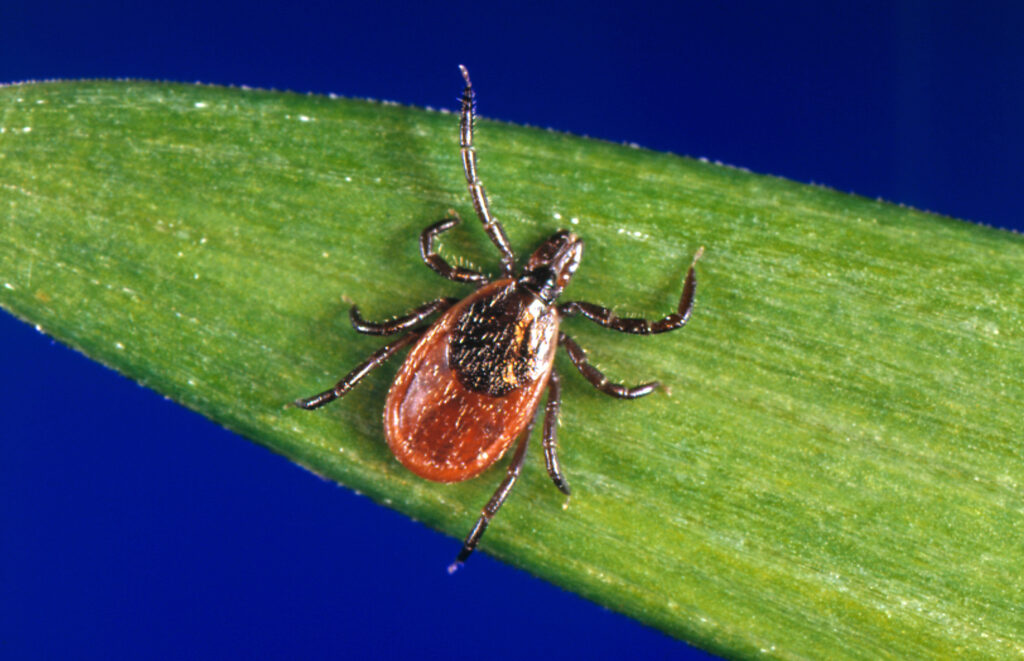
The black-legged tick, which transmits Lyme disease, is widely distributed across the eastern United States and is spreading to the Northeast, the region where hospitals have been hit harder by tick-related visits. The black-legged tick is also expanding into areas such as Michigan and Ohio, and in the Appalachian Mountains through Virginia and into North Carolina, Hinckley said.
Another common culprit is the lone star tick, which is most often associated with a life-threatening red meat allergy, and has been spreading northward. The adult female has a white dot or “lone star” on her back. The lone star tick is generally more dominant in the Southeast and in south central regions, Hinckley said. But over the last decade, experts have seen its population expand north up the Eastern Seaboard into the Mid-Atlantic states and New England, she said.
For residents of the Mid-Atlantic region, “there is more overlap” of both ticks, Hinckley said.
Every year, an estimated 31 million peoplein the United States are bitten by a tick. Some ticks are infected with germs that can cause serious diseases, including Lyme disease, Rocky Mountain spotted fever and alpha-gal syndrome, the red meat allergy. Lyme disease is the most common, with an estimated 476,000 people treated for it each year, according to the CDC.
If someone finds an attached tick on their body, they should remove it as soon as possible. It’s generally not necessary to go to the emergency department, experts say. Usually, a person can use a plain set of tweezers or even fingertips to remove the tick, Hinckley said. The longer the tick stays attached, the higher the chances of having a disease transmitted.
The biggest challenge for physicians like Stanton is that many people with tick-related illnesses don’t remember an exposure and or having a tick attached. Young ticks, or nymphs, are tiny — the size of the head of a pin, or a poppy seed.
“Unless you’re looking for them, you’re not going to see them,” he said.
When people arrive in the emergency department with symptoms that mimic a virus, such as body aches and low-grade fevers, it’s difficult to diagnose quickly unless there is the bull’s eye rash associated with Lyme disease or the rash linked to Rocky Mountain spotted fever.
Blood tests for tick-borne diseases can take a few days to return results.
If Stanton suspects a tick-related illness — a tick exposure or early symptoms — he starts antibiotics, typically doxycycline.
“It’s very much a disease process we treat preemptively and presumptively because the longer you wait, the harder it is to treat.”
Sometimes, ticks can be in hard-to-reach places. Last year, Stanton removed a tick embedded in a patient’s ear canal. The patient couldn’t see it but could hear it scratching. Stanton applied a generous amount of lidocaine, a topical anesthetic, and used a special instrument with tiny pincers at the tip to remove the tick.
The post More people are heading to the ER for tick bites this year. Here’s why. appeared first on Washington Post.