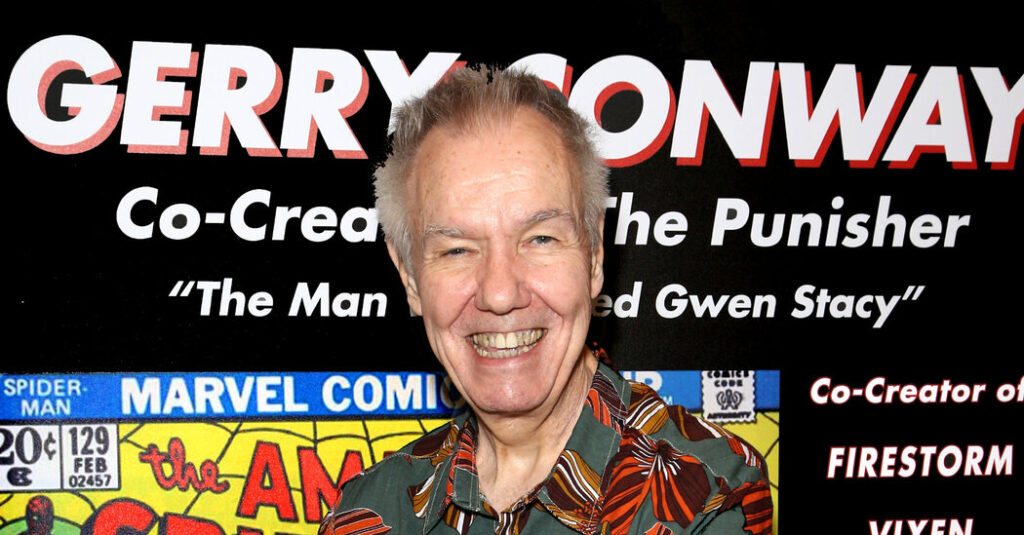
Gerry Conway, a comic book writer for DC and Marvel who infuriated fans in 1973 by killing off Spider-Man’s love interest and then thrilled them later the same year by helping to create the Punisher, a violent, ambivalent and enduring antihero, died on Sunday at his home in Thousand Oaks, Calif. He was 73.
His wife, Laura Conway, said the cause was pancreatic cancer.
The demise of Gwen Stacy — an early romantic interest of Peter Parker (Spider-Man’s alter ego) who plummets off a New York City bridge in Issue No. 121 of The Amazing Spider-Man — began with an idea from the comic book artist John Romita Sr.
To keep readers engaged, Mr. Romita suggested, the Spider-Man creative team should kill off a supporting character.
“There was a transition going on in the comic book field of trying to make things more real, emotionally and realistically,” Mr. Conway said in an interview for this obituary in October. “I wanted these stories to fuel Peter’s pain.”
Eliminating Peter’s Aunt May was also a possibility, but Mr. Conway pushed for Gwen to be the victim instead.
“I’ll be honest,” he said. “I thought she was boring as hell for me as a writer.”
Peter Parker would never fully recover from the loss. The reaction from fans was also intense.
“We had readers writing in letters,” Mr. Conway recalled. “I was the most hated man in comic books.”
Stan Lee, the public face of Marvel, felt the brunt of the backlash and told the team they should bring Gwen back, something Mr. Conway opposed. (Mr. Lee would eventually get what he wanted, in a way: In 2014, a superpowered Gwen Stacy from an alternate universe was introduced, and has proved extremely popular.)
Mr. Conway did not undo the tragic death at the time, but he did come up with a story involving a Gwen Stacy clone and a villain called the Jackal who employed a brutal henchman provisionally named the Assassin.
“My editor and I went to Stan, who was really good at naming characters,” Mr. Conway said.
They explained the Assassin’s back story: Criminals had murdered his wife, and he wanted to punish them.
Mr. Lee responded, “Well, there’s your name. He’s the Punisher.”
Mr. Conway presented a sketch of a black uniform with a skull to Mr. Romita, Marvel’s art director, who turned the image into an indelible costume with a large white skull emblazoned on the torso. (Ross Andru, who drew Issue No. 129 of The Amazing Spider-Man, in which the Punisher had his debut, is also credited as a creator of the character.)
Starting in the early 2000s, the skull image was embraced by military personnel, law enforcement and far-right political groups, seemingly as a symbol of a willingness to kill.
This use of the image rankled Mr. Conway. “I think it’s both a misappropriation and a misunderstanding,” he said in October. “He is an outlaw. He is not a good guy. Even when he’s the star of his own magazine, he’s an antihero. He’s never portrayed as someone you should emulate. And he especially is not someone cops should be emulating. He’s exactly the guy the cops should be against.”
Mr. Conway said he appreciated the darkness in Jon Bernthal’s portrayal of the character in the recent TV series “Daredevil” and “The Punisher,” especially on an episode in which the Punisher confronts law enforcement officers who idolize him.
“I’m happy that Bernthal’s performance cements the reality of that character,” Mr. Conway said. “He is a broken, damaged, unhappy guy. You don’t want to be him.”
Gerard Francis Conway was born on Sept. 10, 1952, in the Bay Ridge neighborhood of Brooklyn. He was the older of two children of Francis John Conway, a manager at an advertising printing plant, and Margaret (McAllister) Conway, a housewife who had been a telephone operator during World War II.
They expected Gerry to pursue what they considered dependable work. “They did not approve of my ambitions to be a writer,” Mr. Conway said. “I think they were somewhat appalled.”
It likely did not help that he dropped out of New York University during his freshman year to write a novel and pursue a career in comics.
As a teenager, he loved telling stories and reading comics, some of them written by Jim Shooter, who was around his age. “If he can do it, I can do it,” Mr. Conway recalled thinking.
He was 15 when he sold his first story to DC Comics, although it would not be published until eight years later, in the Tales of the Unexpected series.
Another of his stories had a quicker turnaround: It appeared in the House of Secrets series in 1969. By late 1970, when Mr. Conway was 18, he was writing more regularly for Marvel. (His parents should have been proud: He was earning around $1,200 a month, compared to the $1,000 his father was paid.)
Having a relationship with both DC and Marvel made Mr. Conway the ideal writer for “Superman vs. the Amazing Spider-Man” (1976), which was drawn by Mr. Andru and Dick Giordano and was the first team-up of the rival publishers’ flagship heroes.
In addition to his wife, Mr. Conway is survived by a daughter, Cara Conway Fratta, from his first marriage, to Carla Joseph, which ended in divorce; another daughter, Rachel Conway, from his second marriage, to Karen Britten, which also ended in divorce; a grandson; and a sister, Peggy Conway.
By the early 1990s, Mr. Conway was uncertain about his future. “I knew that I needed to get a pension and health care,” he said, “because nothing like that was going to happen in comics.” (Most creators, even the very successful, are freelancers.)
He reached out to Dean Hargrove, a television producer, writer and director he knew from a previous project. Mr. Hargrove asked him to rewrite a script, which led to other screenwriting opportunities.
Mr. Conway eventually worked on shows like “Father Dowling Mysteries,” “Law & Order” and “Law & Order: Criminal Intent,” and began producing as well.
In 2009, he returned to comics. His final credit came in 2023 for a story in the What If series for Marvel, written with Jody Houser, that reimagined Gwen Stacy’s final day.
In that version, Spider-Man dies — saving her.
George Gene Gustines has been writing about comic books for The Times for more than two decades.
The post Gerry Conway, a Creator of the Punisher in Spider-Man Comics, Dies at 73 appeared first on New York Times.