Disputes over budgets can make enemies out of friends, but they can also have the opposite effect.
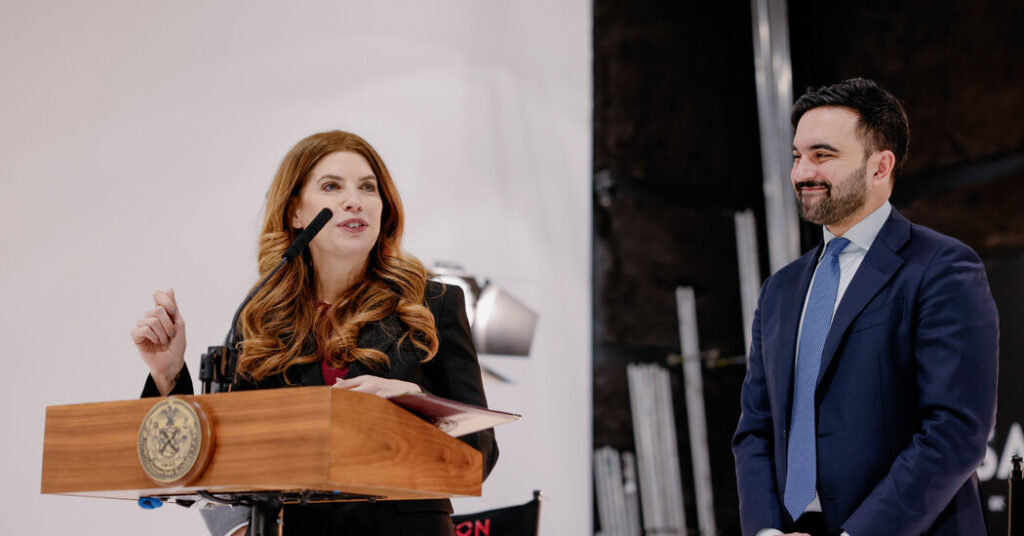
New York City’s mayor, Zohran Mamdani, and its City Council speaker, Julie Menin, put aside their growing list of differences to join together on Tuesday to announce that they would extend the deadline for the mayor to introduce an executive budget and call on Gov. Kathy Hochul to send more money to help the city’s fiscal woes.
At the heart of their pitch was a proposed change to a tax credit called the Pass Through Entity Tax used by some business owners. If implemented, they asserted that the measure could raise up to $1 billion a year in tax revenue.
Mr. Mamdani insisted it was crucial that the state step up. “A crisis of this scale cannot be handled without state action,” he told reporters.
But in a sign of the inertia weighing down both city and state budget negotiations, Ms. Hochul immediately threw cold water on the request, noting the billions of state dollars earmarked for child care, cash assistance and a new tax on second homes in New York City.
“I think it’s crystal clear,” she said. “We have helped them.”
The state budget is already nearly a month overdue, and the fiscal uncertainty has now begun to affect the rest of the state. At their news conference on Tuesday, the mayor and Ms. Menin said they would push back the executive budget release to May 12, in the hopes that they could convince the state to be more generous.
Here’s where things stand.
What do Mamdani and Menin want?
Any proposal to raise New Yorkers’ taxes — especially in a year where the governor is running for re-election — is going to be a hard sell, even with New York City facing a projected $5.4 billion deficit through the next fiscal year.
In seeming recognition of that, Mr. Mamdani and Ms. Menin chose to target the Pass Through Entity Tax, an optional tax that certain businesses can pay in order to get a credit on their state income tax returns.
The New York City leaders asked the governor to consider cutting the P.T.E.T. credit to 75 percent from 100 percent, suggesting that the change would generate as much as $1 billion each year by essentially targeting the wealthy.
“Any way you slice it, it’s basically a tax increase on these people,” said Andrew Rein, the president of the Citizens Budget Commission. Mr. Rein urged the mayor to first delineate how his administration planned to achieve a promised $1.7 billion in savings before clamoring for more tax hikes.
When asked about the proposal on Tuesday, Ms. Hochul did not mince words.
“It’s not happening,” she said.
What type of tax would Hochul prefer?
Despite her resistance to raising income taxes, Ms. Hochul has come to support a measure that would tax second homes, sometimes called pieds-à-terre, in New York City worth upward of $5 million.
The measure has received a warm welcome in the Legislature, even in the absence of details of how the tax might work.
The governor has claimed that the measure will raise at least $500 million a year for the city. But it remains unclear what tax rates would need to be imposed to raise that figure.
There are also serious questions around how the city would determine which properties ought to be taxed: Assessed values would perhaps be the most straightforward metric, but these values are notoriously low, leading many multimillion dollar homes to appear as if they are worth far less.
Real estate and business groups, including the Partnership for New York City, are opposed to the proposal and have requested a carve out for people who can prove they already contribute substantially to the city’s economy.
Kara Cumoletti, a spokeswoman for the Hochul administration, said the governor had discussed the plan with a wide range of “impacted stakeholders” and remained committed to the plan. “If the business community has additional ways they would like to generate revenue for the city, they are welcome to propose them,” she said.
Is New York City being slighted by the state?
At the heart of the city’s request is an unbalanced equation: New York City continuously sends more money to Albany than it receives in return, by the billions of dollars.
In recent years, New York City has contributed nearly $69 billion in state tax revenue, according to a report by the CUNY Institute for State and Local Governance, roughly 55 percent of all state tax receipts.
Of that haul, around 40 percent is returned to New York City from the state operating fund — roughly $47.6 billion, the study found.
Mr. Mamdani has blamed this imbalance on the city’s dire financial straits. “That gap is not sustainable, and if we fail to close it, crises like these will become a routine occurrence,” he urged on Tuesday.
Mr. Mamdani’s critics argue, however, that as the wealthiest municipality in the state, New York City has a responsibility to redistribute some of its revenue to poorer areas, much as Mr. Mamdani argues wealthy individuals should be taxed to benefit poorer individuals.
Where does the mayor’s property tax proposal stand?
Mr. Mamdani first raised the notion of a property tax hike as a threat: If Ms. Hochul was unwilling to raise taxes on the wealthy, the city would have no choice but to raise revenue through a tax it controls.
The mayor was instantly barraged by concerns from members of his own coalition — most notably by representatives of Black homeowners in Brooklyn — who protested the tax as regressive. Since then, Mr. Mamdani has mostly backtracked on the proposal, telling city and state lawmakers that he was unlikely to pursue such an increase in a series of closed-door meetings.
“We are continuing to work every day to ensure that it’s off the table,” Mr. Mamdani said in an interview with The New York Times.
What happens if no new taxes are implemented?
The most likely scenario is that the city will have to make cuts to its programs and services, as Mr. Mamdani’s predecessor, Eric Adams, repeatedly did and undid amid a torrent of criticism. It’s an outcome that Mr. Mamdani, who has sought to use his term as proof that the government can deliver meaningfully for people, would like to avoid.
Mr. Mamdani has already begun to explore slashing roughly $3 billion in expenditures, like consulting contracts with companies that his base despises, like McKinsey, and a rental-assistance program called City FHEPS that he once championed.
If Mr. Mamdani is able to meaningfully reduce city spending, it could help convince Ms. Hochul to float him a bit more cash in the short term. The mayor has also mulled drawing down the city’s reserves to close the gap, but that prospect has drawn criticism from financial ratings agencies and the city comptroller, Mark Levine.
Grace Ashford covers New York government and politics for The Times.
The post What We Know About New York’s Proposed Tax Increases appeared first on New York Times.