For today’s high school and college students, the all-night writing session, hunched over a laptop at home or in a library carrel, is on the way out.
In the era of artificial intelligence, take-home writing assignments have become so difficult to police for integrity that many educators have simply stopped assigning them.
Instead, in a rapid shift, teachers are requiring students to write inside the classroom, where they can be observed. Assignments have changed too, with some educators prompting students to reflect on their personal reactions to what they’ve learned and read — the type of writing that A.I. struggles to credibly produce.
This transformation is happening across the educational landscape, from suburban districts and urban charter schools to community colleges and the Ivy League.
The New York Times heard from nearly 400 college and high school educators who responded to a callout about how generative A.I. is changing writing instruction. Almost all described a deep rethinking of how to teach writing — and whether it still matters, since A.I. has become a better writer than most students (and adults), they said.
Teachers are responding to a widespread challenge. Over the past year, A.I. use has become ubiquitous among American students. Between May and December of 2025, the share of American middle school, high school and college students who reported regularly using A.I. for homework increased from 48 to 62 percent, according to polling from RAND — even as two-thirds of students said the technology harmed critical-thinking skills. A third of the students reported using A.I. to draft or revise writing.
Chatbots can easily produce polished essays in response to any prompt — analyzing Supreme Court cases, parsing symbolism in “The Great Gatsby,” explaining the science behind the Artemis mission. A.I.-powered browser extensions allow students to instantly generate and revise text as they complete online assignments. The tools are able to find and replace language in student writing that could trigger A.I.-detection software, and can also rephrase published writing into new text that students can turn in as their own.
Educators consider many of these uses akin to plagiarism. But some are also worried about students falling behind the curve of a technology that is reshaping the economy and day-to-day life.
“The standard curriculum was a thesis-driven research essay that students completed on their own time outside of class,” said Marc Watkins, who directs the A.I. Institute for Teachers at the University of Mississippi. “That is, unfortunately, gone.”
The Revival of Paper and Pencil
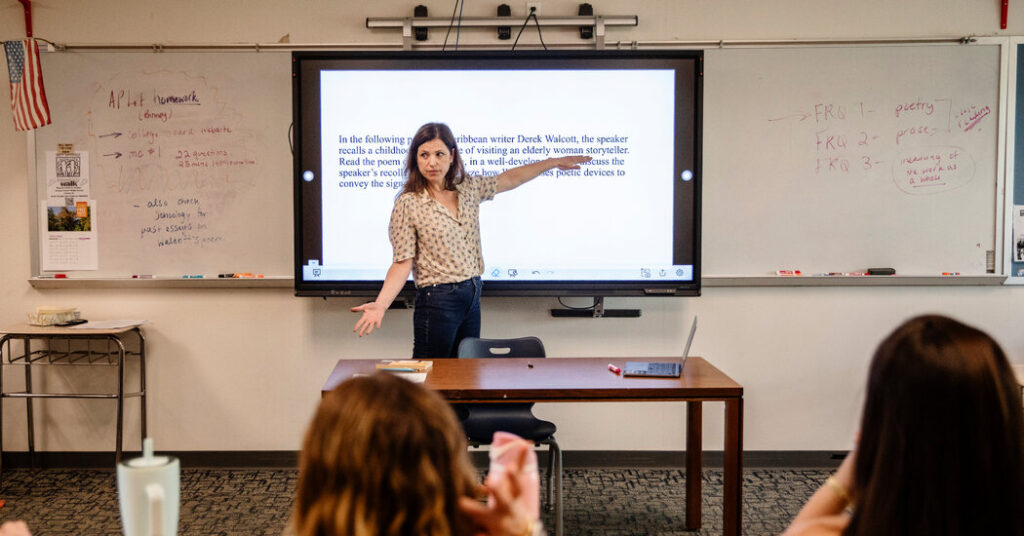
Over the past year, Jessica Binney, 49, overhauled her English classroom at John Jay High School in the Katonah-Lewisboro school district, north of New York City. She gave up on assigning three-to-five-page papers, once a staple of the homework in her Advanced Placement courses. Now, her students write in-class essays, either by hand or on a laptop with a locked-down browser.
Ms. Binney regrets the loss of depth that longer assignments could produce. But she and many other educators who have moved writing into the classroom described relief at being able to abandon the highly imperfect science of A.I. detection. Student reliance on chatbots had gotten “worse and worse” as the technology gained sophistication, Ms. Binney said.
One April afternoon in her A.P. literature class, Ms. Binney read aloud “XIV,” a poem by the St. Lucian Nobel laureate Derek Walcott. It describes the poet and his brother as children, trekking into the Caribbean forest to listen at the feet of a traditional storyteller.
Walcott’s language is lush and challenging. Students marked up paper handouts of the text, underlining and scrawling in the margins. Then they took out notebooks and began to draft essays analyzing literary devices.
“I want you to write out a really rough, terrible draft in your writers’ notebooks,” Ms. Binney told them. “And then I want you to scratch it out and rewrite it.”
There was nary a laptop or tablet in sight. For these juniors and seniors, who have been taught on screens for much of their schooling, Ms. Binney’s class can be a welcome break.
“It’s a relief,” said Cassady Tondorf, 17. “There’s less distraction.”
Her classmate Naomi Siegel, also 17, agreed. “I’m able to connect with people more easily throughout the class, because we’re not as much on our computers.”
If there is a downside, it is that today’s teenagers have little experience writing with pens and pencils. Their handwriting can be atrocious. Still, many educators said they were willing to deal with that inconvenience in order to ensure they were grading authentic student work.
At Kingsborough Community College in Brooklyn, Matthew Gartner said that because of A.I. overuse, he now has his freshman composition students write on paper in the classroom for 30 minutes, then share their drafts immediately in small groups.
“It creates connection and a desire to communicate well,” he said.
Jane-Marie Law, a religious studies professor at Cornell, said she recently realized that despite asking her students to sign an honor code promising not to use A.I. for writing, they were still doing so.
“Gone were any errors,” she said. “Also gone was a sense of freshness and daring. ChatGPT made everything so safe.”
This fall, she plans to move toward mandatory, in-class writing by hand.
At the University of Virginia, Devin Donovan, who teaches writing and rhetoric, requires students to write on paper in class, and revise drafts using scissors and tape to cut up and reorder paragraphs.
At the end of the semester, a final piece is polished and submitted via computer — a common approach.
“I’ve moved past the idea of catching people or punishing this,” Professor Donovan said of A.I. His new method fosters “a real person-to-person experience, which is sort of unfakeable.”
Resisting Temptation
Most teachers and students are navigating A.I. without clear guidance from school administrators or policymakers. Leaders have denounced cheating, but have also praised the technology’s promise, often without offering many specifics on how students should and should not be using A.I.
Young people are using it. Recent studies of ChatGPT and of Anthropic’s Claude chatbot show that help with schoolwork is among the most popular uses of generative A.I. When it comes to writing, two-thirds of ChatGPT queries ask for edits or translation. A third ask the chatbot to generate text from scratch.
(The Times is suing OpenAI, the maker of ChatGPT, claiming that it violated copyright when developing its models. The company has denied those claims.)
Megan Hart, an English teacher at South Forsyth High School outside of Atlanta, said that last year, she noticed take-home essays returned sounding eerily similar and formulaic.
At the same time, her district has encouraged teachers to get comfortable with generative A.I., she said. Several of Dr. Hart’s former students have told her they use A.I. frequently in their adult jobs, helping to convince her that teenagers need to develop A.I. skills.
Now, she requires students to complete most writing in the classroom, but she also teaches them how to use A.I. to find reliable sources for research papers. And she has worked with students to use A.I. to solicit feedback on drafts.
“The kids have to build that critical thinking,” she said, including fact-checking the information A.I. provides. “This is an assistant that is here to help me. But it can also really make me look like an idiot.”
Breton Sheridan, who teaches English at a Philadelphia charter high school, has prioritized in-classroom reading and writing, oral presentations and debates.
The problem with A.I., Mr. Sheridan said, was that while adults who have mastered basic skills may use A.I. on the job, teenagers have not yet grasped those basics.
“They are using generative A.I. to write before they learn how to write. They are reading ChatGPT summaries of a book before they have ever read a book,” he said. “The result is a diminished population.”
But he noted that schools serving low-income students, like his, are often under the most pressure to show that they are they are embracing innovative technology and preparing students for the working world, where it may soon be standard to rely on generative A.I.
The shift toward in-classroom writing is part of a broader conversation about how educators can counteract the negative impact of screen time on attention and learning. Laptops, tablets and gamified learning apps entered most classrooms over the past decade, but there is little evidence they increased student achievement.
Rather, test scores declined over the same period, especially in reading.
Still, the tech industry continues to aggressively market its products to schools. Some A.I start-ups are appealing directly to students through funny, tongue-in-cheek social media videos featuring attractive young influencers. The videos coach students on how to use generative A.I. to breeze through writing-related coursework.
Educators said that while A.I. may be helpful for research and revision, they still want students to face down the blank page and craft original text.
Daniel Herman, who teaches humanities at Maybeck High School, a private school in Berkeley, Calif., said he continues to see student writing as essential, “to help them become better readers, thinkers and explorers of the world and their mind.”
Teenagers said they were eager for adults to guide them on how to use A.I. ethically and productively.
“It’s really concerning how dependent we are,” said Ms. Siegel, the John Jay senior.
She hopes to become a defense attorney and recently decided to reel back her use of A.I. for editing because she found it introduced a stilted voice into her writing.
“But,” she added, “we’re getting into a world full of technology, and we have to learn how to allow it to benefit us.”
Dana Goldstein covers education and families for The Times.
The post How A.I. Killed Student Writing (and Revived It) appeared first on New York Times.