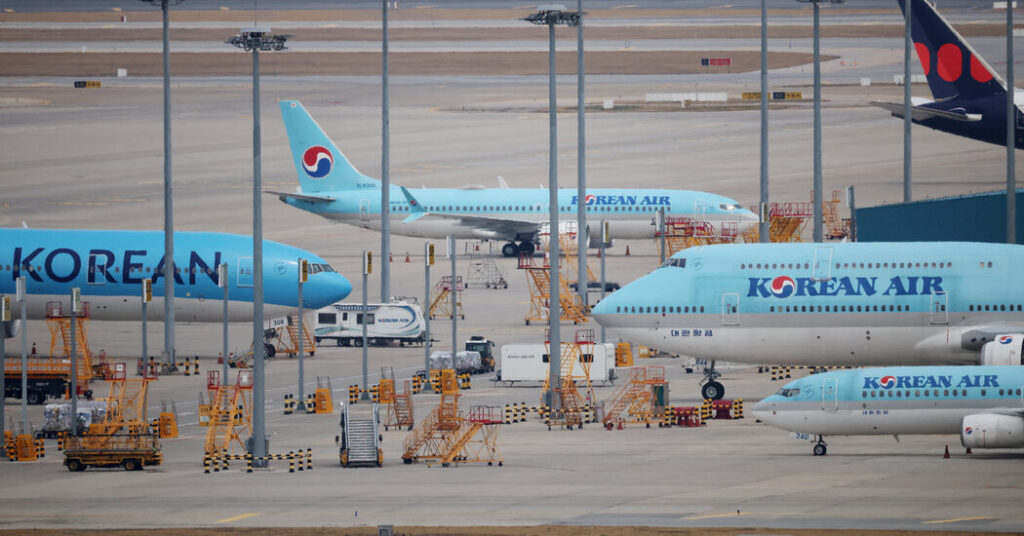
Korean Air confirmed on Thursday that it would suspend carrying roosters on flights from the United States to the Philippines, after an animal welfare group said the birds were being exported for use in cockfights in violation of federal law.
The airline, South Korea’s largest carrier, had been used by rooster farms in Oklahoma and Texas to transport birds to Asia, according to a report by Animal Wellness Action, an animal rights group based in Washington. Korean Air operates passenger and cargo flights from Dallas Fort Worth International Airport to Manila via Seoul’s Incheon International Airport.
“Korean Air has suspended the transportation of roosters of all ages on routes from the United States to the Philippines,” Diane Yang, a spokeswoman for Korean Air, said in a statement. “Korean Air is firmly committed to the lawful and safe transport of live animals.”
Cockfighting, the practice of attaching metal spurs to the legs of chickens and confining them to fight each other to the death, is illegal in the United States. Transporting an animal across state or national borders for the purposes of fighting is also illegal under the Animal Welfare Act.
Cockfighting is legal in the Philippines and in some states in Mexico. Those two countries are the largest export destinations for American-bred roosters, said Wayne Pacelle, the president of Animal Wellness Action. There is a long tradition of game-fowl breeding in the United States, and the success of American-bred birds in tournaments fuels demand abroad.
Legal gambling in cockfighting arenas in the Philippines raises tens of millions of dollars for operators. Before online bets were outlawed in 2022, the country’s gambling regulator collected some $82 million in revenue from online wagers on cockfights in a single year.In its report published in October, Animal Wellness Action accused a group called North Texas Livestock Shipping Services of transporting trafficked roosters primarily via Korean Air to the Philippines.
The structure and legal status of the group could not be independently verified. A person reached by phone who said he was a member described it as an informal group and not a registered company, and said the birds were transported for breeding, not fighting.
“Closing their biggest transport route would hobble this illegal trade,” Mr. Pacelle said in a phone interview.
Korean Air’s cargo division offers transport services for several types of live animals and livestock, including birds, horses, cattle and pigs.
Kevin Chambers, an investigator for Animal Wellness Action, said he followed a shipment of roosters from Texas to the Philippines, where they were entered into the World Slasher Cup, an international cockfighting event in Manila, in February.
“They normally declare them simply as chickens,” Mr. Chambers said in an email.
Each rooster can be sold for around $2,000, according to Animal Wellness Action’s report. Mr. Pacelle said that at least 40,000 roosters are trafficked from the United States to the Philippines each year, generating tens of millions of dollars for American breeders.
“No documents require their declaration as fighting roosters,” Mr. Chambers said. “No one is going to pay $2,000 for a normal chicken.”
Francesca Regalado is a Times reporter covering breaking news.
The post Korean Air Bans Roosters on U.S. Flights to the Philippines appeared first on New York Times.