Oil prices hit a fresh wartime high on Thursday, surging to a four-year high above $120 a barrel, before pulling back in volatile trading on concerns that the war in Iran could escalate, leading to a longer disruption of fuel supplies from the Middle East.
President Trump maintained his stance that the naval blockade of Iran’s ports would persist until Tehran gives up its nuclear program. His remarks to Axios on Wednesday suggested that the standoff over the Strait of Hormuz, the vital trading route for oil and natural gas supplies, was not nearing a resolution.
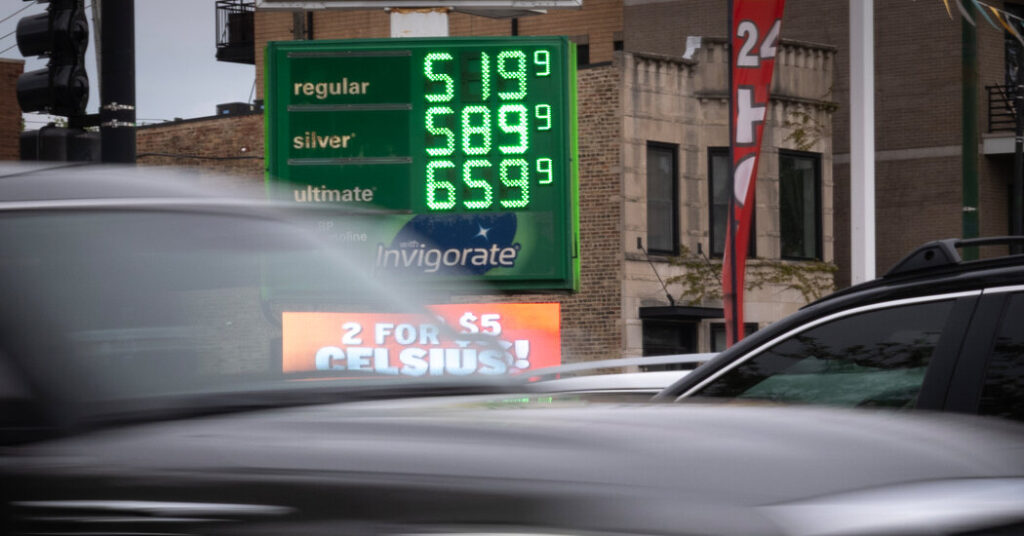
The average price of regular gasoline in the United States has followed oil higher, hitting $4.30 a gallon on Thursday, up 27 cents in a week, according to data from the AAA motor club.
After the Federal Reserve held interest rates steady on Wednesday, Jerome H. Powell, the central bank’s chair, said that policymakers needed to be “very cautious” about their next steps, given the significant uncertainty about the economic outlook.
“We’re very well aware that people are experiencing higher gas prices all over the country now,” Mr. Powell said. “And that hurts.” He added that if energy costs remained high, the effects could filter through to airfares and other products and services dependent on oil. “People are going to start to feel that,” he said.
Higher energy prices and the lingering effects of Mr. Trump’s tariffs are expected to keep inflation elevated through the rest of the year, according to Bernard Yaros, the lead U.S. economist at Oxford Economics. “Inflation will get worse before it improves,” he wrote in a research report.
He added that it can take several months for the effects of energy shocks to hit the economy by weighing on job growth. “The labor market remains in a fragile ‘low-hire, low-fire’ equilibrium that risks being upset as the uncertain impacts of the war play out further,” he noted.
The World Bank estimated that the war in Iran would push energy prices up 24 percent this year, according to a broad index covering oil, gas and coal. As a result, the outlook for economic growth has “dampened materially,” the institution noted.
“The war is hitting the global economy in cumulative waves: first through higher energy prices, then higher food prices and finally, higher inflation, which will push up interest rates and make debt even more expensive,” Indermit Gill, the World Bank’s chief economist, said this week.
The conflict has threatened growth in countries with fledgling recoveries. In Europe, the economy of the 21 countries that use the euro grew just 0.1 percent in the first quarter of the year, down from 0.2 percent growth at the end of last year, data published on Thursday showed.
The European Central Bank and Bank of England held interest rates steady on Thursday. But the central bankers made clear they were facing hard decisions for how they would weigh the jump in inflation against the risk of an economic slowdown when setting interest rates in the future.
Over the past two weeks, the price of Brent crude, the global benchmark for oil, has risen about 30 percent. The price of Brent for June delivery, a soon-to-expire contract that investors trade based on their expectations for where prices are headed in the near future, briefly traded above $126 a barrel, the highest since 2022. It then whipsawed back to below $115 a barrel, a decline of more than 2 percent on the day. A barrel of Brent traded for $72 just before the war.
West Texas Intermediate crude, the U.S. benchmark, was around $107 a barrel, flat on the day.
Investors and analysts are focused on the continued disruption to shipping in the Strait of Hormuz, the narrow waterway between Iran and Oman that normally carries as much as one-fifth of the world’s oil supply. Consumers are starting to feel the ripple effect from the energy supply crunch, putting a strain on the U.S. economy.
American households have received larger tax refunds this year because of a giant tax cut passed last year, cushioning the blow of higher energy costs. But the recent rise in gasoline prices has already soaked up about half of the increase in those refunds, according to analysts at Bank of America.
“Unless there is relief at the pump, the ‘gas tax’ should start to weigh increasingly on the consumer in coming months,” they wrote.
Gasoline prices hit a fresh wartime high.
-
U.S. gasoline jumped to the highest point since the start of the war in Iran, according to AAA, an increase that has raised the cost for drivers 44 percent since the first U.S.-Israeli strikes.
-
Diesel prices stood at $5.50 on Thursday, up 46 percent since the start of the war.
Stocks are mixed as investors weigh energy disruptions against earnings growth.
-
Futures on the S&P 500 pointed to a slight rise when stocks resume trading in the United States on Thursday. The benchmark index is roughly flat for the week, a sharp contrast to the turmoil in energy markets.
-
U.S. stocks have been heavily influenced by the biggest technology companies, which have reported bumper profits and extensive plans to develop artificial intelligence systems.
-
“Markets are being pulled in opposing directions as surging oil prices and geopolitical risks weigh on sentiment, while strong tech earnings and A.I. optimism provide support,” Bob Savage, the head of markets macro strategy at BNY wrote in a research note.
Eshe Nelson contributed reporting from London.
Gregory Schmidt is a Times business editor overseeing coverage of the European economy. He is based in London.
The post Oil Hits Wartime High Above $120 a Barrel as Standoff Shows No End in Sight appeared first on New York Times.