Twenty years ago Andy Sachs, an eager journalist fresh out of Northwestern University, stepped into the office of the most fashionable devil in movie history, the Runway magazine editor Miranda Priestly. Since its premiere in 2006, “The Devil Wears Prada” has been, unironically, one of my personal favorites. I’m not the only one; the comedy has become as iconic as the many luxury brands featured in it. On the occasion of “The Devil Wears Prada 2,” due Friday, here are the most memorable moments of the original film that make it such a fan favorite. Gird your loins.
Those Withering Glances
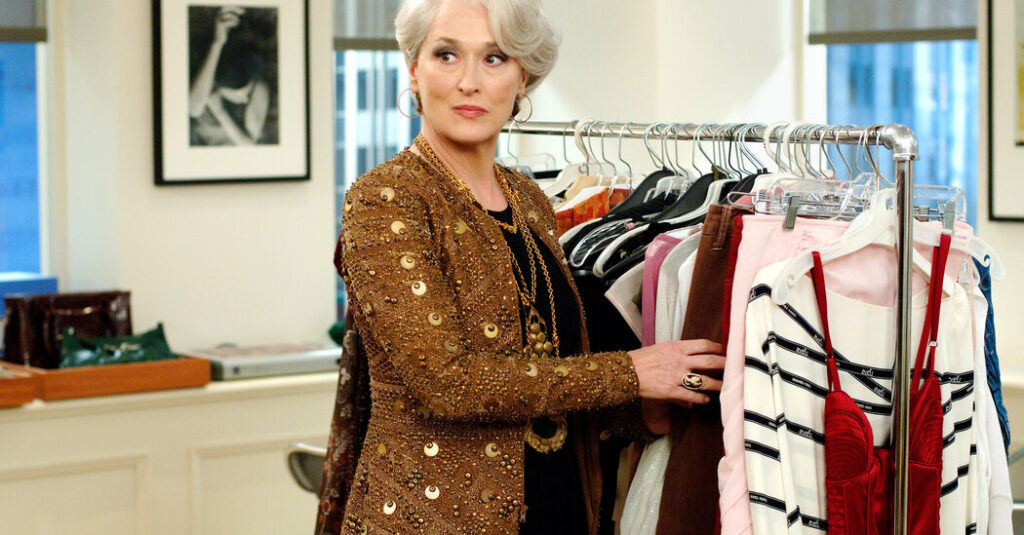
Of course Meryl Streep is a masterly actress. And yet her every particular combination of peaked eyebrows, steely stare and grimace here is its own minute masterpiece. Take the slow top-to-bottom survey Miranda gives an unfashionable Andy (Anne Hathaway) on her first day as an assistant, or the look of amazement and icy glare when Andy mistakenly creeps up the stairs of her fancy townhouse. The most chilling moment, however, might be when the designer James Holt shows Miranda a dress with an oversized bow so repellent that her whole visage deflates and her mouth puckers as though she has caught a whiff of some musty bargain basement shop. Even when she chooses to withhold judgment, it’s nevertheless still apparent.
That Rare Smile
Conversely, Miranda’s few looks of amusement prove there’s some humanity beneath that arctic exterior. You can see it when Andy talks her way into the assistant position and Miranda peers curiously over the rim of her glasses. But it’s not until Andy has quit Runway and they spot each other across a street that Miranda’s hidden affections for Andy become apparent, a full smile creeping across her face before it’s upended by a scowl and a sharp “Go!” to her driver.
That Sweater
If there is one scene that encapsulates the film, it is the cerulean-sweater conversation. When Andy scoffs at a room of Runway employees choosing between two very similar belts, Miranda soundly decimates her with a monologue about the ubiquitousness and utility of fashion. Streep plays the scene with such a savory mix of dryness, drollness and casual superiority that the moment becomes about so much more, including how seriously Miranda takes her position and how knowledgeable she truly is (even if, yes, the “history” itself is a fabrication by the filmmakers). It’s a moment that also shows Andy isn’t perfect either. She took the job already dismissive of it, not even bothering to look up the name of the editor in chief. So, yeah, Miranda’s a jerk, but Andy should’ve just kept quiet and taken notes.
That Betrayal
What would Runway be without the fashion expertise, snarky comments and enormous statement rings of Stanley Tucci’s character, Nigel? Perhaps the only Runway employee Miranda truly respects, Nigel seems to evade her scorn throughout the film. But just as he is about to make his escape from Runway for a coveted position with a fashion designer — a job that will finally afford him the autonomy he could never have under Miranda — she persuades the designer to pick her rival, instead, sacrificing his promotion in a political move that preserves her own position. It’s not just the sabotage that makes Miranda so despicable, it’s also the secretive way she takes advantage of his loyalty.
That Glow-Up
Who doesn’t love a fashion montage? Usually such scenes take place outside a dressing room or closet, but this sequence is delightful both for the wide range of trendy ensembles and the way the progression occurs while Andy is commuting through Manhattan. It’s a brisk transformation that seems to happen like magic, her outfit changing as she steps out of the subway or a car passes by. And it mirrors the opening scene, when model-like fashionistas — in sharp contrast to dowdy Andy — carefully get dressed for work.
Those Boots
Andy takes in stride most of the casual abuse she gets at Runway, particularly when it comes from Miranda’s first assistant, the endlessly snooty Emily (Emily Blunt). But when a freshly transformed Andy strolls in with a nonchalant hair flip, a gobsmacked Emily asks for a fit check, which Andy smugly interrupts: Yes, she’s wearing Chanel boots. Middle finger politely implied.
That Fat-Shaming
The film invented equations that would shock mathematicians: 0 equals 2, 2 equals 4 and 6 equals 14. I’m talking dress sizes, of course, as explained by Nigel. “The Devil Wears Prada” is filled with fatphobic comments, but it’s not the film itself espousing these problematic views. Rather, it is poking fun at the ridiculous standards of the fashion industry via an ongoing dialogue about weight, as when Emily, who is starving herself on an inane cheese-cube diet, proclaims what the disordered eaters among us have thought but never dared say aloud: “I’m just one stomach flu away from my goal weight.”
That Awful Boyfriend
Years after the film was released, the internet came to the conclusion that the real villain of the film was Andy’s boyfriend, Nate (Adrian Grenier). In all the times I’ve seen this movie, that’s never been a doubt in my mind. It might be tough to pick up on initially, given Grenier’s boy-next-door charm, but Nate is supportive until Andy resolves to dedicate herself fully to the job. He’s also one of the movie’s misogynistic voices, along with Andy’s other suitor, the writer Christian Thompson. Both men seem to want to decide what is best for her career. Plus, for a chef, Nate can’t even manage a decent-looking grilled cheese. That should be proof enough of his uselessness as Andy’s partner.
That Ringing Phone
This particular ringtone was so omnipresent in the early ’00s, and so central to the film’s depiction of Andy’s all-consuming job, that even today when I hear that high-pitched five-note chime, I have a slight Pavlovian anxiety response. Andy’s relationship to phones reflects her arc working for Miranda. On her first day, she’s awakened when Emily phones to demand she get started on a coffee run. Her early missteps include asking a caller to spell Dolce & Gabbana. Soon the phone comes to represent her increasing alienation from the people around her, ringing as she hangs out with friends or argues with Nate. When Andy finally ditches the phone in a fountain in Paris, it’s a symbolic moment of triumph.
The True Heart of the Movie
Near the end, after Miranda’s great betrayal of Nigel, Andy wonders if she’s on the right path. But Miranda dismisses her concern, saying that everyone wants this life. It’s the crux of the whole film: the cost of a thriving career full of power and glamour. But that trade-off isn’t unique to the imaginary world of Runway: “The Devil Wears Prada” is a fable about ambition and the risks and choices people make to get ahead.
Maya Phillips is an arts and culture critic for The Times.
The post 10 Reasons We Love the Original ‘Devil Wears Prada’ appeared first on New York Times.