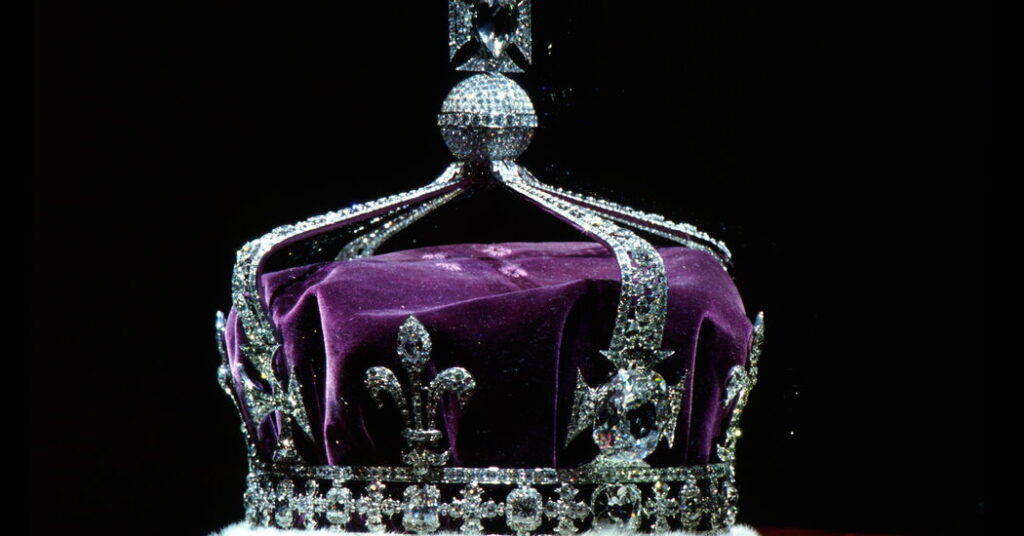
The Koh-i-Noor diamond has over the centuries been seized by Mughal emperors, Persian shahs, Afghan warlords and other powerful leaders. Britain acquired the stone in 1849 and it now sits in the Tower of London, one of the royal family’s crown jewels.
India and other countries in South Asia and the Middle East want it back, calling it stolen property and a painful symbol of colonial plunder.
And on Thursday, people there were pleased to learn that the cause has a new ally: The mayor of New York City.
Before attending a ceremony with King Charles III in New York on Wednesday, Mayor Zohran Mamdani was asked in a news conference whether he had a message he might want to convey to the king.
“If I was to speak to the king separately from that, I would probably encourage him to return the Koh-i-Noor diamond,” he said.
The remark made Mr. Mamdani one of the only prominent American officials to publicly suggest that the stone be returned.
It was not immediately clear whether Charles and Mr. Mamdani discussed the diamond in New York. Buckingham Palace declined to comment. The mayor’s office did not respond to an overnight inquiry.
A Bloody History
The Koh-i-Noor, which means “mountain of light” in Persian, is one of the largest cut diamonds in the world, at 105.6 carats and about the size of a chicken’s egg. Historians believe it was sifted from the sands in southern India thousands of years ago. It changed hands over the centuries in conquests across the Indian subcontinent.
In the 19th century, a blind Afghan king hid the diamond in the crack of a prison wall. Years later, a mullah who did not recognize its significance was found using it as a paperweight, according to the 2017 book “Koh-I-Noor: The History of the World’s Most Infamous Diamond” by William Dalrymple and Anita Anand.
Throughout its history, the diamond was said to have cursed its male owners who faced torture, illness or the loss of their kingdoms, Mr. Dalrymple and Ms. Anand wrote. Several owners were assassinated, often over the stone.
“It has a long history of bringing bad luck and, again, seems to have been the tripwire which tripped up King Charles on his trip to New York,” Mr. Dalrymple said in an interview from New Delhi on Thursday.
The British acquired the diamond in 1849 from a 10-year-old maharajah of the Sikh Empire, Duleep Singh. In a public ceremony in Lahore, in present-day Pakistan, the frightened boy was surrounded by British officers speaking an unfamiliar language, according to the book.
Officers there forced him to sign the Treaty of Lahore, which solidified British control over the Sikh Empire. One of its stipulations was that he surrender the Koh-i-Noor to Queen Victoria.
The British administrator overseeing India at the time, Lord Dalhousie, was triumphant. “I had now ‘caught my hare,’” he wrote in a letter after the document was signed.
“The Koh-i-Noor has become in the lapse of ages a sort of historical emblem of conquest in India,” he added. “It has now found its proper resting place.”
Calls for Restitution
Since the end of British rule in India in 1947, the governments of India, Pakistan, Iran and Afghanistan have each claimed ownership of the Koh-i-Noor.
In Indian school textbooks, the case of the diamond has been taught as an example of Indian cultural heritage being stolen by British colonial rulers.
The Indian government has been talking publicly about the issue for decades. In 2016 — at a time of intense public debate related to a domestic court case over the stone — it said it was resolved to “make all possible efforts to bring back the Kohinoor Diamond in an amicable manner.”
Some people in India have spent years pursuing their own claim to the gem on behalf of devotees of the Hindu deity Lord Jagannath. They have cited a will in which Duleep Singh’s father, Ranjit Singh, bequeathed it to the deity before his death in 1839.
Priya Darsan Pattnaik, a Hindu activist in India, said in an interview on Thursday that he was encouraged by Mr. Mamdani’s comments.
“I am amazed to hear that Zohran Mamdani raised this issue,” said Mr. Pattnaik, who filed a lawsuit demanding the diamond’s return in the International Court of Justice last year. “We should make efforts to bring back the Koh-i-Noor.”
The British government has rejected such claims, insisting that the gem was obtained legally. It has also cited a 1963 British law that prevents its museums from removing items from their collections.
Today, the stone is set in the crown of Queen Elizabeth, Charles’s grandmother, who used it for her coronation in 1937 as queen consort to King George VI. It is now displayed in a museum housing the British Crown Jewels at the Tower of London.
The diamond was last seen in public on the queen mother’s coffin during her funeral in 2002. It was omitted from Queen Camilla’s 2023 coronation, a gesture that avoided a diplomatic clash with the Indian government. She instead wore the crown of Queen Mary, the queen consort from 1910 to 1936.
British royals and officials have rarely spoken publicly about the Koh-i-Noor. In 2010, Prime Minister David Cameron told an Indian television show that returning the diamond would set a dangerous precedent.
“What tends to happen with these questions is that, if you say yes to one, you suddenly find the British Museum would be empty,” he told New Delhi Television. “To disappoint all your viewers, I’m afraid it’s going to have to stay put.”
After speaking about the diamond at the news conference on Wednesday, Mr. Mamdani exchanged pleasantries with King Charles at the 9/11 memorial in Lower Manhattan alongside other officials, including Gov. Kathy Hochul of New York and Gov. Mikie Sherrill of New Jersey.
On Thursday, Mr. Mamdani’s comments were reported in the news media in India, Pakistan and Afghanistan. None of the three governments issued public statements about the diamond or responded to requests for comment.
Mr. Mamdani’s invocation of the diamond’s history was in character. He was born in Uganda, also once part of the British Empire, to Indian parents who have shaped his politics. His father, Mahmood Mamdani, is a leading scholar on colonialism. His mother, Mira Nair, is an award-winning filmmaker whose work has examined the colonial experience.
Mr. Mamdani, the city’s first democratic socialist mayor, has often criticized colonialism and expressed support for marginalized people.
His administration’s racial equity plan describes the history of New York as one marked by the colonization of the Indigenous people. And in a St. Patrick’s Day speech, he compared the resistance of the Irish people under British colonialism to the struggles of Palestinians.
On Wednesday, his spokesman, Joe Calvello, made clear that Mr. Mamdani is no monarchist.
“The mayor,” he said, “is generally opposed to the idea of a king.”
Jeffery C. Mays and Claire Fahy contributed reporting from New York, and Elian Peltier from Islamabad, Pakistan.
John Yoon is a Times reporter based in Seoul who covers breaking and trending news.
The post The Case for Returning the Koh-i-Noor Diamond Has a New Backer: Mamdani appeared first on New York Times.