To hear Justice Samuel A. Alito Jr. tell it, the Voting Rights Act of 1965 has served its laudable purpose of eliminating racial discrimination in elections and has now passed its sell-by date.
“Vast social change has occurred throughout the country and particularly in the South,” Justice Alito wrote for the six conservative justices in the majority in Wednesday’s decision that appeared to deal a coup de grâce to a towering achievement of the civil rights movement.
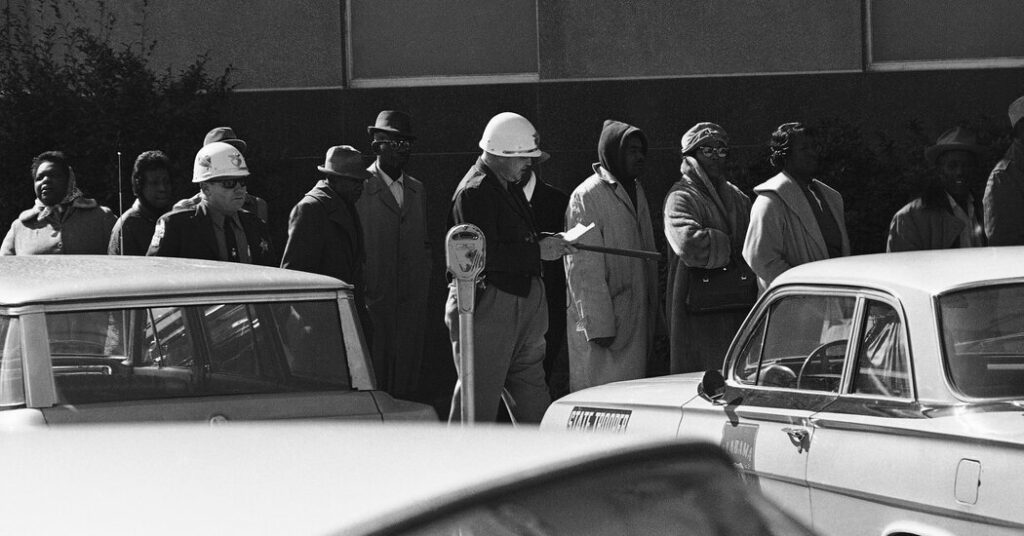
A stunningly effective piece of legislation secured at the cost of blood and lives in the South in the Jim Crow era, the act helped Black voters match and sometimes exceed registration rates of those of white people.
Justice Alito denied none of that, acknowledging, though mostly through quotations from earlier opinions, that the law was a response to “nearly a century of entrenched racial discrimination in voting, an insidious and pervasive evil which had been perpetuated in certain parts of our country through unremitting and ingenious defiance of the Constitution.”
As a result of the Voting Rights Act, he wrote, Black Americans, once barred from the polls, now vote at similar rates as the rest of the electorate.
That theme — that the aims of the law have now been satisfied — has run through the three rulings issued by the court’s conservative majority over the past 13 years that collectively robbed the act of its power. That was of a piece with other efforts by the court’s conservative majority to ensure that race-conscious policies do not continue indefinitely, as in its decision to put an end to affirmative action in higher education. It also reflected divisions in the wider society about how much progress America has made at eliminating the racism of its past.
On Wednesday, the court ruled that lawmakers in Louisiana had violated the Constitution by taking account of race in drawing up a new majority-Black district. Justice Alito said the Voting Rights Act, as updated by the court, did not allow that.
Chief Justice John G. Roberts Jr. made a similar point about race in America in 2013 in the first of those cases, Shelby County v. Holder, which cut the heart out of the act by effectively eliminating its requirement that jurisdictions with a history of discrimination get federal permission before changing voting procedures.
“Our country has changed,” the chief justice wrote. The act was “strong medicine,” he said, but it was initially the right response to “entrenched racial discrimination.” When it was first enacted, he wrote, the voter registration rate of Black people stood at 6.4 percent in Mississippi. The gap between Black and white registration rates was more than 60 percentage points.
Forty years later, in the last election before Congress reauthorized the act in 2006, Chief Justice Roberts wrote, the Black registration rate in Mississippi was 76 percent, almost four percentage points higher than the rate of white people.
Justice Ruth Bader Ginsburg was unimpressed by that logic. Getting rid of a law that was working, she wrote in dissent in the Shelby County case, “is like throwing away your umbrella in a rainstorm because you are not getting wet.” Essentially, she argued that the success of the Voting Rights Act only proved its necessity.
The second case in the court’s Voting Rights Act trilogy was Brnovich v. Democratic National Committee in 2021, in which the court gave states new latitude to impose restrictions on voting notwithstanding the Voting Rights Act.
All of the court’s assertions in those three cases raise an empirical question and a legal one. First, does eliminating protections of the act in the current era disadvantage minority voters? And, second, who should decide when a statute is no longer needed?
A recent study to be published in The Journal of Politics, provided a tentative answer to the first question, analyzing nearly a billion votes cast in federal general elections between 2008 and 2022. It concluded that there is “significant and robust evidence” that the racial turnout gap widened in parts of the country that had been covered by the Voting Rights Act after the Shelby County decision, “translating to hundreds of thousands of uncast ballots by voters of color.”
The Shelby County decision had led to a wave of measures making it harder to vote.
According to the study, conducted by Kevin T. Morris, of the Brennan Center for Justice at New York University, and Michael G. Miller, of Barnard College, the turnout gap between Black and white voters in those jurisdictions grew by nine percentage points between 2012 and 2022.
In dissent on Wednesday, Justice Elena Kagan acknowledged gains in minority voting power in the decades since the enactment of the Voting Rights Act.
“But it is a separate question whether those gains will endure once the act’s protections are gone,” she wrote, in an opinion joined by Justices Sonia Sotomayor and Ketanji Brown Jackson.
“And surely — but apparently not — the proper actor to answer that question is Congress,” she wrote.
The full impact of the decision will take some time to assess. It may affect several states in the coming election and many more in 2028.
Justice Kagan wrote that she “will be interested to see, for example, whether time will vindicate the majority’s view that the ‘great strides’ made in African American office holding, ‘particularly in the South,’ will hold up after the issuance of this opinion. My own guess is not.”
But she said such predictions were no part of a judge’s job.
“It is for the people’s representatives in Congress to decide when the nation need no longer worry about the dilution of minority voting strength,” she wrote. “So long as Congress has not done so — and it has not — this court has no right to cancel (sorry, ‘update’) a duly enacted statute on the theory that it knows better.”
Some Republican state officials took a different view, applauding Wednesday’s decision.
“The court rightly acknowledged that the South has made extraordinary progress, and that laws designed for a different era do not reflect the present reality,” said Steve Marshall, Alabama’s attorney general.
“We will act as quickly as possible to apply this ruling to Alabama’s redistricting efforts and ensure that our congressional maps reflect the will of the people, not a racial quota system the Constitution forbids,” he said.
Emily Cochrane contributed reporting.
Adam Liptak is the chief legal affairs correspondent of The Times and the host of The Docket, a newsletter on legal developments. A graduate of Yale Law School, he practiced law for 14 years before joining The Times in 2002.
The post In Narrowing Voting Rights Act, Conservative Justices See Progress on Racism appeared first on New York Times.