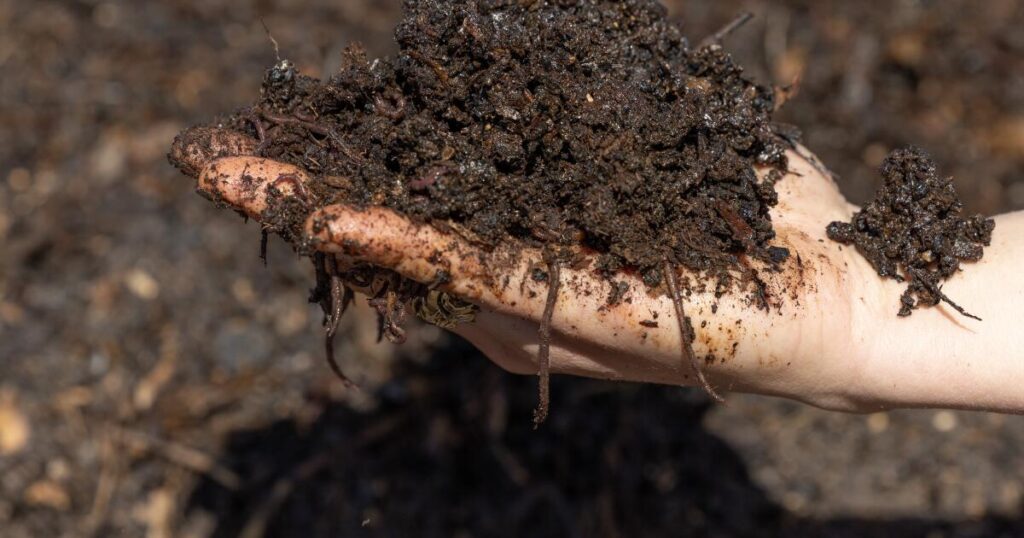
I love the idea of transforming garbage into free mulch and fertilizer. Composting is a win-win: I save money and keep my eggshells, coffee grounds and weeds out of a landfill.
Compost is the single best additive available for improving any soil type. Is your soil too sandy? Add compost. Too dense? Add compost. Lacking nutrients? Say it with me now: Add compost! That’s why we gardeners call it “black gold.”
It’s as close to a cure-all as we can get, increasing the water-holding capacity of sand and the drainage of clay, while introducing billions of beneficial organisms that will nourish your plants for a long time.
Location, location, location
Before starting, decide whether you want an open or contained pile. From what I’ve seen, compost bins and tumblers could set you back anywhere from $50 to $300. This might be worth it to you if you’re concerned about aesthetics, or if you live in an apartment with a balcony. If you opt for a tumbler, you might want one that drains the liquid into a container, because this liquid can be mixed with water to make extremely rich plant food.
An open pile in a back corner of the yard — if you have one — would work just as well. Or, you could compromise and make your own receptacle by bending a length of chicken wire into a round or oval shape, fastening its ends with strong twine or zip ties, then anchoring it into the ground with stakes.
Your pile or bin should be close enough to avoid an out-of-sight-out-of-mind situation, but maybe not right next to where you’re grilling dinner. And despite what you might think, a properly constructed pile of rotting garbage won’t create unpleasant odors.
Proportions matter
There are two ingredient categories in compost, “browns” and “greens,” and they should be added in almost equal parts.
Browns, which are usually but not always brown, include spent perennials, dry leaves, cut-up (undyed) leather, twigs, paper and straw. They should make up 50% or slightly more of your pile’s ingredients. Browns are full of carbon and will keep things from smelling badly.
Green materials are rich in nitrogen and, likewise, are mostly green, or at least fresher than browns. They include grass clippings, fruit and vegetable scraps, and freshly picked weeds that have not gone to seed. Cornstarch packing peanuts and coffee grounds also are rich in nitrogen, so even though they defy this color-coding principle, they are considered greens, which help speed the decomposition of all the ingredients in the pile. Greens should make up 50% or slightly less of your pile.
Cutting up large or coarse ingredients like banana peels will speed up their decomposition.
Never add meat, fish, dairy, fat or oils to compost. Avoid diseased plants or weeds that have gone to seed, and skip plastic, glass or anything that won’t break down. Manure from animals that don’t consume meat (rabbits, cows, horses) is fine, but do not use waste from carnivores. That means leave dog poop and kitty litter out.
Caring for your compost
Keep your pile moist but not soggy. Give it a sprinkle of water every time you add a new layer of materials.
As it decomposes, the bacteria in the pile will cause its center to heat up and “cook” your compost. Turn the pile with a pitchfork or spade (or spin your tumbler) about twice a week to keep the heat evenly distributed.
The process can take anywhere from a couple of months (if your pile is small and you toss and moisten it regularly) to a couple of years (for very large or neglected piles). Regardless, you will end up with a dark, crumbly, highly nutritious amendment that resembles rich soil.
If some larger pieces, like sticks, remain in your finished compost, you can sift them out with a screen. Use a half-inch screen if you intend to use your compost in potting mix or garden beds, and quarter-inch screen for seed-starting mix. Rubbing the compost against the screen with a gloved hand will help things along.
Incorporate compost into new beds before planting, mix it into containers, scatter it over the lawn or use it in place of mulch. It will provide slow-release nutrients, fortify roots, and create rich, healthy soil that will support and protect your plants over time.
Damiano writes for the Associated Press.
The post Still unsure about composting? Here’s why and how to make ‘black gold’ for the garden appeared first on Los Angeles Times.