One of New York City’s longest-running turf wars festers in the shadows of municipal Brooklyn.
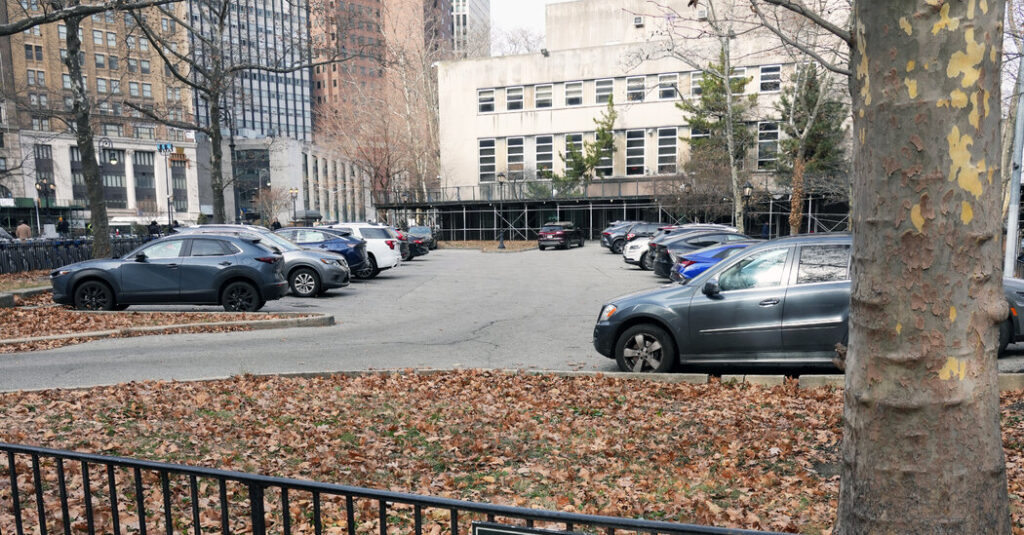
The battlefield in question seems utterly unremarkable. Its asphalt is cracked. Pigeons meander among the weeds that surround it. And yet, to the Brooklyn judges who preside in the neighboring courthouse, it is a sanctuary as inviolate as the law they are elected to adjudicate, and woe unto those who threaten it.
For more than 60 years, the judges have used this patch of land as a parking lot. And for roughly half that time, a broad swath of Brooklyn society — public officials, neighborhood gadflies and parents alike — have argued that the lot should be converted into a park.
Their argument is based on more than a stubborn desire for more green space: The land is parkland.
Two Democrats from Brooklyn are leading the renewed fight to get the judges booted, and part of their battle strategy is to draw the new mayor, Zohran Mamdani, to their side.
There are few issues more divisive than parking among dwellers in this space-constrained, archipelago city. For those who have cars, there is never enough of it. For their opponents, cars are anti-urbanist forces that destroy the environment and take up precious street space that might otherwise go toward cycling or walking.
To New Yorkers like those, the judges’ perpetual squatting on mapped parkland is nothing short of an abomination. Over decades, their simmering sense of injustice has fueled intermittent political efforts to evict the cars. Literally and figuratively, the judges have remained unmoved.
Two decades ago, Abraham Gerges, then an administrative judge for State Supreme Court in Brooklyn, was one of the parking lot’s staunchest defenders. Now retired, he expressed shock in a recent interview that this debate remained unsettled, and maintained that parking near the courts was necessary because judges face threats.
As he made his case, his wife interceded.
“Someone from jail threatened your life!” she said. (The threat, according to a memorable 2002 article in The New York Post, involved a convict who “tried to find a witch doctor to place a deadly voodoo hex” on the judge. Mr. Gerges was given round-the-clock protection.)
Death threats, Mr. Gerges said, “are not unusual things.”
If anything, they have become more prevalent. Last year, the Department of Homeland Security alerted law enforcement agencies of a spike in the harassment of judges. The New York Times recently reported that it had independently identified thousands of threats against state judges spanning just the last three years.
The justices say having a safe and close place to park three dozen cars seems like a reasonable request, even at the expense of parkland.
But to those who want to see the judges evicted, this festering dispute is the embodiment of everything that is wrong with the Democratic political machine that controls Brooklyn, from the judges it helps select to their extrajudicial power over acreage that rightly belongs to the public.
“Anywhere else in this city, this wouldn’t even be a discussion; it wouldn’t even be a conversation,” said Antonio Reynoso, the borough president whose offices in Borough Hall bookend the parking lot. “It’s park space.”
On a wintry afternoon, Mr. Reynoso took a reporter to the maps room on the top floor of Borough Hall, Brooklyn’s oldest public building. He asked an aide to show him the book of maps containing the parking lot.
An office manager, Jessica Kallo, pulled out a topographical, cloth-paged book from 1945 and opened it to a hand-drawn map showing the lot within the confines of Columbus Park, a green space that the Brooklyn officials say sprawls across 7.9 acres and encompasses Borough Hall.
Then Mr. Reynoso headed to his conference room to show his vision for a redesigned park, replacing the judges’ parking lot with a lawn, a kiosk, a public restroom and plantings, with a path winding among them.
Fixing a ‘supreme bungle’
The judges say history is on their side.
Archival newspaper records indicate that parking for the courthouse — which one critic likened to a “ beached limestone whale” — has, on and off, been a “sore point” for the Downtown Brooklyn community for 68 years. But in the 1950s, the issue was not the existence of judicial parking, but rather the lack of it.
A Daily News article from 1958 entitled, “Whoops! A Supreme Bungle,” criticized the government for building a courthouse without adequate parking spots.
Even Robert Moses, then the city’s parks commissioner, was flummoxed.
“We suggested having parking in the basement of the building, but we got nowhere with the idea,” a parks spokesman told the newspaper.
By the following year, the city had decided to allow the judges to store their cars in a section of Columbus Park.
In the most recent court battle over the lot, the judges cited a 1959 news article from a long-defunct newspaper, The New York World-Telegram, which described the site as “exclusively for the use of the 18 justices of the court and high administrative officials.” This was evidence, the 21st-century judges argued, that the parking lot had always been intended as theirs.
Newspaper archives suggest that the debate remained relatively dormant for decades. But quietly, over time, the tenor changed.
In 1999, when the state was seeking community support to build a new courthouse on nearby Jay Street, the administrative judge promised to move cars from the park to the courthouse’s new garage, The Daily News reported. That didn’t happen. Instead, the judges gave up 16 parking spots in a strip of land that used to be part of Fulton Street, and borders the existing parking lot.
The lot is accessible via a curb cut from Joralemon Street, the location of Brooklyn Law School, and the Brooklyn Municipal Building, home to a hodgepodge of city agencies.
The signage adjoining the parking lot is as confusing as its status. One sign reads, “authorized vehicles only.” A bit to the right, another sign attached to a wrought-iron fence reads “Columbus Park” above the Parks Department emblem — the silhouette of a leaf that Parks Department experts believe might belong to a London plane. Behind the sign is an actual London plane tree. Behind the tree is the parking lot.
On a Tuesday in April, the lot was populated by a white Volvo, two black Lexuses, a gray Mercedes SUV, a black BMW, a gray Acura, a black Subaru and a black Tesla. There were also eight empty spaces and a black Honda whose license plate — “Supreme Court 76” — Mr. Reynoso finds ironic, given the judges’ stated concerns.
“If safety was paramount, maybe they have inconspicuous plates versus plates like this,” he said.
Calling in the big guns
The area around the courthouse has long suffered for park space, but a 2004 rezoning of Downtown Brooklyn probably made it worse. The goal was to attract new office tower development, but a forest of residential towers sprouted instead.
Still, for the 50 or so State Supreme Court judges who now work in the courthouse on Adams Street, just south of the federal courthouse on Cadman Plaza East, it is not as though parking spaces are nonexistent.
The streets immediately surrounding the courthouse have as many as 46 on-street parking spots available to court employees, according to an April 2025 email from the Brooklyn transportation commissioner to Mr. Reynoso and Lincoln Restler, a city councilman. Casting the net wider would hike that number to 160 authorized on-street spots.
Other options have been floated.
Last June, Todd Bristol, the former chief operating officer of Brooklyn Law School, reached out to Mr. Restler. In an email, Mr. Bristol said he had been following the story of the disputed parking lot, and a Brooklyn Law School residence, Feil Hall, at 205 State Street, had a parking garage with room for more cars.
The Marriott Hotel and office building across the street sits atop a 1,000-car garage where officials with other security-minded organizations, including the Secret Service and the district attorney’s office, park their cars, a representative for Muss Development, the hotel’s owner, said. That garage could also accommodate the judges.
Mr. Reynoso and Mr. Restler say they have made their case in meetings with court officials, at their offices and during a field trip to the area surrounding the contested parking lot. Mr. Reynoso even proposed a de facto valet service, where the judges could drop their cars off, and those cars could be brought somewhere else.
Any hope of a compromise was seemingly shelved last summer when the Board of Supreme Court Justices of Kings County sued the city.
By then, the plans to remake Columbus Park, including the parking lot, were gaining steam. The borough president and the councilman had enlisted the city’s parks and transportation departments, two architecture firms and the local business partnership to envision a new green space, one that, as Mr. Reynoso put it, had the “symptoms” of a park: a playground, a skatepark, stands of trees. They even secured $21 million in city funding.
The judges grew alarmed. And in July, they sued the city and Eric Adams, then in his last year as mayor, arguing that New York had violated a 2008 agreement requiring it seek the judges’ approval before removing the parking lot and asserting that the city has the “legal, practical, and moral” obligation to provide judicial parking. They did not dispute that the area was parkland.
“No alternatives have yet been proposed that would provide adequate security for our judges,” Al Baker, the spokesman for the state Office of Court Administration, said recently. “The current lot, which has been in that location since the courthouse was built in the middle of the last century, provides the necessary security for our judges who are under increasing threats.”
Enter Randy Mastro, Mr. Adams’s first deputy mayor, whose reputation as a talented, bare-knuckled brawler preceded him. He said he learned of the lawsuit during the mayor’s daily staff meeting for senior aides. He resolved to find out if the city was, in fact, planning to tear out the judges’ parking lot.
He determined that the plans were theoretical at best, and called up Arthur Aidala, whose law firm was representing the judges, to let him know. After a little information and a little persuasion, the lawsuit was dropped.
“I made the call and then the case was withdrawn, if not that day then the next day,” Mr. Mastro said. “It was a frivolous suit.”
Mr. Aidala’s memory confirmed Mr. Mastro’s recollection.
“We were told that there’s no plans to take away their parking lot, so it’s a frivolous issue,” Mr. Aidala said.
And yet, Mr. Reynoso and Mr. Restler persisted.
That September, they sent a letter to Justin Barry, executive director of the Office of Court Administration, and David Nocenti, counsel for the office, saying that they recognized “the safety of judges is of paramount importance in these turbulent times,” but also noting that the judges had access to ample street parking.
Mr. Barry responded promptly.
Each of the options the politicians had presented “degrades and jeopardizes the safety of our judges assigned to 360 Adams Street,” he wrote.
At the moment, park advocates see some reason for hope. Mr. Reynoso has appealed to Mr. Mamdani. Earlier this month, the mayor’s corporation counsel, Steven Banks, met with Mr. Restler. The councilman emerged from the meeting more hopeful than he had felt in years.
“He was sympathetic to our community’s desire for more park space,” Mr. Restler said.
The judges, however, remain unpersuaded.
“They’ve told us very clearly that we need to go somewhere else,” Mr. Reynoso said.
Susan C. Beachy contributed research.
Dana Rubinstein covers New York City politics and government for The Times.
The post Why Can’t Parkland Be Used as a Park? Ask the Judges Who Park There. appeared first on New York Times.