Tapestries embroidered with Quranic verses were shipped from the Kaaba in Mecca, Islam’s holiest shrine. Tiles came from a mosque in Uzbekistan. A golden metal dome was made to replicate the architecture of ancient Syria.
Jeffrey Epstein spent years making connections across the Middle East, in pursuit of business deals and two intertwined hobbies: acquiring rare Islamic artifacts with which to decorate an unusual building on his private island, and expanding his network of wealthy, powerful people.
Through connections that extended into the royal court of Saudi Arabia, Mr. Epstein secured a meeting with Mohammed bin Salman, now the Saudi crown prince, and also obtained elaborate tapestries that once adorned the sacred spaces inside the Kaaba and covered its exterior walls.
Mr. Epstein’s dual passions were encapsulated in a single photo from 2014. In it, he poses with Sultan Ahmed bin Sulayem, a prominent Emirati executive, as they admire one such tapestry splayed on the floor of Mr. Epstein’s New York townhouse. Like others in Mr. Epstein’s orbit, Mr. bin Sulayem was ultimately brought down by his association. Earlier this year, he was forced to resign as the head of DP World, a Dubai ports company.
The ways in which Mr. Epstein, who killed himself in 2019 while awaiting trial on sex trafficking charges, sought to concurrently expand his network and his art collection are further revealed in the millions of pages of records released in January by the Justice Department.
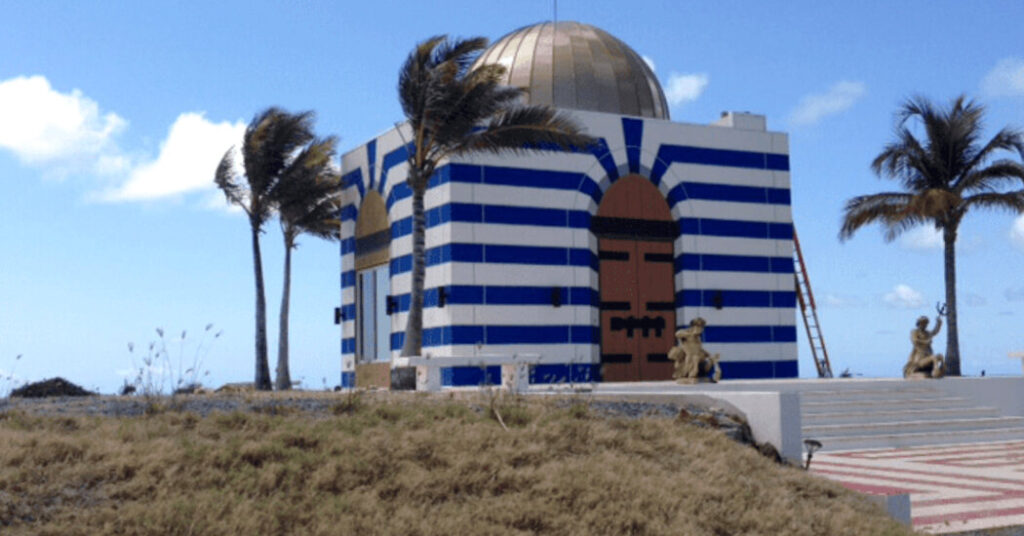
The documents also resolve a lingering mystery about a strange building on Little Saint James, Mr. Epstein’s private island in the Caribbean, whose construction and decoration was a yearslong obsession for the financier.
The building, a blue-and-white-striped structure topped with a golden dome, has been variously described as a music room, a pavilion, a chapel and even an occult temple. But correspondence between Mr. Epstein and his associates over many years, and an interview with an artist hired to work on it, illuminate its intended purpose.
For Mr. Epstein, a secular Jew, the building was a “mosque.”
Making a ‘Mosque’
Mr. Epstein had a longstanding fixation on Islamic design. In 2003, he boasted to Vanity Fair that he owned “the largest Persian rug you’ll ever see in a private home — so big, it must have come from a mosque.”
His vision for an island shrine began while he was in a Palm Beach County, Fla., jail, having pleaded guilty to soliciting prostitution. Before his release in 2009, Mr. Epstein hired architects to design a “hammam,” a Turkish bathhouse surrounded by “Islamic gardening,” according to his correspondence.
He soon scrapped that plan and instead sought a permit for a “music room” in a building he called 5 Palms, emailing himself design ideas, including images of ancient Middle Eastern mosques.
In 2011, Mr. Epstein wrote to a contact in Uzbekistan seeking authentic tiles. “It will be for the inside walls, like a mosque,” he said.
Ion Nicola, a Romanian artist, was hired for the project. In an interview in March, Mr. Nicola confirmed that Mr. Epstein regularly called the building his “mosque.” (It remains unclear if Mr. Epstein intended that the building ever be used as an actual mosque.)
Mr. Epstein’s records show that in 2013, he sent Mr. Nicola a picture of the Yalbugah Hammam, a 15th-century bathhouse in Aleppo, Syria, with a golden dome, a recessed arch over the door and striped masonry, seeking sketches that would resemble it.
Among other tasks, Mr. Epstein asked for a design replacing the Arabic word for God with his initials in English. “Remember we saw the aribic writing in black and white,” he wrote to Mr. Nicola in an email plagued with his customary typos and misspellings. “instead of allah, i thought j’s and e ‘s.”
The Diplomat and the Prince
Around 2010, Mr. Epstein became friendly with someone who would help make his ambitions for the mosque and his business become a reality: Terje Rod-Larsen, a Norwegian diplomat. The files show the men frequently exchanged messages about business as well as personal and international affairs.
Saudi Arabia was a common refrain in their yearslong correspondence, but the chatter about the kingdom intensified in 2016. Mohammed bin Salman, known as M.B.S., who was then the deputy crown prince, wanted to take the state-owned petroleum company Aramco public, and Mr. Epstein hoped to become his financial adviser.
Mr. Rod-Larsen connected Mr. Epstein to Raafat Al-Sabbagh, a consultant to the Saudi royal court, and his aide Aziza Al Ahmadi. Through them, Mr. Epstein waged an intense campaign to woo Prince Mohammed. He met them in New York and pressed to pitch the royal in person, sharing what he called in a message “radical ideas,” like the creation of a new currency called “the shariah” for use among Muslims.
Soon, a visit was in the works. Ms. Al Ahmadi sent Mr. Epstein to the Saudi Consulate, instructing him to say “that you, Jeffrey Epstein, has an invitation from His Royal Highness: PRINCE mohammed bin salman.”
After arriving in the kingdom, Mr. Epstein emailed Mr. Rod-Larsen two photos of himself joking around with Mohammed, one of which he would later display in his New York home.
Souvenirs of a Sacred Site
Ms. Al Ahmadi and Mr. Epstein met in New York early in 2017. At the same time, their assistants were corresponding about a tent being shipped from Saudi Arabia to his island.
Her representative said more items would soon be sent “for the mosque.”
“We are receiving 3 pieces from the Kaaba,” Mr. Epstein’s assistant told a customs broker.
A separate document included pictures of embroidered tapestries. One was “used inside the Kaaba,” according to the document; another, called a Kiswa, had covered the outside of the shrine; and a third was from the same special factory in Mecca, it said.
A Kiswa has great religious significance. Every year, a new covering for the Kaaba, costing about $5 million, is crafted by hundreds of artisans in a royal workshop, using about 1,500 pounds of raw silk and 250 pounds of gold and silver thread.
After a Kiswa is removed, it is divided. The tapestries can be donated to institutions or individuals or distributed for charity auctions.
Ms. Al Ahmadi described her shipment’s gravitas to Mr. Epstein in an email. “The black piece was touched by minimum 10 million Muslims of different denominations, Sunni, Shia and others,” she said. “They walk around the Kaaba seven rounds then every one tries as much as they can to touch it and they kept their prayers, wishes, tears and hopes on this piece. Hoping after that all their prayers to be accepted.”
How she came by the pieces is unclear. Ms. Al Ahmadi did not respond to a request for comment, nor did the Saudi government, Mr. Al-Sabbagh or Mr. Rod-Larsen’s attorney.
Dark Clouds
In 2017, Hurricane Maria wreaked havoc across the Caribbean, including on Mr. Epstein’s island. One record showed that some items in the “mosque” were destroyed or damaged.
But rough weather was not the only problem plaguing Mr. Epstein and the people in his orbit. Mohammed had risen to crown prince and declined his guidance, evidently annoying Mr. Epstein. “The kingdom needs lots of expensive help now as they did not follow the jew directions,” he texted Mr. Rod-Larsen, presumably referring to himself.
After the journalist Jamal Khashoggi was killed in the Saudi Consulate in Istanbul in October 2018, Mr. Epstein wrote to Mr. Rod-Larsen about allegations that Prince Mohammed had given the order. (The crown prince has denied ordering that Mr. Khashoggi be killed but has accepted responsibility for the murder, which took place under his leadership.)
“Dark cloud over his head,” the diplomat replied. “And it won’t go away.”
For Mr. Epstein, that prediction would soon prove true. Within weeks, a Miami Herald investigation exposed secret details of his 2008 plea deal, ultimately leading to his downfall.
In exchange for that stint in county jail, Mr. Epstein had been promised immunity from prosecution on far more severe charges.
He was arrested on new charges in July 2019. The next month, Mr. Epstein transferred ownership of his island to a private trust. Two days later, he was found dead after hanging himself in a federal jail in Manhattan.
Will Houp and Urvashi Uberoy contributed reporting.
Ephrat Livni is a Times reporter covering breaking news around the world. She is based in Washington.
The post Epstein Obtained Objects From Islam’s Holiest Site for His Island ‘Mosque’ appeared first on New York Times.