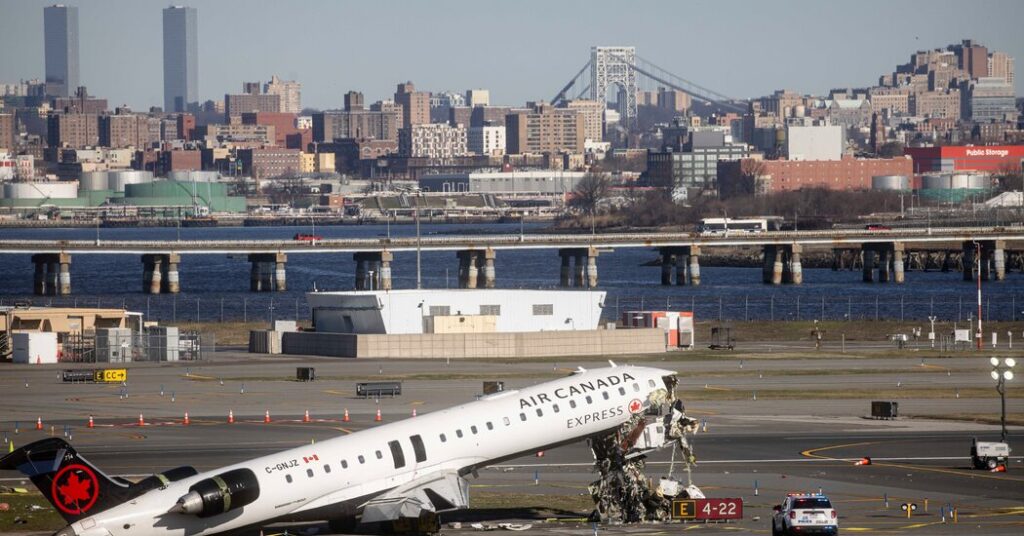
The Port Authority of New York and New Jersey said Tuesday that it will install trackers on rescue vehicles at its three major airports after investigators faulted the agency for not having the recommended devices on a fire truck during a deadly collision with a jet at LaGuardia Airport.
In a preliminary report on the deadly crash issued last week, the National Transportation Safety Board highlighted the fire truck’s lack of a transponder that would have constantly sent signals about its location to LaGuardia’s air-traffic control tower. The device would have connected with an existing automatic warning system, which could have alerted controllers to the impending collision with an Air Canada Express jet, the investigators said.
On Tuesday, James Allen, a spokesman for the Port Authority, said it would be expanding the use of the devices, recommended by the Federal Aviation Administration, to its major airports after testing them at Newark Liberty Airport last year.
Mr. Allen said the Port Authority recognized that “transponder technology can provide an additional layer of visibility on top of existing surface-surveillance systems that already track ground movements.” He said the Port Authority “will be expanding that capability across our airports, building on the technology already in place.”
Mr. Allen noted that the fire truck, identified as Truck 1 and operated by two officers of the Port Authority Police Department, had been in contact with the control tower and had received clearance from a controller to cross the runway.
The truck was responding to an emergency call from a different plane near midnight on March 22 when it entered a runway just before the Air Canada jet landed and crashed into it, killing the plane’s two pilots.
The safety board’s investigators are still seeking a cause for the crash and have not said that a transponder on the fire truck would have prevented it. But they said in the report that the absence of a transponder on the fire truck involved in the collision left the airport’s automatic warning system “unable to correlate the track of the airplane with the track of” the truck that it struck.
The F.A.A. has been advising airports to voluntarily install transponders in their fire trucks and other vehicles for 15 years. Last year, it said it was “actively encouraging,” though still not requiring, airports with airfield surveillance systems such as LaGuardia’s to install them. Many big-city airports have followed the guidance, including those in Boston, Chicago, Denver, Los Angeles, Minneapolis, St. Louis and San Francisco.
Despite the F.A.A.’s encouragement, airport officials at the Port Authority balked at installing the type of transponders that the federal agency had recommended at LaGuardia and its other two major airports, Kennedy International and Newark Liberty International. The Port Authority chose to install a different system for tracking its fire trucks and other ground vehicles that it considered better suited to the navigational needs of its employees because it tracked their location everywhere on the airfield, not just on runways and taxiways.
As the Air Canada jet hurtled down the runway at more than 100 miles an hour, the tower attempted to rescind that clearance, calling out, “Stop, Truck 1, stop.” The officer riding beside the sergeant who was driving the truck later recalled hearing an order to “stop, stop, stop” on the tower’s radio frequency. But when questioned by investigators, he said that he did not initially realize that the order to stop was intended for his vehicle, according to the report. There was no mention of an interview with the sergeant, who was the more seriously injured of the two firefighters.
The firefighters were hospitalized and remain on leave from their jobs. Port Authority officials declined to discuss their injuries or conditions.
Mr. Allen said that the Port Authority would “continue to work closely with the N.T.S.B. as its investigation proceeds and remain focused on working with the F.A.A. to strengthen safety across our airfield operations.”
Industry experts said that the cost of the transponders, which is less than $10,000 each, should not have been the reason for any major airport to decide not to install them.
Chris Zanardi, who heads the commercial group at Passur Aerospace, a company that provides and maintains transponders for airports, said as a rule, the transponders are “not seen as cost-prohibitive by airport operators.” He said “each transponder typically costs in the thousands to purchase and install, not the tens of thousands.”
Federal funds are available to help airports cover the cost of installing transponders in vehicles.
Mr. Zanardi and Passur’s chief executive, Ilhan Ince, declined to speculate about why the Port Authority would have decided not to install transponders on its fire trucks. But they said that since the LaGuardia crash, inquiries from other airport operators about obtaining transponders had increased significantly.
Miami International Airport has ordered transponders for nine of its emergency response vehicles, according to WPLG-TV. A spokewoman for Miami-Dade Fire Rescue, Andrea Rudchenco, said that the agency was working with the Miami-Dade Aviation Department to purchase the transponders at a cost still to be determined.
Ms. Rudchenco said that the aviation agency and fire rescue department had considered adding transponders for several years “and decided this year to move forward with procuring and installing them as another layer of safety.”
In late 2024, the San Francisco Airport Commission awarded Passur Aerospace a $395,000 contract to maintain its vehicle transponders for three years. In 2020, the Chicago Department of Aviation awarded a nearly $2.7 million contract to a different company, Exelis, to maintain the 179 transponders installed at its two major airports, O’Hare International and Midway International, and possibly to install more. The contract stated that the price for each transponder was less than $7,000.
Chicago’s airport managers cited similar transponders that had been installed at other major airports, including Boston Logan International, Denver International and St. Louis Lambert International. In arguing for the contract with Exelis, they said that the F.A.A. “has been and continues to be aggressive in encouraging” them to use the transponders in vehicles and had given Chicago $421,875 in 2012 to purchase and install the devices at O’Hare.
The F.A.A. said in a statement this week that it “encourages airports to equip vehicles with transponders, which enable air traffic controllers to track vehicle movements and detect potential runway conflicts before they occur.”
Patrick McGeehan is a Times reporter who covers the economy of New York City and its airports and other transportation hubs.
The post Port Authority to Install Tracker Not Used During Deadly LaGuardia Crash appeared first on New York Times.