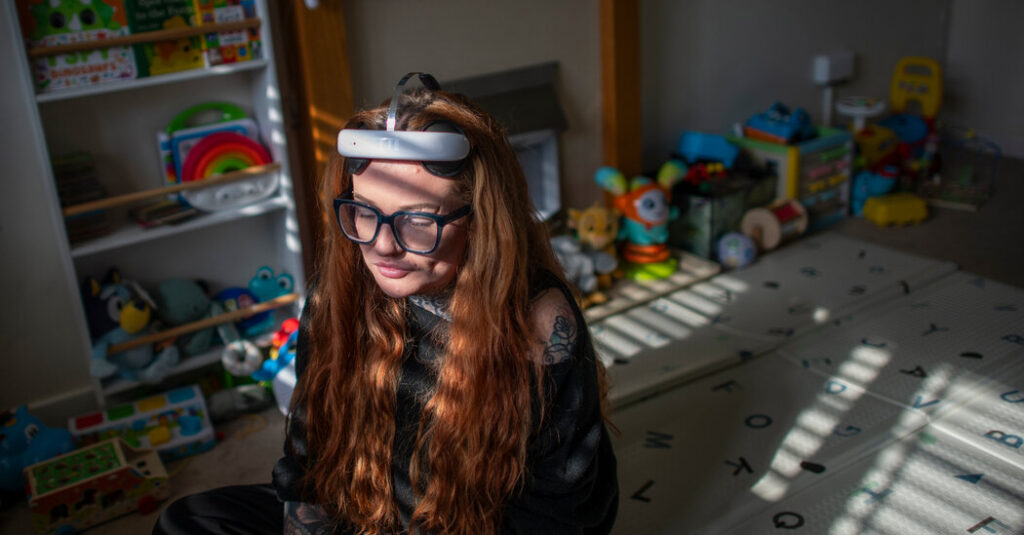
The first question Sophie Davies had was: Will it affect my memory?
In the three weeks since giving birth, Ms. Davies had been in a downward spiral. She checked herself into the mother-and-baby unit of her hospital in East Anglia, England, where doctors ratcheted up the dose of Prozac she took to manage her obsessive-compulsive disorder.
But every morning she woke up in tears, and every time she looked at her baby boy, she felt hollow with guilt. “I’m never going to be able to be a mom,” she recalled thinking, “or if I am, I’m not going to be able to be a good one.”
A month in, a hospital worker suggested she try a headset that used an electric current to treat depression. The word “electric” gave Ms. Davies, then 34, pause. It sounded like electroconvulsive therapy, or ECT, the scary-sounding treatment that triggers seizures and can result in memory loss.
This therapy was different. Transcranial direct-current stimulation, or tDCS, uses a weak electric current to shock the brain and does not produce seizures.
“This is as far from ECT as a jet engine is from my bicycle,” Dr. Mark George, of the Medical University of South Carolina, where he is a leading expert in neuromodulation, a term that encompasses all therapies that use electricity to modify brain function.
Ms. Davies did an internet search and confirmed that the side effects of tDCS — ringing in the ears, headaches and mild burns or irritation where the electrode pads touched the forehead — were generally transient and didn’t include amnesia. She decided to give it a try.
In England, the brain stimulation device has been approved for treating depression since 2019. It can be prescribed by a doctor or purchased over the counter, where it sells for around $530.
In December the Food and Drug Administration greenlit the same device, made by the Swedish company Flow Neuroscience, as an approved depression treatment in the United States. The device is expected to sell for between $500 and $800.
The F.D.A. approval was a milestone for a technology that has been around for 25 years, but has struggled to prove itself. “It legitimizes the therapy itself as a medical therapy, and not just something sold online for wellness or enhancement,” said Anna Wexler, an assistant professor of medical ethics at the University of Pennsylvania, who has studied D.I.Y. brain stimulation.
It is also part of a larger movement to expand psychiatry’s tool kit beyond selective serotonin reuptake inhibitors, which have become the default mental health treatment for depression ever since they were introduced in the late 1980s. Today, about one in six Americans is on an S.S.R.I.
“We’re just scratching the surface of what’s going to be possible,” said Dr. Sarah Holly Lisanby, who directs the psychiatry and behavioral sciences department at Duke University and has developed several neuromodulation techniques for psychiatric conditions. “It’s a whole new way of intervening.”
Tickling Neurons at Home
The basic idea behind neuromodulation is that depression is, in part, a disease of impaired neural connectivity. Stimulating the brain electrically is thought to lower the threshold for neurons to fire off signals, helping the depressed brain to work better overall.
While zapping the brain may sound more exotic than tweaking its chemistry (as antidepressant drugs do), electricity is actually the brain’s lingua franca. No matter what kind of energy you speak to it in — magnetic pulses, ultrasound, even infrared light — brain cells translate it into electrical impulses, tiny spikes in voltage that travel from cell to cell.
“Ultimately, we’re trying to get into the brain and tickle neurons,” said Dr. George. who was a consultant for another neuromodulation device that was also approved last December.
ECT, the first electric therapy, did more than tickle neurons. It made neurons fire en masse, often traumatizing patients and fraying their memories when it was introduced in 1938 (see the 1975 film, “One Flew Over the Cuckoo’s Nest”). Doctors have since refined the technology, which today is considered the gold standard for severe, intractable depression.
More recently, a form of neuromodulation called transcranial magnetic stimulation, or T.M.S., has been gaining ground. T.M.S., which uses magnetic pulses to stimulate brain circuits, has proved to be safe and effective for most forms of depression, and is now approved for treating migraines, obsessive-compulsive disorder and for quitting smoking.
But creating a magnetic field requires an expensive, unwieldy machine, making it necessary for patients to come to a clinic several times a week. Because the design of tDCS is simpler than T.M.S.— essentially a 9-volt battery attached to the head — it has long held the promise of portable, at-home treatment.
By 2012, psychiatry hoped that tDCS might revolutionize the treatment of all sorts of disorders thought to stem from impaired brain connectivity, including schizophrenia, A.D.H.D., motor impairments from strokes, multiple sclerosis, fibromyalgia and even the loss of smell from Covid. When the journalist Sally Adee donned a tDCS headset to help her learn how to wield an assault rifle, as research for her book, “We Are Electric,” on the burgeoning science of bioelectricity, she noticed the therapy also seemed to drive out “the angry little bitter gnomes” of self-doubt that plagued her.
But after years and dozens of clinical trials, the results of many tDCS studies were unconvincing. “There’s some positive, but they weren’t overwhelming, they weren’t a slam-dunk,” Dr. George said. In 2024, research by Dr. Andre Brunoni, a professor of psychiatry at the University of Texas Southwestern Medical Center who was a paid member of Flow’s advisory board until last year, showed that at-home use of the Flow device was no more effective at lifting depression than a well-known placebo: internet browsing.
More Potential Than Proof
The trial that led to the F.D.A. approval of the Flow device — called the Empower study — wasn’t a slam-dunk, either. After receiving a Flow headset in the mail, 174 trial participants with moderate to severe depression were supervised remotely while they self-administered mild shocks five days a week.
The primary outcome was a “minor” improvement in the Hamilton depression scale for participants receiving active treatment, Dr. Rodrigo Machado-Vieira, a study author and professor of psychiatry at UT Health, Houston, said. Moreover, the F.D.A. cited “a moderate level of uncertainty of benefit,” because many participants could tell whether they were getting the real treatment or a placebo.
The study’s secondary findings were more promising. By the end of the trial, 58 percent of the participants who received the treatment showed some response, compared with 38 percent in the control group. Forty-five percent experienced full remission, compared with 22 percent in the control group.
The F.D.A. did not approve the device for the one-third of depressed Americans who have already tried multiple interventions to be inadequate or ineffective. Instead, the agency approved tDCS as a first-line treatment for depression, to be used either on its own or in combination with another treatment like an antidepressant.
However, this approval could open the floodgates to new devices and more focused studies on the effectiveness of the technique. Researchers are now working to enhance tDCS by increasing the voltage combining the brain stimulation with other treatments or mapping a person’s individual brain anatomy to personalize the technology.
“It’s the end of a beginning,” said Dr. Brunoni, who has spent 15 years looking into the treatment for various mental health conditions. “But I don’t think it’s fully developed yet.”
Thinking Outside the Pill Box
Part of the allure of at-home brain stimulation is that it brings electric therapies one step closer to being as accessible and widespread as drugs like Prozac, Dr. George said.
“Our brains are so pharmaceutically inclined,” he said. “This fits into the model of pills.”
At the same time, tDCS could also challenge the current, pill-centric paradigm, by pushing psychiatrists to go beyond old notions of serotonin deficiencies and chemical imbalances, and to think more broadly about getting the brain unstuck. The two treatments together, research suggests may work together to nudge the brain toward a more plastic, activated state to help people overcome old patterns.
For instance, Dr. Somayya Kajee, a psychiatrist in Norwich, England, has found that tDCS helped some of her patients taper off an antidepressant or avoid having to start on another one. She added she has successfully used Flow to treat her neurodivergent patients who were taking medication for A.D.H.D. or autism, and who did not want to add on an S.S.R.I.
Ms. Davies started tDCS a few weeks after increasing her Prozac dosage. When she first put the headset on for 30 minutes, the recommended interval, she recalled feeling only a slight tingling — a “spicy sensation,” similar to having your hair bleached, as a participant in a clinical trial put it.
But within a few days, something shifted for Ms. Davies. She felt clearer, she said. The harsh voice in her head quieted. It was as if the world was in color again.
She said she could not say for sure what made the difference — the tDCS, delayed effects of the antidepressant, the passage of time or some combination — but “whatever it was helped to make me think, ‘Actually, maybe I can do this,’” she said. For the first time, she looked forward to giving her baby a bath.
The post Could At-Home Brain Stimulation Reduce Psychiatry’s Reliance on S.S.R.I.s? appeared first on New York Times.