“Let’s go to Haiti, and how history repeats itself.” With these words, the CBS Sports commentator Nico Cantor celebrated the qualification of the Haitian soccer team for the 2026 FIFA World Cup last November, its first in over 50 years. The team’s victory over Nicaragua, he explained, had come on Nov. 18, a national holiday in Haiti.
“Two hundred and twenty-two years ago today,” Mr. Cantor said, “Jean-Jacques Dessalines led Haitian forces into the Battle of Vertières” — the last major battle of the Haitian Revolution — “where he defeated the French and gained independence.” The country’s triumph on the soccer field, he suggested, was the latest chapter of its long quest for dignity and sovereignty.
For many Haitians, the convergence was deeply meaningful. In a world in which they and their country are often attacked and demeaned, in which their people are often pushed around and rejected, the moment of unity and victory on a global stage was part of a sustained struggle against the odds.
Over centuries, competing stories about the country have become a way of fighting over much larger questions about freedom, racism and what the future of the societies of the Americas and the world will look like. For many decades after the Haitian Revolution began in 1791, the country’s reputation as the cradle of one of the world’s largest and most successful antislavery uprisings created anxiety and fear among enslavers throughout the Americas.
Since then, its very existence has routinely been cast by outsiders as a disturbance and threat. In the United States, the attacks against Haitian immigrants that were at the fore in the 2024 U.S. presidential campaign — and that continue today — are part of a centuries-old tradition.
But there has always been another way of viewing Haiti, too; one rooted in solidarity and an understanding that the past struggles and future aspirations of Haiti and the United States are intertwined.
Haiti was once French Saint-Domingue, a brutal plantation system where more than half a million enslaved Africans labored to produce products like sugar and coffee for European consumption. It was, for much of the 18th century, the most profitable colony in the world.
The mass uprising that overthrew slavery there in the early 1790s sent shock waves through Europe and the Americas. When Napoleon Bonaparte sent a force to re-establish slavery there in 1802, his troops were met with steadfast resistance. In 1804, Jean-Jacques Dessalines, who had been born into slavery, proclaimed Haiti’s independence and declared: “We have dared to be free.”
Many outside observers found all this to be simply “unthinkable,” notes the Haitian anthropologist Michel-Rolph Trouillot. They couldn’t imagine the enslaved, whom they considered mere property, as historical actors, let alone equals or victors. So they sought to explain away the events by blaming outside agitators and casting the revolution as nothing more than unfurling barbarism.
Thomas Jefferson, writing in 1799, worried about the “cannibals of the terrible republic,” anxious about the influence they would have on enslaved people in the United States. Throughout the 19th century, pro-slavery writers and politicians continued to cast Haiti’s independence as a disaster, and negative depictions of the country and its people in media of that era became staples of broader racist thought.
This very loud tradition has often shrouded the long reach of the Haitian revolutionaries’ powerful ideals and practices. As Jefferson feared, the revolution inspired an antislavery movement in the United States, including the nation’s largest slave revolt in Louisiana in 1811.
The abolitionist John Brown considered the Haitian Revolution an inspiration and an example, and the Haitian government carried out a state funeral in his honor in the National Cathedral, complete with an empty casket, after he was executed in 1859. For Americans who also had a vision of a future based on freedom and equality, Haiti was, in the words of Frederick Douglass, “bone of our bone, and flesh of our flesh.”
Over time, Haiti became a magnet for migrants from around the world, including African Americans, Germans and people from the Middle East. But that began to change in 1915 when the United States invaded Haiti and rewrote its constitution to allow foreign landownership in the hopes of developing a sugar plantation economy there under U.S. control.
The occupation, which lasted until 1934, upended life in Haiti, with U.S. authorities seizing land and waging a brutal counterinsurgency campaign against those who resisted. It also laid the foundations for decades of dictatorial rule under the Duvalier family from 1957 to 1986.
Many Haitian migrants fleeing that regime sought refuge in the United States, but as their numbers grew in the 1970s, they encountered increasingly restrictive immigration policies. Washington largely supported Haiti’s dictatorial regime as a regional bulwark against communism, so, in contrast to those fleeing neighboring Cuba, the United States considered Haitian migrants economic rather than political refugees.
In 1981, President Ronald Reagan signed an executive order directing the Coast Guard to interdict boats carrying Haitian migrants on their way to Florida. This immigration strategy, still active today, was developed specifically to prevent Haitians from setting foot in the United States, where lawyers could work with them and help them claim asylum.
Throughout the 1980s, Haitians were accused of bringing AIDS to the United States — a spurious claim that nonetheless led to a fresh wave of anti-Haitian sentiment in America. In the 1990s, after a violent coup against the democratically elected president Jean-Bertrand Aristide sent thousands more fleeing the country, the U.S. naval base at Guantánamo Bay became a detention camp for many Haitians, as well as Cubans, who had been caught on the water seeking refuge in the United States. A series of subsequent crises have led Haiti to an increasingly dangerous and unstable place.
The Haitian diaspora in the United States now numbers over a million people. These migrants play a crucial role in Haiti’s economy through remittances and are a vibrant part of the communities in which they live. They also continue to be frequent targets of virulent attacks.
The hundreds of thousands of Haitian migrants who are in the country under the Temporary Protective Status program, which was established in the aftermath of a devastating 2010 earthquake, may soon have that status revoked pending a Supreme Court decision later this year.
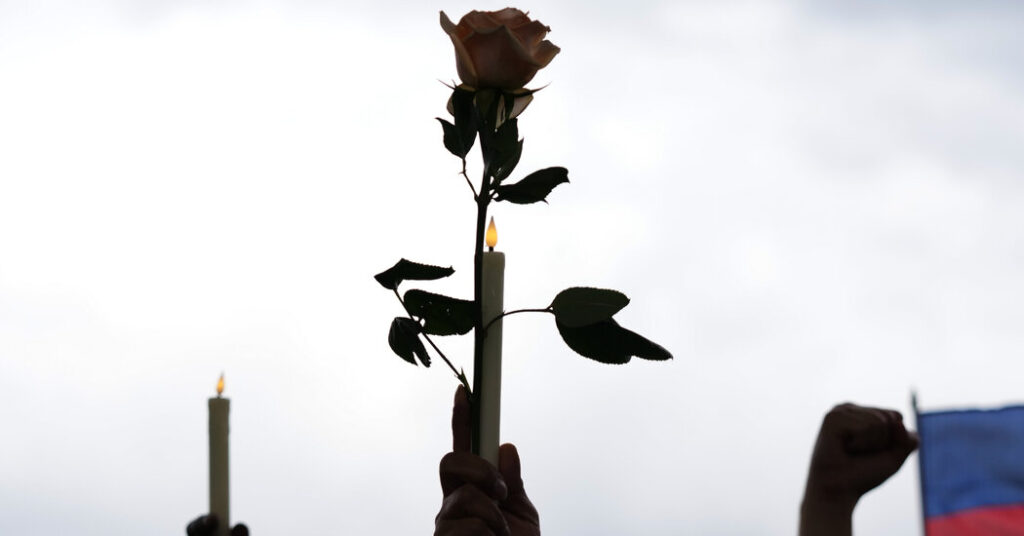
But there is a different tradition we can draw from: one of exchange and kinship, nurtured by Frederick Douglass and many others over the past centuries. The acts of support shown to Haitian migrants in communities like Springfield, Ohio, where hundreds of locals gathered in a Baptist church in February to protest plans to terminate Temporary Protective Status for Haitians, demonstrate that that tradition remains very much alive.
That is the past we can carry into the future. We can still dare to be free.
Laurent Dubois is a professor of history at the University of Virginia and the author of “Haiti: The Aftershocks of History,” among other books.
The Times is committed to publishing a diversity of letters to the editor. We’d like to hear what you think about this or any of our articles. Here are some tips. And here’s our email: [email protected].
Follow the New York Times Opinion section on Facebook, Instagram, TikTok, Bluesky, WhatsApp and Threads.
The post Haiti’s Original Sin? Freedom. appeared first on New York Times.