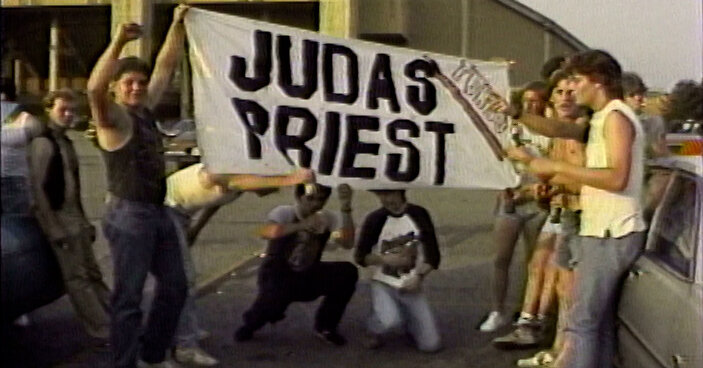
In the early evening of May 31, 1986, in a sprawling, oil-streaked parking lot in the Washington, D.C., suburbs, heavy metal history was made.
Judas Priest was performing that night with Dokken at the Capital Center in Landover, Md., and the aspiring documentary filmmakers John Heyn and Jeff Krulik arrived to capture the tailgating scene before the doors opened.
Unsure what to expect, they hauled the Sony Trinicon video camera and microphone Krulik had borrowed from his job at a nearby public-access television station and worked their way through the lot to talk with anyone who’d speak with them. Fortunately, the heavily intoxicated, Judas Priest-worshiping teens and young 20-somethings they approached were more than eager to oblige.
There were mullets, cutoff T-shirts, Trans Ams, all manner of animal prints — and lots and lots of beer. Each interviewee delivered unforgettable lines at a rapid pace, many in a powerful Baltimore accent. Asked about meeting the Judas Priest frontman Rob Halford, “I’d jump his bones,” offered one young woman, her red hair-sprayed coif suspended several inches high.
The result was an endlessly quotable, extremely entertaining 17-minute ethnography of Baltimore- and D.C.-area youth in the mid-1980s that Heyn and Krulik titled “Heavy Metal Parking Lot.”
“The interviews are just wild,” Heyn, 68, said in a video interview. “It’s like one assault after another.”
Forty years on, among fans in the know, the documentary sits firmly in the pantheon of immortal rock films, alongside far more well known heavyweights such as “School of Rock” and “This Is Spinal Tap.” Its fans include Dave Grohl, Cameron Crowe and Edward Norton, who grew up in Columbia, Md. Ten years ago, a library at the University of Maryland even curated an exhibit on it to commemorate the film’s 30th anniversary.
When it was made, however, the success of “Heavy Metal Parking Lot” was far from assured. It was produced on VHS, while movie festivals at the time — the most obvious place to show it and generate interest — only accepted submissions on film.
With few other options for distribution, Krulik and Heyn arranged to screen and hawk the documentary at various art galleries, record stores and music venues in the Baltimore-Washington area, and, occasionally, New York. They also gave away tapes to pretty much anyone who’d take them. After years of mostly fruitless hustling, by 1990, they said, they were ready to move on.
Four years later, Heyn got a phone call suggesting the movie had a much bigger audience than the men knew. It was from the filmmaker Sofia Coppola: She had tracked down his number from the White Pages and wanted to know if she could use a clip of “Heavy Metal Parking Lot” in a TV series called “Hi Octane” she was developing for Comedy Central with her friend Zoe Cassavetes. She explained that she had come across the tape at Mondo Video A-Go-Go, a video store in East Hollywood known for stocking odd, experimental and cult films.
Stunned, Heyn called the store and spoke with the owner, Robert Schaffner, known as Colonel Rob. Schaffner explained that he was a huge fan of “Heavy Metal Parking Lot” and had regularly rented out copies to celebrities including the Go-Go’s singer Belinda Carlisle and the actor, director and screenwriter Paul Mazursky. “At that point, we realized, ‘Hey, there’s some sort of following on the West Coast,’ which was really exciting for us, because we didn’t get it out there,” Heyn said.
That was just in Hollywood. Later they would learn that Nirvana regularly watched the film on its tour bus after one of the band’s roadies, Mike Dalke, saw it at a party hosted by the punk icon and White Flag member Pat Fear. Without knowing it, Krulik and Heyn had created a bootleg sensation.
Mikael Jorgensen, the keyboardist for Wilco, discovered “Heavy Metal Parking Lot” in the late 1990s while living in Chicago. Growing up in an evangelical household in New Jersey, he was “terrified” of metalheads. “I was convinced that Kiss meant ‘Knights in Satan’s Service’ and that W.A.S.P. meant ‘We Are Satan’s People,’” he said in a video interview. So when he came across the film through friends who worked at the Chicago indie music labels Thrill Jockey and Drag City, he couldn’t look away. Since then, he estimated, he’s seen the documentary around 30 times.
The music critic Steven Hyden attributed the film’s enduring popularity in part to how well it captures a specific moment in rock music fandom. It was “maybe the last time” people could indulge in rock ’n’ roll excess “in a wholly unironic way,” he said in a phone interview. “You know, raising the devil horns with a beer in your hand.”
While aesthetically, the film has the lo-fi feel of a home video, “It’s actually a really well put together short documentary,” Hyden said. “You really get a sense of about a dozen characters or so who have several different story lines that intertwine, and you feel like you get to know them in not a lot of time.”
One of these characters was Eileen Zelaya, then 20. Asked on camera by Krulik what’s in the Styrofoam cup she’s holding, she offers the faux-outraged response, “Jack Daniel’s and Coke, what else?!”
Zelaya, now 60, has worked in the finance department of the International Monetary Fund for the past three decades. She said she remembers being interviewed by Krulik and Heyn, but never thought about it again until sometime in the mid-2000s, when a friend said he saw her in the film. When she told her manager at the I.M.F. about it, he tracked down a copy of the VHS and bought it for her.
“My voice sounded terrible, but it was very funny to see it,” she said. “So much time had lapsed. I just thought it was hilarious.”
It’s hard to argue with that assessment. On the other hand, the film’s feel-good ridiculousness risks obscuring the fact that Judas Priest had more depth than the Budweiser-chugging teens rocking out to party-and-rebellion anthems like “Living After Midnight” and “You’ve Got Another Thing Comin’” might have fully appreciated.
“Electric Eye,” from the band’s 1982 album “Screaming for Vengeance,” took on mass surveillance in the name of keeping “the country clean.” While “Breaking the Law” hits incredibly hard, it was as much an acknowledgment of the economic pain gripping parts of the United Kingdom in the late ’70s as it was a teenager-approved ode to anarchy. And in 1998, Halford became one of the few figures in pop — let alone heavy metal — to come out as gay during that era. Watching “Heavy Metal Parking Lot” today, this adds a level of irony to the tailgating scene’s aggressively heterosexual vibe.
Others have noticed these contradictions. In February, a new documentary on the band, “The Gospel of Judas Priest,” premiered at the Berlin Film Festival. Co-directed by the Rage Against the Machine guitarist Tom Morello and the veteran metal documentarian Sam Dunn, it is meant as something of a correction, reminding modern viewers just how immense the band’s influence was on rock music and culture.
After unknowingly conquering their slice of the underground, Krulik and Heyn tried to leverage the popularity of “Heavy Metal Parking Lot” into more mainstream projects, with mixed success. In the early 2000s, the Trio TV network produced a short-lived series they created called “Parking Lot.” Episodes included “Dolly Parton Parking Lot,” “Yanni Parking Lot,” “Cher Parking Lot” and “Cat Show Parking Lot” — “although a lot of them didn’t actually take place in a parking lot,” Krulik, 65, said in a video interview. “They were a little liberal with the approach.”
In 2001, after interest from Hollywood, the pair co-wrote a feature film script titled “Heavy Metal Parking Lot: The Movie,” but it was never picked up.
Ultimately, they’ve seen very little money from the documentary. Which may be just as well, since they never secured a music license from Judas Priest or releases from their interview subjects, making their claim to ownership over the film legally murky.
But whatever Krulik and Heyn lack in profit, they’ve made up for in appreciation of their timeless tribute to teenage foolishness and freedom. “It’s lightning in a bottle,” Jorgensen said, adding, “All there was to do back then was to hang out with your friends, smoke cigarettes, drink beer, have sex, listen to music and go to work.”
The post The Cult Music Documentary ‘Heavy Metal Parking Lot’ Turns Middle-Age appeared first on New York Times.