At 4:30 a.m., our dog howled. He heard the emergency sirens before we did. Through the window, my wife spotted cars pulling into the parking lot of the high school across the street — our town’s evacuation site. Texts from friends warned that a nearby stream had surged over 30 feet, and that the 120-year-old dam seven miles uphill from our home on the North Shore of the Hawaiian island of Oahu was in imminent danger of failure. Overnight on March 20, the local weather station had recorded nearly 20 inches of rain. We got up, and made a plan to get to higher ground. This was not my first evacuation.
I was 10 when I ran from my first disaster, a fire that burned my island summer camp in Belgrade, Maine, to the ground. After escaping by boat, we spent the rest of that summer in Goodwill clothes, rebuilding the camp we’d lost. Since then I’ve been trapped on a subway in the 2003 New York City blackout, have sheltered through four hurricanes in four states and have driven through the Thomas Fire in 2017 as it surrounded my home in Ojai, Calif.
In a rapidly warming world, my bad luck is increasingly ordinary. The number of federally declared disasters per year has roughly doubled in the past two decades, affecting more Americans than ever before. By 2050, experts predict, approximately 118 million Americans may face one or more extreme weather events annually.
You might think that after all of this I’d have a go bag always ready, especially since I review bags for a living as a reporter for Wirecutter. But I don’t. What I’ve learned, across every one of these close calls and near misses, is that what keeps us safe isn’t the stuff we pack or stockpile; it’s the community we build before calamity strikes. At a time when Americans are increasingly isolated from one another, we must see our ties with our neighbors as essential preparation for the future ahead.
Much of America’s mainstream doomsday-readiness culture assumes that preparation begins (and ends) with the individual or the single family. On YouTube, channels such as Corporals Corner, City Prepping and American Outlaw share tips for surviving extreme situations, often alone. Go down these rabbit holes and you’ll find a jargon-heavy community whose insiders speak in acronyms that paint vivid pictures of the civilizational collapse they seem to expect. Instructions to build and maintain a bug-out vehicle, or B.O.V., to escape a world without the rule of law, or W.R.O.L., means “I’m never coming home,” INCH.
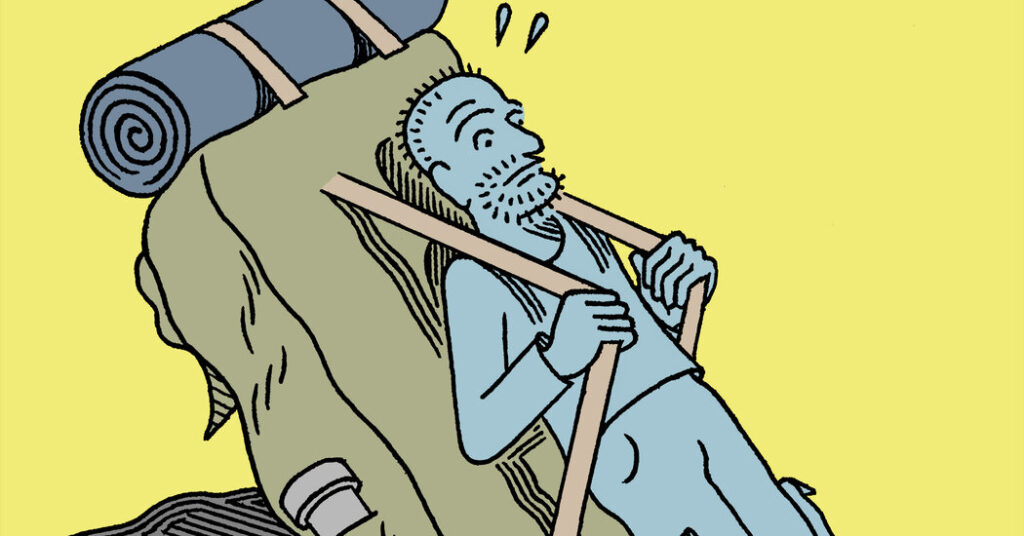
The most commonly known manifestation of this is the bug-out bag, or B.O.B., that assemblage of carefully curated survival equipment that we’re told to keep near us at all times, ready for the moment we have to run. A typical kit might include a compass, ready-to-eat meals, a bivouac sack, a tourniquet and radio or satellite communications. It may also include a firearm, or another self-defense device, because one of the tenets of this mode of preparation is that in any emergency, other people are a threat.
I’ve tried to build a bug-out bag. But I found it overwhelming to plan that carefully for every possible contingency. And then at some point I realized I’d never once needed one. The bug-out bag prepares us for a world we can abandon, a disaster we can survive on our own. Time and again, I’ve experienced neither.
What I have witnessed, instead, remains stubbornly consistent. Official announcements, whether they are push notifications from the county or emergency email alerts, are often unreliable, incomplete and occasionally flat-out wrong. That’s assuming cell networks are even functioning.
When the water is rising or the wildfire is spreading, you will need to make crucial decisions with rapidly changing information. Every decision you make in a disaster comes down to two questions: Is it safe where we are now? Will we be safe if we try to evacuate?
More often than not, answering those questions means relying on the people around you.
When the flood hit my town of Waialua, more than 230 people were rescued, predominantly by other residents. Neighbors drove farm equipment deep into floodwaters to carry people out of their homes in excavator buckets. Through it all there were no fatalities reported. By the afternoon, local organizations, such as the Lāhui Foundation, had established aid collection and systems for volunteer and recovery efforts. The effectiveness of this response did not emerge from nothing. The foundation had already built networks, protocols and, most important, community trust, in earlier relief efforts, such as the Lahaina fires on Maui. The reason the response in Waialua was so effective was that the people and the organizations were ready to act.
None of this means individual preparation is useless. Water, medication, important documents, a few days of food are all important. But true preparation isn’t something you can buy off Amazon or stuff in a bag, and it certainly won’t be found on YouTube. It’s built by people and our commitments to one another.
Chris Ellis, a military veteran who spent years studying the prepper community for his book “Resilient Citizens,” writes about how there’s a fine line in prepping between developing resiliency through self-sufficiency and making a hobby out of isolation. True preparedness, he writes, requires you to: “Expand your home beyond just the four walls. Learn what others have to offer and recognize what brings us together and what we hold in common. What we truly need is community involvement.”
As the environment becomes more treacherous, we can’t rest in the false comfort that more stuff is enough to keep us safe. It’s the people around us who matter most to our survival.
You don’t need to wait for the crisis to come to build this community yourself. In fact, it’s critical that you don’t, because it’s more and more likely that you, too, will face the devastation of an extreme weather event. Building these networks now allows us to address concerns such as aging infrastructure, community needs and the readiness of our towns and cities before the disaster hits, rather than dealing with the fallout of these failures later. This communal effort is the bulwark we have against what’s to come.
Tomorrow there will be no climate havens. The sirens will sound again. Pack a bag if you want. But the real preparation begins when you knock on your neighbor’s door and invite them over.
Kit Dillon is a senior staff writer for Wirecutter.
The Times is committed to publishing a diversity of letters to the editor. We’d like to hear what you think about this or any of our articles. Here are some tips. And here’s our email: [email protected].
Follow the New York Times Opinion section on Facebook, Instagram, TikTok, Bluesky, WhatsApp and Threads.
The post The Prepper Delusion appeared first on New York Times.