The hulking brick building on 30th Street and First Avenue in Manhattan was conceived with the best of intentions. Proposed by an “alienist,” as psychiatrists used to be called, who believed his patients deserved the best, it was built nearly 100 years ago as the Bellevue Psychiatric Hospital, with a light-filled auditorium, Juliet balconies and open views of the East River.
By the mid-1980s, however, the building had become a homeless shelter for single men, notorious as a troubled and often dangerous place, where an inspector once found a shard of glass from a broken window hanging over a dormitory bed and feces smeared across a wall.
Long a way station for New York City’s most vulnerable and desperate, the 30th Street Shelter and Intake Center is shutting down, after an announcement last month by Mayor Zohran Mamdani’s administration.
The men who were staying there have already been transferred to other shelters. Its operations as a center where people go to be assigned a bed elsewhere were supposed to end this week, though those plans have been put on hold because of a lawsuit.
The shifting history of the shelter offers a window into the city’s approach to homelessness over the past 40 years, what the Mamdani administration hopes to move away from and how grueling and slow that process can be.
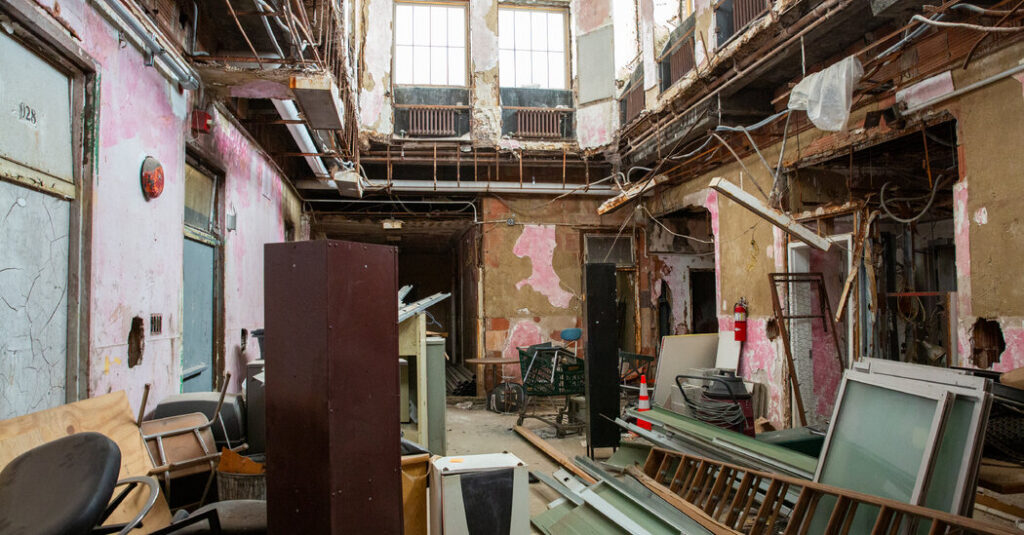
The city says the building, long known informally as the Bellevue shelter, is in such disrepair that it is unsafe. There are nets suspended over its limestone cornices and balconies to keep them from plunging to the ground.
Sneha Choudhary, a spokeswoman for City Hall, said conditions at the shelter had been “unacceptable for years.”
“Leaving people in a space that is falling apart is a failure of our responsibility to care for our fellow New Yorkers,” she said. “The decision to vacate was necessary for safety and based on clear expert guidance.”
The dormitories have a forbidding, institutional feel, reminiscent of the locked psychiatric facility the building used to be.
And a recent visit to the underbelly of the building, and to long-abandoned spaces that are off limits to the public, showed an incredible degree of decay.
Portions of the ceiling were visibly sagging. Walls were bubbling where water had seeped through. Corroded support beams looked like they had been dunked in acid, the areas around them propped up temporarily with bright red pillars.
Parts of the basement smelled like sewage, and nobody in the building knew why. The auditorium, which had a friendly mural on the wall of the sun over mountains, had been colonized by pigeons that came and went freely through a broken window, flying under a ceiling pocked with giant holes.
The shelter’s reputation over the years — for theft, open drug use, violence — has made it an object of fear among men who have no place else to go. Though it has been the front door of the New York City shelter system, many have chosen instead to sleep on the street.
But as the homelessness crisis has steadily grown, it has been difficult to close such a large intake center near Midtown Manhattan, where homeless adults often end up, and to make up the capacity nearby.
“It became a very problematic place,” said Lilliam Barrios-Paoli, a former New York City official who held a variety of positions under four mayors, including overseeing homelessness.
“It’s not that people didn’t realize it was problematic,” she said. “They didn’t know what else to do.”
The Hospital Jimmy Walker Built
Despite the building’s troubled history, what came before it might have been worse.
It replaced what was known as the Bellevue Insane Pavilion, where patients were “packed together like cattle,” according to “Bellevue: Three Centuries of Medicine and Mayhem at America’s Most Storied Hospital,” a book by the Pulitzer Prize-winning historian David Oshinsky.
The facility, a staff member quoted in the book said, was a “never-ending kaleidoscope of human misery.”
Dr. Menas S. Gregory became its director in the early 20th century because no one else wanted the job. He renamed it the Psychopathic Pavilion, so the patients treated there would sound curable, Mr. Oshinsky said. He decreased the use of physical restraints and narcotics.
But he wanted to do better. He wanted Bellevue to have a brand-new building, and during the Roaring ’20s, he found an ally in Mayor Jimmy Walker.
Walker had friends and family who had been patients at Bellevue. One of his first acts as mayor was to tour the pavilion and declare, “I would be unwilling to keep a dog there.”
The building took seven years to complete — the process slowed considerably when the head contractor took the money he had been paid in advance and fled to Europe — and when the Bellevue Psychiatric Hospital opened in 1933, packed with lavish finishes, fine materials and grand stairways, “the Italian Renaissance facade didn’t quite match the somber mood of the Great Depression,” Mr. Oshinsky wrote.
Today, only the faintest traces of that grandeur remain. An elaborate star pattern in the lobby’s terrazzo floor is still there, but nearby murals of tropical plants, painted in the 1930s as part of the New Deal’s Federal Art Project, have been covered in white paint.
In a seventh-floor dormitory, where up to a dozen men would sleep just feet apart on open cots, there are numbers painted on the wall to mark each location — bed 7-061, bed 7-062, bed 7-063. But if you look out the window, fogged from moisture trapped between panes of glass, you can see the river.
A Homeless Shelter Opens
In 1985, Bellevue moved the last of its psychiatric patients to its main hospital building on First Avenue, after a lawsuit contended the 30th Street building was an outdated fire hazard with poor ventilation.
But instead of closing the building, city officials decided to use it to address an urgent and growing need: a ballooning population of people who had nowhere to live.
That growing crisis stemmed from a number of causes.
Single room occupancy hotels and the city’s cheapest housing stock were disappearing. The state emptied out many of its psychiatric institutions. Federal and state governments were cutting back on housing assistance. And the city had a new legal responsibility to provide shelter to anyone who asked, a mandate established in 1981 that still exists today.
The city opened old hospitals and armories and crammed them with shelter beds. An armory in Washington Heights had more than 1,000 cots on the floor in a giant open room.
Robert M. Hayes, who was a lawyer for the advocacy group Coalition for the Homeless when the Bellevue shelter opened, said at the time that the building was “awfully dilapidated.” But, he added, “we are not condemning the establishment of the shelter because it is so desperately needed.”
Ms. Barrios-Paoli said that other cities and towns, even other states, began to see the city as a resource. People would be released from prisons and jails and handed a bus ticket to New York, she said, instructed to go to the 30th Street shelter and ask for a bed.
When Patrick Markee started working for the Coalition for the Homeless in the mid-1990s, one of his duties was to inspect shelters like Bellevue to make sure the city was offering a basic standard of care, like providing every bed with an intact mattress.
But every inspection turned up numerous violations, he said in an interview. During one visit, for which the city had weeks of notice, an official positioned himself awkwardly in front of a dormitory window. Mr. Markee peeked behind him and saw the window was broken, a shard of jagged glass hanging over a bed.
In his book, “Placeless: Homelessness in the New Gilded Age,” Mr. Markee said that during another inspection, he found feces spread across the walls of a room.
“This time, city bureaucrats staged an indignant, outraged protest about my inspection notes,” he wrote, “apparently more upset that I’d scribbled the words ‘SHIT ON WALL’ than by the presence of the feces itself.”
A Headache for Many Mayors
For decades after East 30th St. opened as a men’s shelter, the solution to its problems eluded numerous mayors. The Giuliani administration considered letting a for-profit company turn the building into an upscale assisted living facility. The Bloomberg administration wanted it to become a hotel and conference center. The 30th Street Shelter outlasted them both.
All the while, the homelessness crisis grew. The Coalition for the Homeless said that in recent years, homelessness in New York City has reached its highest levels since the Great Depression. Every night, tens of thousands of people sleep in New York City shelters.
One of them, a young man named Lorenzo, his hair in tidy braids, stood outside the building last month, scrolling on his phone in the shade of an enormous green scaffolding. He’d spent the night at the shelter, and he was ready to get out of there.
“It’s like a locked-down facility,” he said.
Lorenzo said the building felt empty. Creepy. It used to hold up to 850 men each night, but by the time the city announced its closure, only about 250 people were staying there. Those men were loaded onto buses and driven to shelters elsewhere. A man named E.J. said he was going to the Bedford shelter, a large armory in Crown Heights.
The Mamdani administration hasn’t said what it will do with the 30th Street building, but an engineering report the city commissioned said it should be torn down.
In its place, the city is hoping to move toward smaller places where people in crisis might actually be willing to go.
Magnolia Gardens in Flushing, for example, is a family shelter that looks like a modest condo or dormitory, with open kitchens and green tile backsplashes. (Unlike shelters for single adults, units in family shelters, where children stay, are required to have kitchens and doors that lock.)
It has space for community events, a back garden and a laundry room with tiles decorated with giant monstera leaves.
But opening new shelters, especially for adult men, is always a battle. Protests are common, and community outrage is all but assured.
The city’s plan to move the 30th Street intake center to the East Village was temporarily blocked by a judge last week, after neighborhood residents sued to stop it.
So for now, intake remains in the old building. But the men who stayed at the shelter are already gone.
Squinting into a chilly drizzle last month, a silent group of men trudged down the sidewalk toward a dingy yellow school bus, which would take them to their next placements.
A few were hauling duffel bags and rolling suitcases. Most carried their things in backpacks and clear plastic garbage bags. One man had nothing with him at all.
As they walked away from the giant, crumbling building, not one of the men looked back.
Elizabeth A. Harris covers books and the publishing industry, reporting on industry news and examining the broader cultural impact of books. She is also an author.
The post Inside a Once-Grand Building That Housed the Vulnerable for a Century appeared first on New York Times.