At the peak of the #MeToo movement nearly a decade ago, Eric Swalwell and Tony Gonzales, the congressmen who resigned on April 14, would have been just two more men in the lineup of the famed and suddenly shamed.
But in 2026? Their double disgrace looks like an outlier.
A president found liable for sexual abuse and accused of multiple sexual assaults sits in the White House. Two members of his cabinet, Robert F. Kennedy Jr. and Pete Hegseth, have also been accused of (and have denied) sexual misconduct. The Equal Employment Opportunity Commission, the federal agency that is supposed to enforce laws against employment discrimination, scrapped its anti-harassment guidance in January.
With the misogynist manosphere’s influence entrenched and liberal “cancel culture” decidedly passé, many of the high-profile men felled when #MeToo flourished now find themselves in various states of uncancellation. The comedian Louis C.K. has a Netflix special coming out this summer. The political journalist Mark Halperin has been welcomed back on TV as a talking head. Andrew Cuomo, the former New York governor, powered past sexual harassment allegations to lead in the New York City mayoral primary for a time last year. (He ultimately lost.)
The #MeToo movement has seemed to be over for years, its power diminished by criticisms that it went too far too fast and stymied by deep-pocketed opponents flanked by lawyers and crisis management teams.
The country’s retreat on sexual misconduct was also fueled partly by some centrists and liberals who worried that #MeToo prioritized believing women — believing any woman with an accusation, according to some — over treating the accused fairly.
Al Franken, the former senator from Minnesota forced to resign in 2017 after eight women accused him of groping or trying forcibly to kiss them, looms large in conversations about overreach. For years after his resignation, liberals argued that Democratic senators caught up in the fever of #MeToo had moved too swiftly to oust him without so much as an investigation.
Such perceived excesses, combined with pushback from the right, made it easier for many people to turn away from #MeToo. For them, the past several years have been a welcome course correction.
“In the immediacy of #MeToo, it was, ‘We’re not going to tolerate anything,’ and swift action,” said Victoria Lipnic, a partner at Resolution Economics who was appointed by President Barack Obama to the E.E.O.C. and now consults on corporate sexual harassment policies. “So we go from that to the backlash: Is there enough due process, or is due process even being accounted for at all for the accused?”
The two congressmen who resigned on April 14 were under investigation by the House Ethics Committee, which oversees Congress’s version of due process. The panel is notorious for moving so slowly that critics say it often simply covers for lawmakers’ abuses.
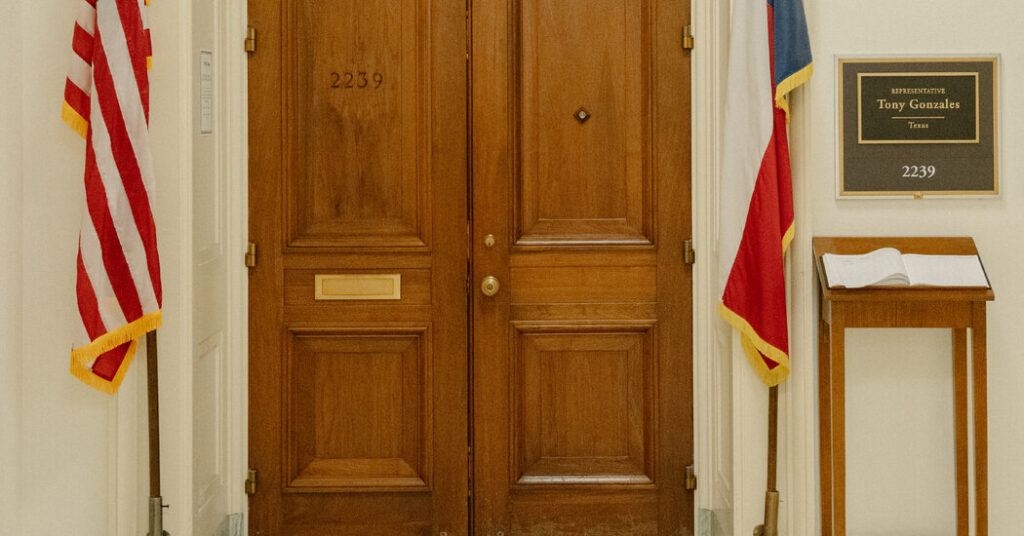
Mr. Gonzales, a Texas Republican, had been in trouble since text messages surfaced in March appearing to show that he had coerced one of his aides into a sexual relationship before she died by suicide last year.
Mr. Swalwell, a prominent Democrat who had emerged as a front-runner in the California governor’s race, is accused of sexually assaulting two women and sending others explicit messages and unsolicited photos of his genitals.
The accusations, in all their graphic ugliness, were evidently too much for many of their colleagues. They faced strong bipartisan pressure from lawmakers who said they would not wait for the Ethics Committee’s verdict to try to expel the two congressmen.
The scandal has prompted calls for Congress to rethink how it handles misconduct allegations. Pressure and public shaming for the two congressmen, after all, is not the same thing as true accountability, said Fatima Goss Graves, the chief executive of the National Women’s Law Center, which runs a legal fund helping sexual harassment victims file cases.
“When you’re talking about something as serious as the allegations that have been made, they’re worthy of a process that is clear, that is transparent, that is consistent, that is fair,” she said. “So it isn’t left up to bipartisan agreement.”
That kind of process was elusive from the start of #MeToo. Instead, rough justice was meted out ad hoc, one cancellation at a time.
To have large-scale impact, #MeToo had to change not only minds but also policies and laws.
“Whether they’re in workplaces, whether they’re in civil court or criminal court, our laws and procedures for imposing consequences — those didn’t really change,” said Deborah Tuerkheimer, a law professor at Northwestern University and the author of “Credible: Why We Doubt Accusers and Protect Abusers.”
Part of the problem may be that we never came to agree on a societal standard for what is acceptable behavior. #Believewomen — another slogan that circulated at the height of #MeToo, urging people to take sexual misconduct allegations seriously — was scorned for canceling men for violations far short of rape, giving rise to what might be called the manosphere’s #believemen campaign.
Neither has there ever been consistent agreement on how many accusers it takes for an allegation to be believed.
Professor Tuerkheimer noted that Mr. Swalwell’s career could not survive multiple named accusers alleging egregious misconduct. A single accuser with a more ambiguous allegation, though, would have faced long odds. The ideal accountability process, she said, would allow for even a single complaint to be heard fairly.
Yet even those who say we have a long way to go acknowledge some progress.
More than two dozen states have passed laws strengthening protections against workplace harassment. Federal legislation in 2022 banned mandatory arbitration for sexual misconduct claims, a win for activists who said forced arbitration kept accusations secret and protected companies from lawsuits at victims’ expense. Congress also tried to clean its own house in 2018, easing the process for victims to bring harassment complaints, among other measures.
Many employers now require annual anti-harassment training for workers.
The bar for opening an investigation is also lower than it used to be, thanks to the heightened awareness of harassment that stemmed from #MeToo, said Ms. Lipnic, former E.E.O.C. commissioner.
Ms. Lipnic also said that more companies had begun moving swiftly to remove those accused of harassment from the same workplace as their accusers.
“Many, many organizations have implemented these robust accountability systems,” she said, “but they can’t take their eye off the ball.”
Frank Dobbin, a Harvard sociologist who has studied workplace diversity and anti-harassment policies, argues that there is a much bigger “but.” His research into trainings and disciplinary procedures at more than 800 American companies with more than eight million employees has shown that typical programs are all but useless, he said.
In fact, they “often backfire,” he noted, with fewer women in management roles, rising hostility toward the programs among male co-workers and retaliation for victims.
Getting people to report allegations has remained extremely difficult. Experts say up to 90 percent of people who experience sexual harassment stay silent.
The Swalwell and Gonzales resignations, alongside the fallout from the Jeffrey Epstein files — which exposed a network of elite men caught up in a sexual abuse scandal of historic proportions — could help catalyze another countrywide conversation about how to address misconduct.
Ms. Graves, of the National Women’s Law Center, said the spotlight cast by the Epstein files might have helped revive attention on the abuses of powerful men, while his victims’ willingness to speak out might have encouraged other survivors to go public. Professor Tuerkheimer said far more people had been reaching out to talk about her work on sexual misconduct since Mr. Epstein’s network of elites was exposed.
“It’s in the zeitgeist in a way that it was during the heyday of #MeToo, then it subsided, now it’s here again,” she said. “I feel like it has the potential to maybe help move us to a next stage of all of this.”
The government’s handling of the Epstein affair has generated fury among hard-right Republican women no less than among their Democratic counterparts. Representatives Nancy Mace of South Carolina and Lauren Boebert of Colorado and the former Georgia congresswoman Marjorie Taylor Greene — who had all been die-hard Trump supporters — have emerged as three of the most determined critics.
The Epstein case may have also pushed Ms. Mace, who says she is a sexual assault survivor, Ms. Boebert and other Republican congresswomen to call for the resignation of Mr. Gonzales.
Their outspokenness meant withstanding crushing pressure from a vengeful White House that had dismissed the Epstein case as a “hoax.” Their swift moves to expel Mr. Gonzales meant breaking with Republican leadership in Congress, which had called for an ethics investigation to be completed before any further action. And their willingness to call out sexual misconduct as a serious problem meant deviating from fellow hard-right Trump supporters who say men, not women, are the true victims.
Three women were also among the few Republican senators to be openly skeptical of Mr. Hegseth, who was also accused of abusing women, before his confirmation as defense secretary.
This, perhaps, is the change that #MeToo wrought.
“You have to distinguish between” the small minority leading a backlash against the movement and “the vast majority of us,” said Damon Centola, a University of Pennsylvania sociologist who studies behavior change and social norms.
Everyone in that majority “acknowledges there are abuses,” he said. “Everyone’s speaking the same language. We’ve crossed that Rubicon.”
Vivian Yee is a Times reporter who writes about women in America, focusing on cultural and political shifts during the Trump years.
The post Eric Swalwell, Tony Gonzales and the Post-Post-#MeToo Era appeared first on New York Times.