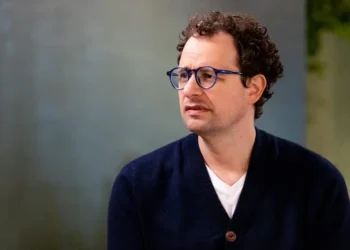
Emil Michael was exuberant.
In just six months as the Pentagon’s new technology chief, he had met with more than 100 start-ups, he told podcaster Molly O’Shea in December, scouring the tech world for companies that could build cheaper, smarter and smaller weaponry to power the future of war. “My job,” he added, is to incubate a fleet of new companies that could rival the likes of Lockheed Martin, Northrop Grumman and other “older primes,” remaking “the whole architecture” of the military.
Best known as Uber’s No. 2 executive in the 2010s, Michael is part of a roster of Trump-era leaders who are bringing their business backgrounds to bear on the Pentagon, aiming to transform the military with a private investor’s tool kit and a mindset shaped by Silicon Valley’s critiques. In addition to Michael — who has been funding companies since leaving the ride-sharing company nine years ago — Deputy Defense Secretary Stephen Feinberg used to run one of the country’s biggest private equity firms, Cerberus Capital Management, and Secretary of the Army Dan Driscoll, a close friend of Vice President JD Vance’s from Yale Law School, had a career in private equity and venture capital.
Rather than enduring years of delays for new munitions, they argue, the Pentagon must actively search for emerging technologies to confront a landscape of growing threats — and then give the companies the financial backing to succeed. They say that a new level of innovation is necessary to fix a broken procurement system and to secure the country as it becomes enmeshed in new conflicts and as warfare evolves from tanks battling on the ground to software-enabled drones.
Michael, the Defense Department’s undersecretary of research and engineering, and this cohort of private-sector leaders have pushed the Pentagon to turbocharge the commercial defense tech market. Some programs speed up projects that began under the Biden administration, while others bolster the private sector much further. One controversial initiative, led by Feinberg, now has the Pentagon take ownership stakes in companies worth billions of dollars, and Michael is using money from the One Big Beautiful Bill to deploy up to $200 billion in federally backed loans to companies working in mineral mining, AI and biotechnology.
Michael, who joined the government last May, said his research and development division has also accelerated efforts to evaluate new tools and put them to use in the military. He pointed to start-ups making mini hypersonic missiles and seaborne drones and analyzing satellite imagery that have all been fast-tracked — and garnered multimillion-dollar Pentagon contracts.
In an interview with The Washington Post, Michael said the speed of these awards demonstrates the administration’s shift in approach. “It’s happened in record time because we’ve given them a wide-open front door,” he said, along with assistance and knowledge. “We sort of bring them all the way through.”
Aside from government funding, the value of private venture capital deals involving defense technology ballooned in 2025 to $48.5 billion — almost double 2024’s total, according to the data firm PitchBook.
But the new approach is also causing concern among some former Defense Department officials, lawmakers and experts, who worry that appointees of President Donald Trump may be ushering in their chosen firms and taking on risks with taxpayer dollars — while placing fewer guardrails on new technology.
“The big problem is the lack of transparency in how they choose to work with private firms,” said Darrell West, a senior fellow in the Brookings Center for Technology Innovation. “It’s not clear where they choose to invest or for what reason.”
For the past several years roughly half of the Defense Department’s almost trillion-dollar budget has gone to contractors, and the administration has set off a frenzy among tech companies for government investment that can boost their prospects.
One of the first companies to secure a loan — for $620 million from the Defense Department’s Office of Strategic Capital — was Vulcan Elements, a start-up manufacturer of rare earth magnets that has received funding from 1789 Capital, a firm that counts Trump’s son Donald Trump Jr. as a partner. 1789 Capital also has funded Hadrian, a six-year-old AI-enabled manufacturing start-up that entered into a $900 million investment partnership for submarine production with the Navy last month — one of three companies in which the Pentagon has announced taking an ownership stake.
A former senior defense official familiar with the loan program, who spoke on the condition of anonymity for fear of professional retaliation, said that Vulcan was given priority over other companies that had been slated to receive loans. This person said that, in their view, taking equity in a company — a strategy that is being adopted across the Trump administration — was unethical, because a financial stake could motivate the department to favor that company in future contracts.
Hadrian did not respond to requests for comment. 1789 Capital declined to comment.
Vulcan said in a statement that it had undergone “comprehensive diligence by multiple government agencies” and “received its contracts based on its proven ability to deliver.”
The Pentagon said that it does not give any company preferential treatment. Michael said his company selection process was transparent.
Margaret Mullins, who served as senior adviser to the deputy defense secretary under Joe Biden, said that the Trump team’s push to outsource weapons development — as it cuts the independent oversight office that tests new weaponry — could weaken the government’s capabilities.
“The Silicon Valley crowd likes to say that it was the mavericks in government that have historically been responsible for innovation, and today the mavericks are in Silicon Valley,” Mullins said. “But by ceding more and more ground to the private sector, we will erode the system that is critical to fostering and harnessing innovation in the first place.”
The loyal soldier
Though Michael is just one of several officials driving the transformation, he is Silicon Valley’s champion, a hard-charging tech world denizen whose appointment clears a path to redirect the military-industrial complex from the Beltway westward.
In an earlier era, advanced weapon technologies might have been developed by the military itself. During the Cold War, government research led to tools such as GPS, voice assistants and even the internet. Today, Silicon Valley venture capitalists and executives argue the country’s atrophied industrial base needs to be rebuilt by private companies.
“It’s not reasonable in business to expect that 100 percent of your bets are going to work,” said Shyam Sankar, Palantir’s chief technology officer, who was one of several Silicon Valley executives recently appointed to be an Army lieutenant colonel. “To a shockingly large degree, the system we have today is a consequence of having won the Cold War and facing no real threat to the nation.”
Michael, who describes himself an “entrepreneur” more than an investor, defended the Pentagon’s unorthodox and fast-moving approach. “When we do that, more private capital crowds around these companies, which means we spend less R&D dollars,” he said. “So as the taxpayer wins, the company wins, and then the warfighter wins.”
At Uber, Michael was known as a forceful dealmaker who was singularly dedicated to the company’s cutthroat mission. The company barreled into fights with regulators in dozens of cities all over the world, rolling into new markets as then-CEO Travis Kalanick sought to inculcate a new model of transportation while insisting the rules governing the taxi industry didn’t apply.
A former Uber colleague said he relished this sort of combat, adding that Michael’s fight with the AI company Anthropic in February, which led to the Pentagon declaring it would cut off access to a key tool, resembled his practices at the ride-hailing company. Michael “would just charge through like a bull if he thinks he’s right,” the person said.
As Kalanick’s second-in-command, Michael oversaw the rapid growth, said three people who worked with him, who all spoke on the condition of anonymity for fear of retaliation. As Uber raised billions in cash to fund its growth, Michael helped bring in investors.
Many of Kalanick’s successes could not have been accomplished without Michael, said one of the people, who worked closely with both executives.
“It was 90 percent Emil,” the person said about Michael’s role in the company’s operations. “He really understood leverage. He understood that you could play people off against each other. He understood FOMO. He’s brilliant at that sort of stuff.”
Michael served on what was known internally as the “A-team,” the most senior among a group of advisers who reported directly to Kalanick, the three people said.
Michael was personally involved in many of the company’s biggest scandals. In 2014, he bragged at a dinner that he could use opposition research to dig up dirt on a journalist, Sarah Lacy, who was critical of the company. He and Kalanick also took employees to visit an escort bar in South Korea, and several executives were accused of mishandling the medical records of an Uber passenger who was raped in India, according to her legal case. (The victim’s case against Uber, Kalanick and the executive who obtained the records was settled; the victim’s case against Michael was dropped.)
Kalanick did not respond to a request for comment. Uber, which is now run by CEO Dara Khosrowshahi, has publicly disavowed the behavior of its original leadership team. Michael emailed an apology to Uber’s staff for his comments.
In the interview, Michael compared cutting through the Pentagon’s bureaucratic thicket and his work at Uber confronting taxi monopolies.
He said he built Uber into one of the world’s most successful companies. “Do I go and work hard and with conviction and loyalty in the things I care about? Yes, but I view that as a positive.”
As the scandals ballooned, the A-team closed ranks, two people said. Michael had “little internal tolerance for voices who were seen as insufficiently loyal or protective” of Kalanick, said the third person. “It became difficult because they didn’t see that what was best for them was not best for shareholders and investors.”
Another person who has known Michael for years and called him a friend described him as “smart, irreverent” and an “anti-woke warrior before it was cool.”
Michael said of his tenure at Uber: “I hope we all, as adults, kind of grow out of whatever limitations we’ve had, but I’m pretty proud of having built one of the most important consumer companies in the world.”
After leaving Uber, Michael moved to Miami, one of the first in a wave of right-leaning tech leaders to leave the Bay Area. He served as a board member, consultant or investor in dozens of companies, including some now seeking to do business with the Pentagon and other government agencies. A government ethics agreement he signed ran to a dozen pages and required him to divest of stakes in major companies including chipmaker Nvidia, Google parent Alphabet and Microsoft.
Two of his other previous investments — in Elon Musk’s xAI and D-Wave, a quantum computing company that Michael helped take public and where he served as a board member — are vying for defense contracts. Michael said he fully divested from D-Wave before he was nominated to his current role. In January, shortly after xAI inked a deal with the Pentagon, Michael sold $5 million to $25 million of xAI stock, according to ethics disclosures he filed this month that were first reported by the Guardian.
Michael said he had recused himself from departmental decisions involving any company he had worked with in the past, and the Pentagon confirmed that this recusal included xAI.
Defense Department spokesman Sean Parnell said Michael is “in full compliance with all ethics laws and regulations. Any claims otherwise are false.”
Friends said that he is scrupulous in evaluating companies.
“He’s very comfortable with brutal honesty and being extremely objective, and that sometimes might rub people the wrong way,” said Delian Asparouhov, a partner at the Peter Thiel-backed venture firm Founders Fund, which invests heavily in defense companies. “I’ve not seen his historical, personal relationships with people have any bearing on how he ends up interacting with them in his official capacity.”
Culture clash
Michael’s arrival at the Pentagon marked the culmination of a shift that began in 1993, when Clinton administration officials informed defense industry executives over dinner that the Cold War was over and federal spending would be cut dramatically.
The meeting — dubbed by defense CEO Norm Augustine “the Last Supper,” ushered in a period of dramatic consolidation in the industry. More than 50 top contractors were whittled down to a handful of companies that held enormous sway with the Pentagon.
To many in the tech industry, the Last Supper also began a cycle of entrenching a calcified, rule-laden acquisition system that is now in desperate need of change. Today, some experts have said that the U.S. industrial base is so under-equipped that in an actual war with China, the country could only produce a few days’ worth of weapons and ammunition without running out, according tothe nonpartisan research organization Rand.
For years Silicon Valley didn’t want any part of the system, harboring a deep distrust of the national security world. In 2018, Google employees forced the company to end its participation in the Defense Department’s experimental project to develop what was then called “Algorithmic Warfare.”
But led by Thiel, some in the tech world began to see opportunity in supplying the military. Thiel backed Palantir, which analyzes vast amounts of military and intelligence data and stepped in to take on the work Google abandoned.
Toward the end of Barack Obama’s second term, defense officials began efforts to repair the relationship, launching an outpost in Silicon Valley known as the Defense Innovation Unit. That work continued in the Biden era, with the office Michael now runs securing funding to ease the path for start-ups to sell their wares to the military and issue cheap loans to new firms.
“We were not as flashy as the current administration,” said a former official.
Yet, Joseph Felter, director of the Gordian Knot Center for National Security Innovation at Stanford University, said there remains a fundamental difference between the military — which prizes dependability — and Silicon Valley — where risk-taking prevails.
“That is where the two cultures tend to clash,” Felter said. “Our acquisition system is designed to limit risk.”
And while there is broad agreement among national security experts that the Pentagon needs ways to more quickly acquire cutting-edge systems, other experts see the potential for conflicts of interest as the industry and the department get closer.
“A lot of the pressure for procurement reform is really about helping venture capital cash out,” said Roberto González, an anthropology professor at San José State University, who studies militarization and technology. González said that’s because defense tech firms are under intense pressure to turn profits quickly: “The best way to do that is by landing a big multiyear Pentagon contract.”
Michael, though, views the changes he is ushering in as a win-win. He described the Pentagon putting up its own money as a way to signal where private investors should put their dollars, creating a more diverse group of companies to help protect the country.
“That’s really become a supercharge for these critical areas where we need to build up our capacity,” he said.
Faiz Siddiqui contributed reporting.
The post The man turning the Pentagon into a venture capital firm appeared first on Washington Post.