
Myles Slayton wanted to be a startup founder, not an influencer.
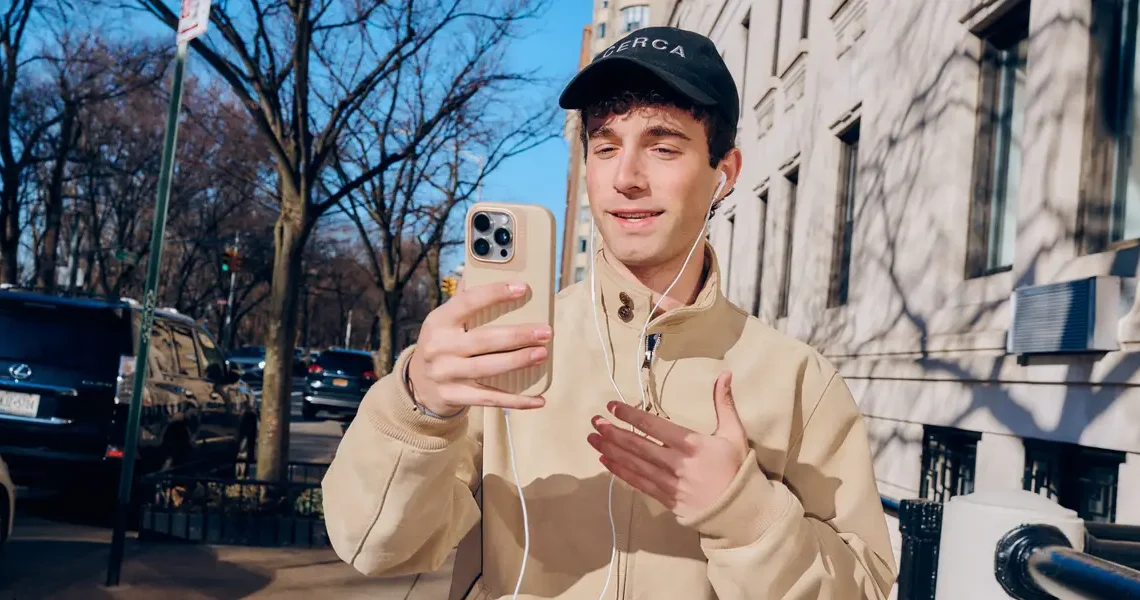
Then the 23-year-old CEO of the dating app Cerca started posting multiple videos a day on TikTok and Instagram, walking around New York City and sharing advice for young singles.
“I saw this beautiful girl outside the 1 train in this leather jacket,” Slayton says in one typical video. “So I went up to her,” and asked for her email. In the post, which has more than 6 million views, he never mentions Cerca. He only occasionally references his startup in the hundreds of videos he’s posted since last July. And yet he now has more than 40,000 followers, gets recognized as the “Cerca guy” on the street, and says his videos have drawn his company scores of new users.
“I don’t like it. I see it as homework,” Slayton tells me of putting himself in front of the camera. But he says that if you’re not posting as a founder, you’re falling behind.
.tt-single { display:flex; justify-content:center; margin:1.5rem 0 0; }
.tt-single-slot { width:325px; height:490px; overflow:hidden; border-radius:8px; }
.tt-single-caption { width:325px; margin:6px auto 0; }
@media (max-width:680px) {
.tt-single-slot {
transform: scale(0.9);
transform-origin: top left;
margin-right: -33px;
margin-bottom: -50px;
}
.tt-single-caption { width: calc(325px * 0.9); }
}
@cerca._.myles/TikTok
“There is inherently pressure,” Slayton says, especially for a startup competing for attention from young users. “When you are a 23-year-old marketing to 23-year-olds, you are at a disadvantage if you are not online posting.”
Startup founders everywhere are obsessively posting videos of themselves gabbing. Claire Lee, the 25-year-old cofounder of Selleb, a social app where users share receipts of things they’ve bought, tells me that she sometimes spends 70% of her day creating content. Lee and her sister run a Substack newsletter that publishes several posts a week and shares fashion and lifestyle content on TikTok and Instagram, like quips about what a certain purchase — sunscreen, fragrance, jewelry — “says about you.”
“Ask any founder who’s trying to get their app or company off the ground, it’s very much like, ‘How do we grab as many eyeballs as possible?'” Lee says.
Venture capital firms, meanwhile, are looking for founders who can talk their book as deftly as they can build. “You’re dead if you don’t market yourself. It’s abundantly clear that the product no longer sells itself,” says Lester Chen, a partner at Andreessen Horowitz who works with startup founders in the VC firm’s Speedrun accelerator. “It was not like that at all 10 years ago at all.”
Going viral “might not close the deal” in securing funding or loyal customers, Chen says, “but it gets a foot in the door.”
@media (min-width: 768px) {
.vertical-image-wrapper {
display: flex;
justify-content: center;
}
.vertical-image-wrapper .vertical-image {
width: min(calc(80vh * var(–img-w) / var(–img-h)), 100%);
min-width: 0;
}
}

Jonah Rosenberg for BI
In the attention economy, founders occasionally speaking to the press or posting manifesto blogs doesn’t cut it anymore. An entire genre of “building in public” has emerged, where startup founders televise the behind-the-scenes of launching, running, and growing their companies. Late last year, Chen’s firm launched A16z New Media, with the task of advising founders on “legitimacy, taste, brand-building, expertise, and momentum they need to win the narrative battle online.”
Leaders across the tech industry are trying to own the narrative by “going direct” through friendly podcasts and industry-owned outlets like Pirate Wires, All-In, TBPN, or Andreessen Horowitz’s new venture MTS, rather than traditional news outlets. Attention, says investor and tech scene party host Andrew Yeung, is “the only moat you have as a software founder.”
“It’s very noisy out there right now. You need to have a point of view,” says Cristin Culver, a publicist for founders and VCs. “Every founder also needs to be an influencer.”
Last winter, Eliza Wu spent two weeks watching thousands of Instagram reels, screenshotting them frame by frame to analyze why they went viral.
“I love nothing more than hacking an algorithm,” says Wu, the 31-year-old cofounder of Corner, a Google Maps alternative for saving and reviewing places like restaurants and bars, tells me.
.tt-single { display:flex; justify-content:center; margin:1.5rem 0 0; }
.tt-single-slot { width:325px; height:490px; overflow:hidden; border-radius:8px; }
.tt-single-caption { width:325px; margin:6px auto 0; }
@media (max-width:680px) {
.tt-single-slot {
transform: scale(0.9);
transform-origin: top left;
margin-right: -33px;
margin-bottom: -50px;
}
.tt-single-caption { width: calc(325px * 0.9); }
}
@thecornerapp/TikTok
Wu landed on a video style: Sitting on the couch with a microphone in hand, talking to the camera about where to shop, drink, or spend time with friends in New York City. Her first videos got about 10,000 views, then jumped to 150,000, and soon hit a million. They don’t always mention Corner, either, even though the content is coming from the company’s account.
Behind each video is about one hour of brainstorming, two hours scripting the video, another two for filming and editing. It adds up, she says. “Marketing is really just blood, sweat, and tears,” Wu says.
@media (min-width: 768px) {
.vertical-image-wrapper {
display: flex;
justify-content: center;
}
.vertical-image-wrapper .vertical-image {
width: min(calc(80vh * var(–img-w) / var(–img-h)), 100%);
min-width: 0;
}
}

Jonah Rosenberg for BI
Lucious McDaniel IV, 25, says that a series of viral home video-style posts on Instagram and TikTok got his Y Combinator-backed food delivery startup BiteSight in front of new customers.
“My brother is gonna show you the app that he built, and y’all are gonna like it,” McDaniel’s 21-year-old sister says, pointing at the screen, standing with her arms crossed behind him as he shows off BiteSight. The video, a riff off a trending format that had been proliferating on TikTok that summer, has over 18 million views.
McDaniel became the face of the company. At one point, he was posting about six times a day, he said. “I’m in the background dancing on TikTok,” he says. “I can’t lie to you. I felt silly. I really felt like, what am I doing with my time? Is this the very best thing that I can be doing?”
.tt-single { display:flex; justify-content:center; margin:1.5rem 0 0; }
.tt-single-slot { width:325px; height:490px; overflow:hidden; border-radius:8px; }
.tt-single-caption { width:325px; margin:6px auto 0; }
@media (max-width:680px) {
.tt-single-slot {
transform: scale(0.9);
transform-origin: top left;
margin-right: -33px;
margin-bottom: -50px;
}
.tt-single-caption { width: calc(325px * 0.9); }
}
@realeater.flou//TikTok
Still, he says the content has paid off. Riding the mass of attention and brief surge on Apple’s App Store charts he’d gotten last summer, McDaniel says he was able to leverage that to raise additional capital. The attention has put his startup on the radar of competitors, too. The intensity of acquisition discussions, he says, has forced him to post on TikTok a little less often.
Founders-turned-influencers aren’t entirely new. Harvard Business School faculty member Jeffrey Rayport pointed to Sophia Amoruso, founder of fast fashion retailer Nasty Gal, as a prime example. “She created a commercial empire that then turned her into a celebrity,” he tells me. While celebrity founders were once more of an anomaly, now it’s nearly an exception for a founder to remain behind the curtain.
“Learning the principles of virality is a founder’s job,” Wu says.
There are perils to posting while building, though.
When Julia Pintar worked for a startup’s social media marketing team, performance metrics like views or even more importantly, the startup’s app downloads, consumed her.
“Every morning the first thing I would do when I woke up was look at App Store Connect and see if we got downloads and see if we got any views,” Pintar said. “It was literally like dopamine. It was like drugs.”
Pintar now runs Playkit, where she works with startups on crafting campaigns and social media strategies to help them go viral. It’s one of several agencies that help founders do just that.
But even as someone whose entire job is helping founders go viral, she admits, there’s a “misconception” that the founder — or their marketing campaign — needs to be massively viral “for it to matter.” Attention, even at a smaller scale of thousands, instead of millions, is sometimes good enough for startups.

Virality, however, doesn’t always deliver a business boom. “It’s sugar water,” says Megan Lightcap, an investor at Slow Ventures. “If you’re optimizing for virality, it’s all super fleeting. In this marketplace of attention, it almost takes focus away from actually just building.”
Viral AI startups like Cluely, which gained momentum last year after pumping out content that claimed its tech could help people “cheat on anything,” are learning the hard way that views, shares, and likes don’t guarantee success.
Even though Cluely CEO Roy Lee evangelized about rage-baiting his company’s way to the top, he’s publicly said that it came with a downside.
“I can’t say if it’s a mistake, but maybe we launched too early,” Lee told the audience at TechCrunch’s Disrupt conference last November. The startup was banking on enough attention to grasp “enough initial users,” he said on stage. Just a few months later, Lee would publicly admit that he had fudged some of the startup’s revenue numbers at the height of Cluely’s viral fame. (Cluely did not respond to a request for comment.)
Extreme self-promotion can be a red flag that a founder is compensating for something, Rayport said, naming Ozy Media and Theranos as examples.
“We all know that there’s a certain kind of founder ethos that’s about fake it till you make it,” Rayport says. “The question is: Are we using social profile building as an extreme way of doing that, in which case, maybe we should all sober up and focus on building real businesses?”
@media (min-width: 768px) {
.vertical-image-wrapper {
display: flex;
justify-content: center;
}
.vertical-image-wrapper .vertical-image {
width: min(calc(80vh * var(–img-w) / var(–img-h)), 100%);
min-width: 0;
}
}

Jonah Rosenberg for BI
Retention and sustainable monetization are much more important indicators to both investors and founders that signal whether or not a startup has what it takes to survive in today’s cutthroat competition.
Getting on the hamster wheel of the content machine, meanwhile, can quickly deplete a young startup founder. “It would be a weight off my shoulders not posting,” Slayton says. Burnout is real, and why some founders may pivot to content that’s perhaps less ‘main character energy,’ like Corner’s more recent content, where its founders aren’t front and center.
“There’s a tipping point where founders go too overboard,” says Wu. “You need to remember you’re not a content creator. You’re trying to build a business.”
Sydney Bradley is a senior reporter covering media and tech for Business Insider.
Read the original article on Business Insider
The post For young founders, selfie sticks are as vital as funding appeared first on Business Insider.