If you think about it, “Peter Pan” is a creepy story. Why is that flying boy tapping on Wendy’s window at night? What’s the kid’s problem with daylight, and why can’t he die? Give it a little time, and the lightbulb — vampire! — should come on.
The script for “The Lost Boys,” Joel Schumacher’s 1987 movie that persuaded at least one Gen X-er in your life to get a bleached mullet, began as a reworking of J.M. Barrie’s tale, which emphasized this child-vamp horror. Rewrites turned it into a moody, new wave teen thriller, adding some sex and almost erasing the relationship to the twee original. If you remember the film — and I really really do — it’s probably for Kiefer Sutherland, his punk earring dangling, soaring through the California fog, as a children’s choir sings synth-heavy goth commandments on the soundtrack. Thou shalt not die! Even if you were dead, it could shake you back to life.
When the musical version of “The Lost Boys,” written by David Hornsby and Chris Hoch, with score and lyrics by the Rescues, nails its combination of goofiness and grandeur, we can thank its two unkillable ancestors. For this Broadway production at the Palace, the director Michael Arden borrows from a thousand “Peter Pan” performances in order to thrill us with onstage flight — Lauren Yalango-Grant and Christopher Cree Grant did the stunning aerial choreography — and embraces the ’80s rocker-romantic aesthetics that made Schumacher’s movie so bloody delicious.
Still, the relationship with the film proves tricky. The anticipatory part of horror, it turns out, transfers nicely to the stage — Arden and his frequent collaborator, the set designer Dane Laffrey, are masters of atmosphere. But translating the thriller aspect is harder, and “The Lost Boys” loses its way as it tries, unwisely, to map itself onto the film’s action-packed second half.
This version is still set in 1987; it’s still the story of a mother, Lucy (Shoshana Bean), taking her two boys to the West Coast. The brooding older brother, Michael (LJ Benet), and the comic-book-loving little bro, Sam (Benjamin Pajak), still squabble. But the artistic team has made several clever adjustments. As the three drive away from their old life in Arizona, for instance, we realize this broken family has already gone through hell. “No more monsters,” they sing: Lucy has clearly been married to one; Michael, wincing from a bruised rib, seems to know what it’s like to be prey.
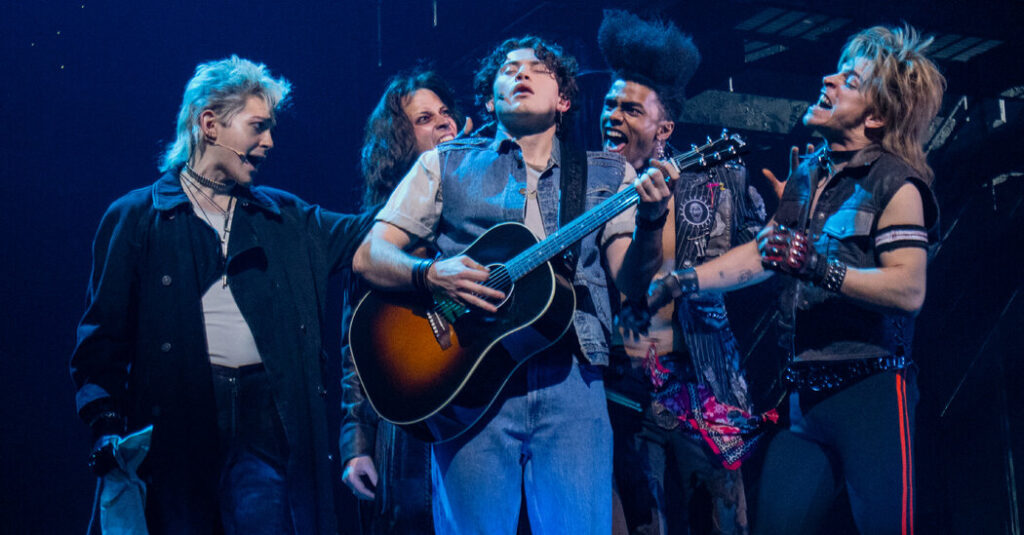
But surely in sandy, run-down Santa Carla, everything will be all right? On their first night there, Michael heads to the boardwalk arcade, where he spots the lovely Star (Maria Wirries). She’s singing in a band, the Lost Boys, with David (Ali Louis Bourzgui), a slithery Billy Idol look-alike in black leather (Ryan Park designed the costumes), and his buds, a trio decked out in feather-soft hair (wigs by David Brian Brown) like the guys in Poison. They smash through their electric playlist as their adoring fans mosh and crowd-surf, back-flipping off the metal struts on either side of the proscenium.
The Rescues — Kyler England, Adrianne “AG” Gonzalez and Gabriel Mann — write songs that have been featured in big-feelings TV shows (“One Tree Hill,” “Grey’s Anatomy”). The composers therefore lean toward yearning indie-pop, but here they do give the Boys some reasonably gnarly numbers. The Boys’ yelling, as well as the sound designer Adam Fisher’s punishing levels of amplification, make them sound believably like a band you’d hear on a beach.
As for the plot, forget the curse of Vlad, it’s already plenty dangerous to follow a lead singer to a second location. Don’t do it, Michael! But of course Michael goes with Star when she beckons, lured into a weird, misty netherworld below the piers, where no one has to grow up.
When Michael’s new sort-of family begins his induction, the Lost Boys sing an a cappella close-harmony chant: “Should your fire turn to dark / take my heart with you.” I won’t argue for those lyrics, but the melody is hypnotic. Wirries imbues Star with a transfixing, persuasive timbre; Benet’s Michael shifts into gorgeousness whenever he’s whispery and quiet. Bourzgui’s vivid rock baritone, though, is a threat before the fangs come out. He has an astonishing chiaroscuro sound: He never sacrifices his moonlit brightness even when the growl in it goes dark.
There’s a deep bench of great voices here — a vision of Michael’s awful father is played by Ben Crawford, one of Broadway’s final Phantoms — and the queen of them all is Bean, whose stunning bluesy belt turns Lucy into something like the heroine. Mom is conducting her own romance, with her video-store boss Max (Paul Alexander Nolan), a Goldwater Republican with certain ideas about single mothers. Her big anthem, “Wild,” is the breakaway in an otherwise rather samey songlist.
Lucy is terrified about what her choices are doing to her children, and Max frightens her further. “I see it every day on the boardwalk,” he says. “Boys their age. Aimless. Angry. Lost.” (A woman sitting behind me whispered a delighted “Oh.”)
Considering how silly things will get after intermission — young Sam sings an ode to superheroes and simultaneously comes out; one fight is so lackadaisically staged it could be described as a vampire staking himself — it’s worth noticing that the musical is thinking about what actually kills us before we’re dead. A bad dad will do it, especially if a son develops the same temper, or misogyny, or societal abandonment. Bourzgui’s David performs his share of hollow cackling, but mostly he’s terribly sad. He’s an immortal street kid pulling himself up by his bootstraps: His loneliness makes him want to eat the world.
To prepare you for this critique, Arden starts the show inside a derelict ironworks — who murdered American manufacturing? — with a TV playing a Ronald Reagan speech on family values. By the television’s flickering glow, we see, or think we see, the first kill of the night. Bare glimmers of sidelight by the designers Jen Schriever and Arden leave much of it to our imagination, though we definitely perceive something touching down, light as a dancer, right before the screams begin. I watched this first scene with my hand pressed to my mouth, as if I were swooning in a Bram Stoker novel. If I hadn’t made it, my last words would have been, faintly, set design …
Because, my children, tonight the design freaks feast. “The Lost Boys” contains the finest spectacle I’ve seen this season outside of the Met Opera: Laffrey’s set consists of a three-tiered brick arcade, a series of arched passageways leading back into shadow, full of cunning secrets — an ornate old elevator, a jillion sliding staircases, a two-story house. There are as many ways to fall into it as to rise, weightlessly, on wires above it. The Palace is a huge Broadway stage, yet Arden and his team make us aware of how much more space is surrounding it that we cannot see. It’s a bit like that moment in the ocean when you realize, oh, there are miles of water down there.
In the second half, though, even these keen delights pall. The pit elevators go up and down a few too many times; the ensemble, so cleverly employed in the beach-concert scenes, become superfluous and turn up as generalized chorus dancers, when the show hasn’t needed such things before. And the ending … well, anyway. I therefore prefer to remember the Lost Boys when the show hasn’t yet grown old. For instance, right now, I’m thinking of the moment when Michael steps backward into a cloud in midair — an image, for me, of breathtaking beauty. Isn’t that enough? Surely no pleasure is meant to live forever.
The Lost Boys At the Palace Theater, Manhattan; lostboysmusical.com. Running time: 2 hours 40 minutes.
Helen Shaw is the chief theater critic for The Times.
The post ‘The Lost Boys’ Review: Live, Die, Reprise appeared first on New York Times.